Molecules wrestle for supremacy in creation of superstructures
August 13, 2009
Molecules wrestle for supremacy in creation of superstructures

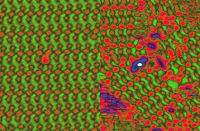
The molecules in the majority form the superstructure while the minority remain disordered.

(PhysOrg.com) -- Research at the University of Liverpool has found how mirror-image molecules gain control over each other and dictate the physical state of superstructures.

The research team studied 'chiral' or 'different-handed' which are distinguishable by their inability to be superimposed onto their . Such molecules are common - proteins use just one mirror form of and DNA, one form of sugars. Chirality leads to profound differences in the way a molecule functions - for example, drugs such as thalidomide can have positive effects on a patient but can prove harmful in their mirror image form.

Molecules can also assemble in large numbers and form 'superstructures' such as snowflakes which are created from large numbers of . When chiral molecules assemble they can create 'handed' superstructures; for example left-handed molecules can assemble together to make a left-handed superstructure. The Liverpool team studied this process in detail by assembling molecules at flat surfaces and using imaging techniques to map the formation of superstructures at nanoscale level.

Before now, scientists have not known whether, in systems containing both left-handed and right-handed molecules, one mirror-form of a molecule could take supremacy over its opposite number in the creation of superstructures, dictating their physical state and chemical and biological properties.

The research found that when equal numbers of mirror-molecules are present at the surface, they organise into separate left and right-handed superstructures, each with distinctly different properties. Crucially, a small imbalance in the population leads to a dramatic difference and only the molecules in the majority assemble into its superstructure, while the minority is left disordered at the surface and unable to create advanced molecular matter.

Professor Rasmita Raval from the University's Surface Science Research Centre said: "We were surprised at these results. All perceived wisdom was that the left and right-handed molecules would simply create their respective superstructures in quantities that reflected the molecular ratio - that is, we would observe proportional representation. Instead, what we obtained was a kind of 'molecular democracy' that worked on a 'first-past-the-post' system where the majority population wrested chiral control of the superstructures and the minority was left disorganised."

Theoretical modelling carried out by the University of Eindhoven in the Netherlands found that this behaviour arises from the effects of entropy, or disorder, which leads the chiral molecules in the majority to preferentially organise into their superstructure.

The work has important implications in the pharmaceuticals industry and could lead to the development of surface processes to enable separation of drugs and products that are currently difficult to purify. The research also introduces the possibility that assembly processes at surfaces may naturally have led to the evolution of proteins and DNA - the molecules of life - containing just one mirror form of amino acids and sugars.

The research, in collaboration with the University of Eindhoven, is published in .

Source: University of Liverpool (news : web)


Rank 5 /5 (4 votes)
Relevant PhysicsForums posts
  • How to determine zinc in a plant.
    createdFeb 11, 2012
  • Stoichiometry
    createdFeb 10, 2012
  • Boiling and melting point of impure substances
    createdFeb 10, 2012
  • Safe nitrogen compound to decompose a 500 deg C in a furnace?
    createdFeb 09, 2012
  • [ask]electron inside drinking water
    createdFeb 08, 2012
  • How to avoid formation of Lithium Chromate ???
    createdFeb 08, 2012
  • More from Physics Forums - Chemistry

More news stories

Scientists discover molecular secrets of 2,000-year-old Chinese herbal remedy

For roughly two thousand years, Chinese herbalists have treated Malaria using a root extract, commonly known as Chang Shan, from a type of hydrangea that grows in Tibet and Nepal. More recent studies suggest that halofuginone, ...

Chemistry / Biochemistry

created 9 hours ago | popularity 4.5 / 5 (17) | comments 14 | with audio podcast

New method to examine batteries -- MRI from the inside

There is an ever-increasing need for advanced batteries for portable electronics, such as phones, cameras, and music players, but also to power electric vehicles and to facilitate the distribution and storage of energy derived ...

Chemistry / Analytical Chemistry

created 9 hours ago | popularity 5 / 5 (6) | comments 0 | with audio podcast

Hydrogen from acidic water: Researchers develop potential low cost alternative to platinum for splitting water

A technique for creating a new molecule that structurally and chemically replicates the active part of the widely used industrial catalyst molybdenite has been developed by researchers with the Lawrence Berkeley ...

Chemistry / Materials Science

created Feb 09, 2012 | popularity 4.8 / 5 (16) | comments 21 | with audio podcast

Fool's gold may prove an unlikely alternative to overexploited catalytic materials

Catalytic materials, which lower the energy barriers for chemical reactions, are used in everything from the commercial production of chemicals to catalytic converters in car engines. However, with current catalytic materials ...

Chemistry / Materials Science

created Feb 10, 2012 | popularity 4.4 / 5 (8) | comments 8 | with audio podcast

Research provides octagonal window of opportunity for carbon capture

(PhysOrg.com) -- Filtering carbon dioxide, a greenhouse gas, from factory smokestacks is a necessary, but expensive part of many manufacturing processes. However, a collaborative research team from the National ...

Chemistry / Materials Science

created Feb 08, 2012 | popularity 5 / 5 (2) | comments 5 | with audio podcast


Google might launch Drive for cloud storage soon

(PhysOrg.com) -- Google's next big move, according to the Wall Street Journal, is a cloud storage service called Drive. Hardly first to the plate, Google is simply catching up to introducing its cloud reposi ...

A mitosis mystery solved: How chromosomes align perfectly in a dividing cell

Although the process of mitotic cell division has been studied intensely for more than 50 years, Whitehead Institute researchers have only now solved the mystery of how cells correctly align their chromosomes during symmetric ...

Lab study raises questions over nano-particle impact

Tests involving chickens have raised questions about the impact on health from engineered nano-particles, the ultra-fine grains commonly used in drugs and processed foods, scientists said on Sunday.

Starve a virus, feed a cure? Findings show how some cells protect themselves against HIV

A protein that protects some of our immune cells from the most common and virulent form of HIV works by starving the virus of the molecular building blocks that it needs to replicate, according to research published online ...

Researchers find extensive RNA editing in human transcriptome

In a new study published online in Nature Biotechnology, researchers from BGI, the world's largest genomics organization, reported the evidence of extensive RNA editing in a human cell line by analysis of RNA-seq data, demons ...

Overeating may double risk of memory loss

New research suggests that consuming between 2,100 and 6,000 calories per day may double the risk of memory loss, or mild cognitive impairment (MCI), among people age 70 and older. The study was released today and will be ...