Why are autumn leaves red in America and yellow in Europe?
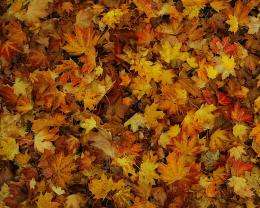
Walking outdoors in the fall, the splendidly colorful leaves adorning the trees are a delight to the eye. In Europe these autumn leaves are mostly yellow, while the United States and East Asia boast lustrous red foliage. But why is it that there are such differences in autumnal hues around the world? A new theory provided by Prof. Simcha Lev-Yadun of the Department of Science Education- Biology at the University of Haifa-Oranim and Prof. Jarmo Holopainen of the University of Kuopio in Finland and published in the Journal New Phytologist proposes taking a step 35 million years back to solve the color mystery.
The green of a tree's leaves is from the larger proportion of the chlorophyll pigment in the leaves. The change in color to red or yellow as autumn approaches is not the result of the leaves' dying, but of a series of processes - which differ between the red and yellow autumn leaves. When the green chlorophyll in leaves diminishes, the yellow pigments that already exist become dominant and give their color to the leaves. Red autumn leaves result from a different process: As the chlorophyll diminishes, a red pigment, anthocyanin, which was not previously present, is produced in the leaf. These facts were only recently discovered and led to a surge of research studies attempting to explain why trees expend resources on creating red pigments just as they are about to shed their leaves.
Explanations that have been offered vary and there is no agreement on this as of yet. One discipline suggests that the red pigment is produced as a result of physiological functions that make the re-translocation of amino acids to the woody parts of the tree more efficient in setting up its protection against the potential damage of light and cold. Other explanations suggest that the red pigment is produced as part of the tree's strategy for protecting itself against insects that thrive on the flow of amino acids. But whatever the answer is, these explanations do not help us understand why the process of creating anthocyanin, the red pigment, does not occur in Europe.
An evolutionary ecology approach infers that the strong autumn colors result from the long evolutionary war between the trees and the insects that use them as hosts. During the fall season, which is when the insects suck the amino acids from the leaves and later lay their eggs, the tree colors its leaves in red because aphids are attracted to yellow ones, so as to advertise to the insects as to the defensive quality of the tree in order to lower the tendency of the insects to occupy the leaves for nutrition and the bark for breeding. In this case too, the protective logic of red pigmentation may be sound, but the yellow leaves cannot be reconciled with this approach. But to settle this point, the new theory can be applied.
According to the theory provided by Prof. Lev-Yadun and Prof. Holopainen, until 35 million years ago, large areas of the globe were covered with evergreen jungles or forests composed of tropical trees. During this phase, a series of ice ages and dry spells transpired and many tree species evolved to become deciduous. Many of these trees also began an evolutionary process of producing red deciduous leaves in order to ward off insects. In North America, as in East Asia, north-to-south mountain chains enabled plant and animal 'migration' to the south or north with the advance and retreat of the ice according to the climatic fluctuations. And, of course, along with them migrated their insect 'enemies' too. Thus the war for survival continued there uninterrupted. In Europe, on the other hand, the mountains - the Alps and their lateral branches - reach from east to west, and therefore no protected areas were created. Many tree species that did not survive the severe cold died, and with them the insects that depended on them for survival. At the end of the repeated ice ages, most tree species that had survived in Europe had no need to cope with many of the insects that had become extinct, and therefore no longer had to expend efforts on producing red warning leaves.
According to the scientists, evidence supporting this theory can be found in the dwarf shrubs that grow in Scandinavia, which still color their leaves red in autumn. Unlike trees, dwarf shrubs have managed to survive the ice ages under a layer of snow that covered them and protected them from the extreme condition above. Under the blanket of snow, the insects that fed off the shrubs were also protected - so the battle with insects continued in these plants, making it necessary for them to color their leaves red.
Source: University of Haifa


