Scientists find a common link of bird flocks, breast milk and trust
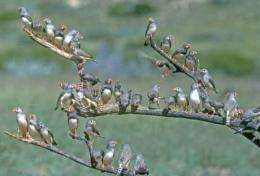
What do flocks of birds have in common with trust, monogamy, and even breast milk? According to a new report in the journal Science, they are regulated by virtually identical neurochemicals in the brain, known as oxytocin in mammals and mesotocin in birds.
Neurobiologists at Indiana University showed that if the actions of mesotocin are blocked in the brains of zebra finches, a highly social songbird, the birds shift their social preferences. They spend significantly less time with familiar individuals and more time with unfamiliar individuals. The birds also become less social, preferring to spend less time with a large group of same-sex birds and more time with a smaller group. Conversely, if birds are administered mesotocin instead of the blocker, the finches become more social and prefer familiar partners.
Perhaps most striking is the fact that none of the treatments affect males -- only females.
According to James Goodson, lead author on the study, the sex differences in birds provide important clues to the evolutionary history of oxytocin functions in humans and other mammals. "Oxytocin is an evolutionarily descendant of mesotocin and has long been associated with female reproductive functions -- things such as pair bonding with males, giving birth, providing maternal care and ejecting milk for infants," said Goodson.
Goodson and colleagues have found hints of similar processes in fish, and he speculates that oxytocin-like neuropeptides have played special roles in female affiliation ever since the peptides first evolved. That was sometime around 450 million years ago, about the same time that jaws evolved.
"The ancient properties of this system appear to be retained in all major vertebrate groups, and date back to our common ancestor with sharks," says co-author Marcy Kingsbury, associate scientist at IU Bloomington.
But if all vertebrates possess similar neuropeptide circuits, why don't they all live in big groups -- flocks, schools or herds? A possible answer to that question is provided in the second part of the Science study. The authors speculated that the behavioral actions of mesotocin may differ across species depending upon the distribution of "receptors" for the chemical in the brain -- that is, places where mesotocin can attach to brain cells and alter their activity.
Using a radioactive compound that attaches to oxytocin-like receptors, the authors mapped the distribution of receptors in three finch species that form flocks and two species that are territorial and highly aggressive. What they found was that the flocking species had many more receptors in a part of the brain known as the lateral septum. And when they blocked those receptors in female zebra finches, the birds became less social.
According to Goodson, these findings suggest that it is actually the concentration and location of receptors that determines whether an individual prefers spending time in large groups. Natural selection could act to increase the number of receptors expressed by certain lateral septum neurons, or by altering the regions where receptor genes are expressed, depending on whether female sociality is favored or not among the individuals of a species.
If Goodson's discovery holds true for other birds and even mammals, the concentration of receptors for mesotocin (and oxytocin) in the lateral septum could accurately predict whether an individual is naturally gregarious.
"The lateral septum is structurally very similar in reptiles, birds and mammals," Goodson said. "To our knowledge, it plays an important role in the social and reproductive behaviors of all land vertebrates."
What might be next for Goodson's research group?
"We still don't understand why mesotocin and oxytocin are so potent in females, but not always in males," Goodson said. "And we also don't fully understand how the lateral septum functions to influence sociality." But he is convinced that his group's ongoing studies of songbirds will soon provide the answers.
Source: Indiana University (news : web)


