LED light bulbs yield big savings in energy
August 13, 2009 By Renee Schoof
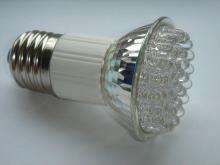
LED Lamp with E27 Edison screw. Image: Wikipedia.
One way the United States could slash its electricity use, dependence on fossil fuels and emissions of heat-trapping gases is really quite simple: better light bulbs.
The Department of Energy is backing research and development aimed at getting light-emitting diodes into common use in homes and businesses at a price that saves money. Hurdles remain: Costs are still high, the quality of what's on the market varies and not all the technical issues have been worked out. Energy experts are confident, however, that this new lighting is the future and that energy savings will be enormous.
Lighting consumes 22 percent of electricity in the United States. The DOE predicts that solid-state lighting -- which uses semiconducting materials to convert electricity into light, and includes LEDs -- has the potential to reduce energy use for lighting by one-third by 2030. That's the equivalent of saving the output of 40 large (1,000-megawatt) power plants, the greenhouse gas emissions of 47 million cars and $30 billion.
LEDs already light universities from Miami to Anchorage, Alaska, streets in many cities and an increasing number of businesses that need lights on all the time.
"In your home, lighting may be 10 percent of your bill. But in an office building it's probably 40 percent, and so if you reduce your lighting energy consumption by a large fraction, the savings will be huge," said James Brodrick, who leads the DOE's solid-state lighting program.
A fact sheet from Brodrick's office says this about LEDs: "In the coming decade, they will become a key to affordable net-zero energy buildings, buildings that produce at least as much energy annually as they use from the grid."
The technology is advancing quickly, and costs will continue to drop, Brodrick said. The DOE tests LEDs and sets performance and efficiency guidelines under its Energy Star program.
LEDs are directional lights, used in recessed lighting and under-counter lights, for example. They're not yet available as bulbs that cast light all around and fit in ordinary sockets.
"There's an enormous and exciting potential, but we have a long way to go before we see anything besides directional lighting," said Jeffrey P. Harris, the vice president for programs at the Alliance to Save Energy, a nonprofit group that promotes energy efficiency.
Even so, LEDs already are used to light offices, hotels, restaurants and other businesses.
The DOE predicts that LEDs will have better performance capability than fluorescent lighting in the next few years, and that they'll continue to improve after that. They're now comparable with fluorescent fixtures in efficiency, and the DOE says its Energy Star LEDs last two to five times longer.
Cost is the biggest reason that LEDs aren't used more widely, Brodrick said.
A common PAR 38 floodlight at Home Depot, for example, costs about $35 online as an LED, about $3.70 apiece in a pack of 15 as a halogen floodlight and about $11 for a compact fluorescent.
Chuck Swoboda, the chairman and chief executive officer of Cree Inc. of Durham, N.C., a leading company in LED lighting, said that commercial use of LEDs would drive down costs, and that a lower initial cost plus the value of energy savings would make them attractive. "It's not that different from the argument of why you should put insulation in a home," he said.
LEDs have other advantages: They can be dimmed, don't emit heat, don't contain mercury -- unlike compact fluorescents -- and can produce warm-toned light.
Swoboda said that Cree was focusing on commercial sales now because that market was bigger than the residential market and commercial users got quicker paybacks from reduced energy and maintenance costs.
In April, Cree announced that it had a new LED PAR 38 bulb designed for stores and museums that uses 12 watts of power instead of 50 to 90 watts for a halogen bulb.
"What happens with LEDs is people think of them as things that go in your cell phone or things you put in the car dashboard, but they don't think of it as truly a lighting product," Swoboda said. "And so this was the latest innovation to kind of go out and show people you can pretty much do anything you can do in an incandescent bulb technology or in fluorescents with LEDs."
Home Depot, the world's biggest retailer of light bulbs, is starting to stock LED bulbs this summer and plans to have 10 kinds by September, said Jorge Fernandez, who's in charge of light bulb purchases for the company.
"There's definitely a lot of interest, but the price is high, and a lot of people say they're waiting to see when the price drops," he said.
Felicia Spagnoli, a spokeswoman for Philips Lighting Electronics North America, said commercial users could make up for the higher costs of LEDs in as little as a year or two.
"We can address environmental concerns at the same time we improve the quality and use of light," she said. "Many people when they think of doing good for the environment think it means going without or having lesser quality, but that's absolutely not the case with LEDs."
Philips is working on many kinds of LEDs, including one to replace a 40-watt incandescent bulb that's scheduled to be available next year, she said.
Derrick Hall of RE/Construct Inc. in Asheville, N.C., said that residential customers weren't asking for LEDs because of the high upfront cost. Still, he's hearing of some nonresidential customers who are looking into LEDs for the energy savings.
LEDs are much better than other lighting options, Hall said. The quality of the light is "far superior," they offer big energy savings and there's no cost to society for dealing with mercury, he said. Mercury, a neurotoxin, is found in small amounts in compact fluorescent bulbs.
Swoboda said that some of the biggest commercial users for LEDs now were fast-food restaurants, because LEDs' light makes food look appealing.
A McDonald's that opened in July in Cary, N.C., is lit almost entirely with daylight and LED lights. Ric Richards, the franchise owner, said the restaurant used 78 percent less electricity than a traditional one.
And the quality of the light?
"Awesome," he said. "The restaurant has great ambience."
Richards estimated that the upfront costs of the lighting would be paid back in two to four years with lower electricity bills.
In Washington, the Pentagon is installing LED lights in a large renovation.
Mark Buffler, an official in charge of technology in the Office of the Secretary of Defense, said in a report that switching from conventional fluorescents to LEDs would conserve large amounts of energy _ 240,000 kilowatt hours annually _ and save money on maintenance and mercury disposal. Buffler also wrote that the project was meant to demonstrate the energy savings potential of LEDs for the rest of the federal government.
ON THE WEB
Department of Energy information on LEDs: http://www1.eere.energy.gov/buildings/ssl/index.html
Energy Star information on LEDs: http://tinyurl.com/mlgeqq
___
(c) 2009, McClatchy-Tribune Information Services.
Visit the McClatchy Washington Bureau on the World Wide Web at http://www.mcclatchydc.com


expensive
directional
unnatural color
low luminosity (dim)
Apart from that they are great!
I.e., there's NO WASTE AT ALL.
I have expensive incandescent bulbs that cause EXTRA heat, because their coating modifies the light to be more like sunlight. They're hot. I only use them in the winter.
Why can't idiots THINK about trade-offs, instead of stampeding like panicked cows to the nearest horizon?
Heat rises, heating the ceiling does very little good.
Apart from the from the afformentioned problem that you're not providing warmth where people want it; electric resistance heating is extremely inefficient.
You get a coefficient of performance of 3-6 with a heat pump depending on the source.
You get twice or thrice higher efficiency burning natural gas yourself rather than burning it over at a power-plant and using a resistance heater.
That makes almost no difference. Again, you're heating the ceiling, it's not going to do that much mixing with the rest of the air in the room before it gets ventilated and the coefficient of performance for an air conditioner is far higher than 1.
It's always a huge waste to heat your house with lightbulbs even if you're backwards enough to use resistance heating. There's a reason nobody puts radiators in the ceiling.
Many cities have converted entirely to LED traffic lights. 14 watt LED lights replace 130 watt incandescent bulbs. For turn arrows, the savings are even higher.
Soylent - people do put radiant heating systems in ceilings. They are fairly common in my area, where relatively small amounts of heat are needed much of the season.
Far Superior to what? a chemical light stick? The quality of light, i.e. CRI, from any LED with high lumen efficiency literally SUCKS. When a CRI over 90 w/ a lumen efficiency over 80/w LED is offered w/ a lifetime cost competitive w/ CFL then the LED marketers can talk about "superior". Until that time, I say they're only marginally acceptable for uncritical lighting.
I appreciate what you are saying, but actually, that is rather my point. I know heat rises. And that if generated at the ceiling, it would tend to stay there. I'm not an idiot, and that's what the researchers are assuming.
I turn on the incandescent light on the *ground floor*. It mostly heats the floor above.
But also, I run air purifiers 100% of the time in used rooms. So there's a fair amount of circulation there.
Again, my point is that draconian idiots are trying to stop me from using what is already an optimal situation for me: the color bulb I want, at 100% efficiency. They're just giving me 100% efficiency at a color I don't want. And perhaps forcing me to use two devices to accomplish what one can. (Heat light)
I've personally seen lighting test labs showing side by side comparisons with fluorescent on one side with a 90 CRI and LED with 70 CRI, and the colors on the LED side looked MUCH better.
CRI is really only for comparing the color rendering of SIMILAR light sources (an 18W fluorescent tube from two different manufacturers) and is relative.
As for Home Depot bulbs - that's totally not the way to go. I've heard MANY people trying out the bulbs - I believe from Lights of America that are still using 5mm LED clusters. This is OLD technology people and will NOT give the brightness that is necessary to retrofit homes. Likewise, Home Depot caters to the mass market or average Joe who is NOT ready to pay such a high cost for their lighting. In any case I don't see what the big hoo-hah with Cree introducing a 12W bulb is. We just came out with an 18W PAR38 floodlight that will replace 100W floodlights and pay back in less than 2 years at an 8 hour burn time:
Eternaleds.com Quanta-18 - 18W LED Flood Light
http://www.eterna...a-18.htm
Some people haven't gotten over the switch from candle-light I suppose.
The US is by far the most energy inefficient of the developed countries. An American like myself who lives in Europe sees that on a daily basis.
Frankly I am tired of all the right wing nonsense being spouted on this board. US energy intensity is much higher than other developed with similar or superior quality of life.
Energy conservation is a way of life in Europe.
It is time that the Americans with their lower quality of life got on board ...
"lower quality of life" ?
Its anecdotal of course but Craig Ferguson, the actor and TV personality, formerly a citizen of the UK, just loves his 'quality of life' in the USA. Part of that 'quality' is the opportunity to achieve.
If one defines 'quality' is 35 hours work weeks, long lunches and being subsidized to hang out in pubs, then Europe has a fine 'quality' of life.
Reason's LEDs sound good:
-Lower electricity consumption
-Variable intensity
-Available in a range of natural colors
-Relatively long operational life
Reasons LEDs sounds bad:
-Expensive to buy
-Directional (w/o diffusers)
So I'd say LEDs are a good way to go, once they hit their stride in mass production terms.
I heat with wood, and my home is built into the ground, so in the summer it stays cool....when can I get my cheap LED bulbs?
What I'd like to see is red, green, and blue LEDs used directly, in a bayer pattern. Maybe even throw some other colors in at the same time - blue-green, yellow, orange, couple of different shades of red. Bayer them out semi-randomly, statistically making a sunlight spectrum, and you'd have some really good light.
These could easily be built in large panels using surface mount LEDs. Heat dissipation might be an issue - I dunno, but I'd think with more area being involved in making the same lumens, it'd be easier.
I picked up a pack at the local wholesaler a few weeks ago. About 6 bulbs for $25 in the northeast. I gave 'em a try and I wasn't impressed. The directional issue was very apparent. I don't have the model number for the bulbs but they were Phillips brand. Looked to have about 8 LED modules within each bulb, clear "lense", standard screw in for fixtures.
They weren't bad, but they were sub-par when compared to the CFLs I had been using, and close to double the price, which is about 4x the price of cheap GE incandescents.
I though I had an ideal solution for the most dangerous location, above stairs.
( Changing popped lamp was dangerous, too ;-)
Sadly, the LED lamp died after a month...
Bath-tub failure curve, perhaps, but at £10 (~$15) a pop, I'll keep the receipt from the next...
Um, how do you *prove* an expensive lamp failed to run for the advertised hours ??
No. LEDs and fluorescent lights produce a fairly spikey spectrum of colours with a poor CRI. Not that I mind much since almost anything is preferable to ugly, yellow incandescent lights.
It is completely insane to ban incandescent lighting however. There are plenty of places(toilets, garages etc.) where the fact that an incandescent lightbulb combines being cheaper than dirt with tolerating being repeatedly cycled on and off is far more important than efficiency.
What about it? It uses monstrously efficient high pressure and low pressure sodium lamps that are more efficient than LEDs can ever hope to be. And it's cheap too.
You can, but you get conspicuosly awful colour rendering if you do that. Even the cheapest, nastiest CFL you can find will use at least 5 different phosphors to produce a range of colours.
LEDs have fairly narrow emission peaks. A good phosphor can produce a broad emissions peak. Combining several phosphors the quality of the lightsource can be made very good.
Wikipedia has good spectrums from each:
http://en.wikiped...ctra.png
(The broad hump on the right is the phosphor, the narrow peak on the left is the LED).
(Why a Bayer pattern? A Bayer pattern has twice as many green as blue or red points and if you're packing circular LEDs square packing is not optimal. Why not the hexagonal packing used on shadow-mask CRTs?)
when does quality of life come into play? I do not like the current offering of LED and CFL lights. I like to dim things, and get an orange glow as they dim, and incandescents and halogens are the only horses that can run that track.
Does my quality of life count, or should i just check into the hole of dirt for the duration?
OLED Tunes its Colors for Sunlight-Style Illumination
http://www.physor...490.html
She got it right on the spot, like she's not putting words in our mouth... Not!
People before having to become environmentally conscious are also cost conscious. We all do our C-B analysis. What she's saying is just one side... the way sales people hide what they want to hide.
Have you ever seen an RGB OLED display? Sony's 19" LED TV gives the crispest and most true-to-life pictures around!
Once again, an RGB LED can reproduce any color...even white (Red, Green, Blue = FFh...ON)
This has been done for years already for stage illumination in the theater and music industries!
I wonder if the statement "Lighting consumes 22 percent of electricity in the United States" also takes this fact into consideration?
Does this spectrum of an R, G and B LED look like a black-body to you?
http://en.wikiped...ctra.png
Or even this blue fluorescent paint 'white' LED?
http://en.wikiped..._LED.png
Some people have rather stringent requirements for colour rendering for one reason or another, you ought not brush them off like that.
My apologies. My favorite colour is ff0000 (red)...but I probably wouldn't notice if there was some green or blue in there, until either reached around 10h or so...your point is well taken.
Heat does NOT rise !
Warm Air rises, HEAT travels in all directions.
This is a common energy misinterpretation.
As far as LED goes, I am on board 100% the more they are mfg and bought, the lower the price will go.
I have LED all thru my house and along with other energy improvements have dropped my electric bill to between $25 and $35 a month, down from 50-80$
THAT is significant my friends.
No it's not. There's conduction, convection and radiative transfer; the only one with any importance whatsoever in your livingroom is going to be convection, hot air rising to your ceiling.
It's also BS.
At 15 cents per kWh what you're telling me is that your lighting needs were equivalent to having 13 lightbulbs, 60 W each, lit for 8 hours every day.
But, since his electricity bill was 50-80$ I'm willing to bet, at $.15 per kWh, he lives alone.
Maybe he's just really afraid of the dark :)