Orchids and fungi -- partners for life
August 13, 2009 Orchids and fungi -- partners for life

Enlarge

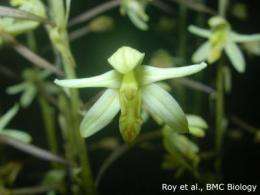
This is an Aphyllorchis montana orchid. Credit: Roy et al., BMC Biology

Three Thai orchids have been found to rely on a wide range of fungi to help them take carbon out of the soil instead of producing their own organic carbon. A detailed study of the relationship, published in the open access journal BMC Biology, also features stunning pictures of the plants.

Marc-André Selosse and Mélanie Roy, from the Centre d'Ecologie Fonctionnelle et Evolutive, Montpellier, France, studied Aphyllorchis montana, A. caudata and Cephalanthera exigua orchids with Suyanee Vessabutr and Santi Watthana from the Queen Sirikit Botanic Garden, Thailand. These orchids have no chlorophyll and rely on fungi colonizing their roots for their carbon supply.

The , which grow on the ground in mountain forests, were collected from 10 different sampling sites in diverse parts of Thailand. The two Aphyllorchis orchids studied were found to associate with a wide range of fungi, while the Cephalanthera was much more specific.

Selosse said, "We show for the first time that certain tropical orchids associate with highly diverse soil fungi colonizing their roots; using stable isotopes, we show that they are likely to use these fungi as a carbon source". Most importantly for conservation concerns, all these fungi associate in turn with the roots of nearby green trees, where they collect carbon for the orchids.

Speaking about the results of the study, Selosse said, "Plants really interact with fungi in an unexpectedly diverse way - the impression one gains is that there is a great need for more research on biological interactions in the tropics to unravel this diversity".

More information: Two mycoheterotrophic orchids from Thailand tropical dipterocarpacean forests associate with a broad diversity of ectomycorrhizal ; Mélanie Roy, Santi Watthana, Anna Stier, Franck Richard, Suyanee Vessabutr and Marc-André Selosse; BMC Biology (in press); http://www.biomedcentral.com/bmcbiol/

Source: BioMed Central (news : web)


print this article email this article download pdf blog this article bookmark this article     Stumble it Digg this share on Facebook retweet share on Reddit add to delicious
Rate this story - 5 /5 (3 votes)


August 13, 2009 all stories

Comments: 0

5 /5 (3 votes)
  • Stumble this up

  • Digg this

  • share this

  • hide
  • Related Stories

  • Saving the wild orchids of Borneo
    created Jul 17, 2008 | popularity not rated yet | comments 0
  • International experts collect alpine fungi in Beartooth Mountains of Montana
    created Sep 08, 2008 | popularity not rated yet | comments 0
  • Hungry microbes share out the carbon in the roots of plants
    created Oct 18, 2007 | popularity not rated yet | comments 0
  • Montana State professor hopes to help high elevation pines grow
    created Jul 17, 2009 | popularity not rated yet | comments 0
  • Dried mushrooms slow climate warming in Northern forests
    created Nov 03, 2008 | popularity not rated yet | comments 0


  • hide
  • Relevant PhysicsForums posts

  • What is transpulmonary pressure?
    created Nov 24, 2009
  • Is there a gay gene?
    created Nov 23, 2009
  • Super quick question about Starling forces?
    created Nov 22, 2009
  • Questions about diffusion
    created Nov 22, 2009
  • More from Physics Forums - Biology

Other News

Variable Temperatures Leave Insects wtih a Frosty Reception

Biology / Plants & Animals

created 2 hours ago | popularity not rated yet | comments 0

(PhysOrg.com) -- For the first time, scientists at The University of Western Ontario have shown that insects exposed to repeated periods of cold will trade reproduction for immediate survival.


When camouflage is a plant's best protection

Rare woodland plant uses 'cryptic coloration' to hide from predators

Biology / Plants & Animals

created 4 hours ago | popularity not rated yet | comments 0

It is well known that some animal species use camouflage to hide from predators. Individuals that are able to blend in to their surroundings and avoid being eaten are able to survive longer, reproduce, and ...


Experts think toxic algae harming endangered fish

Biology / Ecology

created 1hour ago | popularity not rated yet | comments 0

(AP) -- Scientists say they think toxins from a blue-green algae plaguing lakes and rivers around the West are harming an endangered fish in the Klamath Basin, adding another obstacle to restoring species that have forced ...


Destruction spreads 'like a disease'

Biology / Ecology

created 3 hours ago | popularity not rated yet | comments 0

(PhysOrg.com) -- People have cleared more than a quarter of the world’s forests and half of its grasslands, according to a paper published today in the Proceedings of the Royal Society by researchers from The University of Que ...


'Safety valve' protects photosynthesis from too much light

Biology / Cell & Microbiology

created 5 hours ago | popularity not rated yet | comments 0

Photosynthetic organisms need to cope with a wide range of light intensities, which can change over timescales of seconds to minutes. Too much light can damage the photosynthetic machinery and cause cell death. Scientists ...