Liquid-OLED Offers More Light-Emitting Possibilities
August 14, 2009 By Lisa Zyga feature
Liquid-OLED Offers More Light-Emitting Possibilities

Enlarge

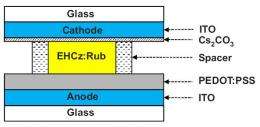
The new liquid-OLED has a liquid semiconducting layer made of EHCz doped with rubrene. Liquid-OLEDs could offer improved device reliability and greater flexibility. Credit: Xu and Adachi.

(PhysOrg.com) -- As organic light-emitting diodes (OLEDs) are poised to go mainstream in the near future, scientists continue to explore new twists on the technology. Recently, researchers have fabricated a "liquid-OLED" - an OLED that uses a liquid organic semiconducting layer to transport charge.

The scientists, Denghui Xu and Chihaya Adachi from the Center for Future Chemistry at Kyushu University in Fukuoka, Japan, have reported the liquid-OLED in a recent issue of Applied Physics Letters. As they explain, the novel design is based on a liquid-emitting layer, and could have advantages for flexible displays and other organic electronics applications.

Usually, OLED displays use solid-state organic films that give off light when an electric current is applied. One significant benefit of OLED displays compared to traditional liquid crystal displays (LCDs) is that OLEDs do not require a backlight. For this reason, OLEDs can be made very thin and flexible, as well as use less power, enabling them to run longer on a single battery charge.

The new liquid-OLED could achieve these same benefits, but by using a liquid organic semiconductor instead of the solid-state films. Other than a few previous studies that have investigated using polymer solutions as the semiconducting layer, this is the first time that researchers have attempted to fabricate a practical liquid semiconductor for OLEDs.

As Xu and Adachi explain, their device uses ethylhexyl carbazole (EHCz) as the liquid semiconducting layer due to its high hole mobility, which is associated with good . The scientists doped the EHCz with solid rubrene, which has a high photoluminescence efficiency. They then prepared a substrate with this liquid mixture placed in between an and , which in turn were sandwiched by glass layers. When testing the device, the researchers observed electroluminescence from rubrene with the naked eye.

“Since EHCz provides hole transport and rubrene does electron transport and emitting functions, the combination leads to electroluminescence,” Adachi told PhysOrg.com.

The researchers hope that, by taking advantage of the new device’s unique liquid properties, they can make further improvements in OLED technology. For instance, liquid semiconductors could easily fill the space between two electrodes in curved structures without cracking or shortage problems. The researchers also suggest that the liquid semiconductors could be circulated or refilled into the active emitting layer. This constant, fresh supply of semiconductors could improve device reliability and reduce degradation.

“This is quite a new concept, realizing truly flexible and degradation-free OLEDs,” Adachi said. “Although the electroluminescence efficiency is still low level, we can surely improve it by optimizing the device parameters and organic semiconductors.”

More information: Denghui Xu and Chihaya Adachi. “ with liquid emitting layer.” Applied Physics Letters 95, 053304 (2009).

Copyright 2009 PhysOrg.com.
All rights reserved. This material may not be published, broadcast, rewritten or redistributed in whole or part without the express written permission of PhysOrg.com.

4.8 /5 (18 votes)  

Filter


Move the slider to adjust rank threshold, so that you can hide some of the comments.


Display comments: newest first

gopher65
Aug 21, 2009

Rank: not rated yet
This is an awesome idea. I'm glad to see someone working on liquid OLED displays. Unless there is an unexpected breakthrough in a field I've never heard of before, I'd bet a lot that this will be the longer-term replacement for LCD and standard OLED screens.
Rank 4.8 /5 (18 votes)
Related Stories
Relevant PhysicsForums posts
  • How is zeno paradox of motion solved
    created1 hour ago
  • Good books for studying physics on own
    created2 hours ago
  • Kinetic energy and crumple zones
    created4 hours ago
  • Finding the E field with a changing p???
    created7 hours ago
  • All matter being liquid in 10^65 years if proton decay doesn't occur.
    created8 hours ago
  • The acceleration of an Elephant and a Paper Clip
    created8 hours ago
  • More from Physics Forums - General Physics

More news stories

Hints of the Higgs - papers are submitted

Back in December 2011, the ATLAS and CMS experiments at CERN presented some exciting results that provided tantalising hints of the Higgs boson.

Physics / General Physics

created 18 minutes ago | popularity not rated yet | comments 0

Physicists 'record' magnetic breakthrough

An international team of scientists has demonstrated a revolutionary new way of magnetic recording which will allow information to be processed hundreds of times faster than by current hard drive technology.

Physics / General Physics

created 16 hours ago | popularity 4.4 / 5 (30) | comments 13 | with audio podcast

Diamond light, brighter than the sun

It’s the size of five football pitches and generates light 10 billion times brighter than the sun. As the Diamond Light Source celebrates its tenth anniversary this year, Penny Bailey visits one of the ...

Physics / General Physics

created 19 hours ago | popularity 4.3 / 5 (6) | comments 14 | with audio podcast

With single laser pulses on single molecules

(PhysOrg.com) -- Physicists at MPQ (Max Planck Institute) succeed in resolving the internal dynamics of individual molecules using UV femtosecond laser pulses.

Physics / General Physics

created 20 hours ago | popularity 5 / 5 (1) | comments 1 | with audio podcast

Searching for a solid that flows like a liquid

(PhysOrg.com) -- A series of neutron scattering experiments at Oak Ridge National Laboratory and other research centers is exploring the key question about a long-sought quantum state of matter called supersolidity: ...

Physics / Quantum Physics

created Feb 03, 2012 | popularity 4.3 / 5 (7) | comments 17 | with audio podcast


Scared of a younger rival? Not for some male songbirds

When mature male white-crowned sparrows duel to win a mate or a nesting territory, a young bird just doesn't get much respect.

Tiny primate 'talks' in ultrasound

One of the world's smallest primates, the Philippine tarsier, communicates in a range of ultrasound inaudible to predator and prey alike, according to a study published on Wednesday.

Playing school sports affects youths' smoking

Young people's choices about using drugs and alcohol are influenced by peers—not only close friends, but also sports teammates. A new study of middle schoolers and their social networks has found that teammates' smoking ...

New study: Adolescents suffering from depression more likely to be bullied

A new study provides evidence that adolescents who suffer from depression are more likely to develop difficulty in peer relationships including being bullied at school.

Preventing bacteria from falling in with the wrong crowd could help stop gum disease

Stripping some mouth bacteria of their access key to gangs of other pathogenic oral bacteria could help prevent gum disease and tooth loss. The study, published in the journal Microbiology suggests that t ...

New study sheds light on genetics of rice metabolism

A large-scale study analyzing metabolic compounds in rice grains conducted by researchers at the RIKEN Plant Science Center (PSC) and their collaborators has identified 131 rice metabolites and clarified the ...