Bionanomachines: Proteins as resistance fighters
August 14, 2009 Bionanomachines: Proteins as resistance fighters

Enlarge

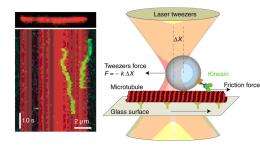
Fluorescent image of single motor proteins (left): Motion of two diffusing kinesin molecules (green) on a microtubule (red) shown as a time series kymograph. Schematic (right): By dragging diffusing kinesin molecules with laser tweezers over a microtubule, the friction force between the motor and its microtubule track can be measured very precisely. Image: MPI-CBG, BIOTEC

(PhysOrg.com) -- Friction limits the speed and efficiency of macroscopic engines. Is this also true for nanomachines? A Dresden research team used laser tweezers to measure the friction between a single motor protein molecule and its track. The team found that also within our cells, motors work against the resistance of friction and are restrained in its operation -- usually by far not as much though as their macroscopic counterparts. These first experimental measurements of protein friction could help researchers to better understand key cellular processes such as cell division which is driven by such molecular machines.

Friction is the force that resists the relative motion of two bodies in contact. The same is true on the nanoscale: Molecular motors have to fight the friction created between them and their tracks. However, since the frictional forces acting on such motors had not been measured before, it was not known how they depend on the speed and the direction of motion.

Friction Slows Down Proteins

Scientists in Dresden at the Biotechnology Center (BIO-TEC) of the Technical University of Dresden and at the Max Planck Institute of Molecular Cell Biology and Genetics (MPI-CBG) immobilized the molecular motor kinesin on a microsphere which was held by laser tweezers and dragged over its track, a so-called . In this manner, the friction force between the motor and its microtubule track was measured very precisely. "Just like for macroscopic machines, protein friction limits the speed and efficiency of the small bio-motors", says Erik Schäffer, group leader at the BIOTEC and Jonathon Howard, director and group leader at the MPI-CBG.

The researchers explain that the protein, in the absence of an energy source, takes eight nanometer (a millionth of a millimeter) wide "diffusive hops", corresponding to the length of the tubulin subunits that make up a microtubule. The motors step from one tubulin subunit to the adjacent one by forming a new bond with the microtubule filament as another bond is broken. When pulled by the tweezers, the energy released from these breaking bonds is lost as friction.

Efficient nanomachines

Protein friction also gives insight into the efficiency of kinesin. "About half of the energy from the motor’s fuel ATP is dissipated as friction between the motor and its substrate" Howard comments. Schäffer adds: "What remains after further dissipation inside the motor is used for mechanical work—the efficiency is usually much better than for man-made machines". The dissipated energy is eventually converted to heat, that contributes to the heating of our body. Thus, for example our muscles are partly heated by protein friction as the muscle do their work.

More information: Volker Bormuth, Vladimir Varga, Jonathon Howard, Erik Schäffer; Protein friction limits diffusive and directed movements of kinesin motors on microtubules; Science 325, 870 (August 14, 2009); doi:10.1126/science.1174923

Source: Max-Planck-Gesellschaft (news : web)


print this article email this article download pdf blog this article bookmark this article     Stumble it Digg this share on Facebook retweet share on Reddit add to delicious
Rate this story - 5 /5 (2 votes)


August 14, 2009 all stories

Comments: 0

5 /5 (2 votes)
  • Stumble this up

  • Digg this

  • share this

  • hide
  • Related Stories

  • One-dimensional Diffusion Accelerates Molecular Motors
    created May 12, 2006 | popularity not rated yet | comments 0
  • Always keeping a safe distance
    created Oct 24, 2006 | popularity not rated yet | comments 0
  • Scaling Friction Down to the Nano/Micro Realm
    created May 28, 2004 | popularity not rated yet | comments 0
  • Motor proteins may be vehicles for drug delivery
    created Mar 20, 2009 | popularity not rated yet | comments 0
  • Tug of War in the Cells
    created Mar 19, 2008 | popularity not rated yet | comments 0


  • hide
  • Relevant PhysicsForums posts

  • What is transpulmonary pressure?
    created Nov 24, 2009
  • Is there a gay gene?
    created Nov 23, 2009
  • Super quick question about Starling forces?
    created Nov 22, 2009
  • Questions about diffusion
    created Nov 22, 2009
  • More from Physics Forums - Biology

Other News

Redback spiders were first spotted in Japan in 1995

Venomous Aussie redback spiders invading Japan

Biology / Ecology

created 4 hours ago | popularity not rated yet | comments 0

Australia's venomous redback spiders are on the march in Japan, where they are believed to have arrived years ago as stowaways on cargo ships, a wildlife expert warned Wednesday.


Study explores violent world of raptors

Biology / Plants & Animals

created 4 hours ago | popularity not rated yet | comments 0

A journey that started with a box of bird feet carried three Montana State University graduate students into the gruesome world of raptors and led to their findings being published in a prominent journal.


Sustainable Corn Production Supports Advanced Biofuel Feedstocks

Sustainable Corn Production Supports Advanced Biofuel Feedstocks

Biology / Biotechnology

created 1hour ago | popularity 5 / 5 (1) | comments 1

(PhysOrg.com) -- Researchers worldwide are trying to economically convert cellulosic biomass such as corn stover into "cellulosic ethanol." But Agricultural Research Service (ARS) scientists have found that ...


Asian carp may have breached barrier protecting Lake Michigan

Biology / Ecology

created 13 hours ago | popularity 5 / 5 (4) | comments 0

Two feared species of Asian carp have zoomed beyond the $9 million electric barriers built to keep them out of Lake Michigan. Now, the only thing left between the carp and the Great Lakes is a lock and dam in southern Chicago.


Got a pain? -- Have a cup of Brazilian mint

Biology / Plants & Animals

created 14 hours ago | popularity 4.6 / 5 (8) | comments 0

For thousands of years it has been prescribed by traditional healers in Brazil to treat a range of ailments from headaches and stomach pain to fever and flu.