Antarctic glacier thinning at alarming rate
August 14, 2009
Antarctic glacier thinning at alarming rate

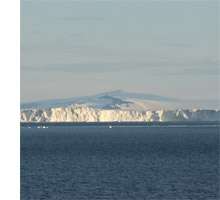
(PhysOrg.com) -- The thinning of a gigantic glacier in Antarctica is accelerating, scientists warned today.

The Pine Island Glacier in West , which is around twice the size of Scotland, is losing ice four times as fast as it was a decade years ago.

The research, published in the journal , also reveals that ice thinning is now occurring much further inland. At this rate scientists estimate that the main section of the glacier will have disappeared in just 100 years, six times sooner than was previously thought.

The Pine Island Glacier is located within the most inaccessible area of Antarctica - over 1000 km from the nearest research base - and was for many years overlooked. Now, scientists have been able to track the glacier's development using continuous over the past 15years.

"Accelerated thinning of the Pine Island Glacier represents perhaps the greatest imbalance in the cryosphere today, and yet we would not have known about it if it weren't for a succession of satellite instruments," says Professor Andrew Shepherd, a co-author of the research from the School of Earth and Environment at the University of Leeds.

"Being able to assemble a continuous record of measurements over the past 15 years has provided us with the remarkable ability to identify both subtle and dramatic changes in ice that were previously hidden," he adds.

Scientists believe that the retreat of in this sector of Antarctica is caused by warming of the surrounding oceans, though it is too early to link such a trend to global warming.

The 5,400 km squared region of the Pine Island Glacier affected today is big enough to impact the rate at which sea level rise around the world.

"Because the Pine Island Glacier contains enough ice to almost double the IPCC's best estimate of 21st century , the manner in which the glacier will respond to the accelerated thinning is a matter of great concern " says Professor Shepherd.

Source: University of Leeds (news : web)

3.5 /5 (13 votes)  

Filter


Move the slider to adjust rank threshold, so that you can hide some of the comments.


Display comments: newest first

SincerelyTwo
Aug 14, 2009

Rank: 2.7 / 5 (7)
we're all going to die!!! ahhhhhhhh!!!
VOR
Aug 14, 2009

Rank: 2.5 / 5 (6)
we're all going to see huge changes and terrible concequences to life and economies play out over decades. Like a glacier, we think it won't crush us because its coming so slowly, but it will squeeze us anyway. The impact may be more managable since it won't hit us all at once, but the magnitude of it will be the same. Huge. Huge and worth the investment of trying to mitigate it as much as we can.
wawadave
Aug 14, 2009

Rank: not rated yet
DPS showing its effects!
Velanarris
Aug 15, 2009

Rank: 5 / 5 (2)
though it is too early to link such a trend to global warming.

This one line alone made me look at the abstract favorably. Since they don't know for sure, they didn't assume and declare from authority.

I'm interested to see what they find going forward.
Rank 3.5 /5 (13 votes)
Related Stories
Relevant PhysicsForums posts
  • Discrepancy between oxygen and carbon-dioxide levels
    createdFeb 09, 2012
  • where gems are found in the world
    createdFeb 09, 2012
  • Wind Waves in Reservoir ~ Wind run-up and Wind set-up
    createdFeb 08, 2012
  • Balance of oxygen in the atmosphere
    createdFeb 01, 2012
  • The case for a methanol-based economy
    createdJan 30, 2012
  • Weather in a rotating cylinder
    createdJan 25, 2012
  • More from Physics Forums - Earth

More news stories

Could Venus be shifting gear?

(PhysOrg.com) -- ESA’s Venus Express spacecraft has discovered that our cloud-covered neighbour spins a little slower than previously measured. Peering through the dense atmosphere in the infrared, the ...

Space & Earth / Space Exploration

created 21 hours ago | popularity 5 / 5 (7) | comments 8 | with audio podcast

Mars Science Laboratory computer issue resolved

(PhysOrg.com) -- Engineers have found the root cause of a computer reset that occurred two months ago on NASA's Mars Science Laboratory and have determined how to correct it.

Space & Earth / Space Exploration

created 22 hours ago | popularity 4.7 / 5 (6) | comments 4 | with audio podcast

Two new moons for Jupiter

Advances in technology have lead to the discovery of new planets outside of our Solar System, and now even new moons in our own backyard.

Space & Earth / Space Exploration

created 21 hours ago | popularity 4 / 5 (1) | comments 7

NASA sees wide-eyed cyclone Jasmine

Cyclone Jasmine's eye has opened wider on NASA satellite imagery, as it moves through the Southern Pacific Ocean.

Space & Earth / Earth Sciences

created 13 hours ago | popularity 3.5 / 5 (2) | comments 2

Clam fields found at deep, low-temperature Mariana vents

(PhysOrg.com) -- Scientists have marveled at the unusual life forms thriving at high temperature hydrothermal vents of the deep ocean.

Space & Earth / Earth Sciences

created 21 hours ago | popularity 4.3 / 5 (3) | comments 0 | with audio podcast


Anonymous knocks CIA website offline (Update)

The website of the Central Intelligence Agency was inaccessible on Friday after the hacker group Anonymous claimed to have knocked it offline.

New error-correcting codes guarantee the fastest possible rate of data transmission

Error-correcting codes are one of the triumphs of the digital age. They’re a way of encoding information so that it can be transmitted across a communication channel — such as an optical fiber o ...

Small modular reactor design could be a 'SUPERSTAR'

(PhysOrg.com) -- Though most of today's nuclear reactors are cooled by water, we've long known that there are alternatives; in fact, the world's first nuclear-powered electricity in 1951 came from a reactor ...

New power source discovered

(PhysOrg.com) -- Researchers at the Massachusetts Institute of Technology (MIT) and RMIT University have made a breakthrough in energy storage and power generation.

The power of estrogen -- male snakes attract other males

A new study has shown that boosting the estrogen levels of male garter snakes causes them to secrete the same pheromones that females use to attract suitors, and turned the males into just about the sexiest ...

Advanced power-grid model finds low-cost, low-carbon future in West

(PhysOrg.com) -- The least expensive way for the Western U.S. to reduce greenhouse gas emissions enough to help prevent the worst consequences of global warming is to replace coal with renewable and other ...