Changes in net flow of ocean heat correlate with past climate anomalies
August 14, 2009 Indian Ocean

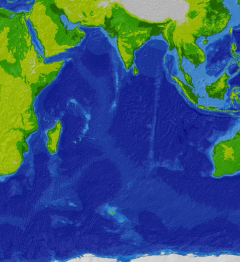
Topographic/bathymetric map of the Indian Ocean region. Image: Wikimedia Commons

Physicists at the University of Rochester have combed through data from satellites and ocean buoys and found evidence that in the last 50 years, the net flow of heat into and out of the oceans has changed direction three times.

These shifts in the balance of heat absorbed from the sun and radiated from the oceans correlate well with past anomalies that have been associated with abrupt shifts in the earth's climate, say the researchers. These anomalies include changes in normal intensities, unusual land temperatures, and a large drop in salmon populations along the western United States.

The physicists also say these changes in ocean direction should be taken into account when predicting global climate because the oceans represent 90 percent of the total heat in the earth's .

The study, which will appear in an upcoming issue of Physics Letters A, differs from most previous studies in two ways, the researchers say. First, the physicists look at the overall heat content of the Earth's climate system, measuring the net balance of radiation from both the sun and Earth. And second, it analyzes more completely the data sets the researchers believe are of the highest quality, and not those that are less robust.

"These shifts happened relatively abruptly," says David Douglass, professor of physics at the University of Rochester, and co-author of the paper. "One, for example, happened between 1976 and 1977, right when a number of other climate-related phenomenona were happening, such as significant changes in U. S. precipitation."

Douglass says the last oceanic shift occurred about 10 years ago, and that the oceans are currently emitting slightly more radiation than they are receiving.

The members of the team, which includes Robert Knox, emeritus professor of physics at the University, believe these heat-flux shifts had previously gone unnoticed because no one had analyzed the data as thoroughly as the Rochester team has.

The team believes that the oceans may change how much they absorb and radiate depending on factors such as shifts in ocean currents that might change how the deep water and surface waters exchange heat. In addition to the correlation with strange global effects that some scientists suspect were caused by climate shifts, the team says their data shows the oceans are not continuously warming—a conclusion not consistent with the idea that the oceans may be harboring "warming in the pipeline." Douglass further notes that the team found no correlation between the shifts and atmospheric carbon dioxide concentration.

"An interesting aspect of this research is that no reference to the surface temperature itself is needed," says Knox. "The heat content data we used, gathered by oceanographers, was gleaned from temperature measurements at various depths up to 750 meters." The team also found that the radiative imbalance was sufficiently small that it was necessary to consider the effect of geothermal heating. Knox believes this is the first time this additional source of heat has been accounted for in such a model.

The team notes that it's impossible to predict when another shift might occur, but they suspect future shifts might be similar to the three observed. Both Douglass and Knox are continuing to analyze various climate-related data to find any new information or correlations that may have so far gone unnoticed.

Source: University of Rochester (news : web)


print this article email this article download pdf blog this article bookmark this article     Stumble it Digg this share on Facebook retweet share on Reddit add to delicious
Rate this story - 4.2 /5 (15 votes)

Rank Filter

Move the slider to adjust rank threshold, so that you can hide some of the comments.


Display comments: newest first

  • Velanarris - Aug 14, 2009
    • Rank: 5 / 5 (2)
    It's very preliminary, but very interesting.
  • Mr_Frontier - Aug 14, 2009
    • Rank: 3 / 5 (4)
    Looks like it's time to recalculate those AGW models again. This time it's in the name of science!
  • zevkirsh - Aug 14, 2009
    • Rank: 3.5 / 5 (2)
    our current understanding is almost useless. most of what goes on in the ocean is because of the interaction between the ocean floor and the bottom of the ocean. heat radiates upwards from the floor up, ocean heat does not radiate from the top of the ocean down to the floor, regardless of what the atmosphere is doing.

    the only information on how much aggregate heat is coming from the ocean floor to the bottom of the actual ocean is EXTREMELY LIMITED.

    this seems like such an obvious fact to the layperson that , one wonders how scientists can draw any seeming conclusions when the certainty about the lack of information we yet possess is so high.

    it remains a great challenge to collect all this data as well. as far as i know, sattelites cannot gather this information. the only way to know is to sample the bottom of the ocean by going there, many times and in many locations.

    also, statistically, hot spots tend to occur in clusters, so it could be that 90% of the occean heat comes from the bottom of the ocean, and 90% of this heat comes from 10 relatively small hot-regions around the world ( some of which would presumably be aligned around the pacific ring of fire.....
    , so we cannot really make good conclusions until we really have heat mapped 95 to 99%all of the bottom of the oceans.
  • mo411 - Aug 14, 2009
    • Rank: 3.2 / 5 (5)
    About ten years ago a shift took place... know what else happened about ten years ago?

    Care to Guess?

    Multiple planetary conjunctions.

    I kid you not. This created a tidal effect few could fathom within the liquid core of all of us, including the star. Ask why the star is so quiet now?

    It is simple physics where we will eventually find the key to understanding global climate. We will find the sun, moon and our neighbors have far more to do with the temperature then anything Gore and his brethren at the UN could ever conceive. As soon as scientist stop drinking the tap water in Washington we will all be better off...
  • Mr_Frontier - Aug 14, 2009
    • Rank: 4.3 / 5 (3)
    We can't even exactly or completely model how a cube of differential temperature spreads with molecular precision. I commend the effort on more detailed and real time climate modelling, which is hard enough. Sensors and data first, modelling second.

    If your car has a complicated problem with it, you don't just take it to the mechanic and let him diagnose it without running tests, taking data, and using past experience to evaluate the solution. If he makes you repair every single part one by one, until he gets to the actual part needing repair, he is selling an inefficient solution based on incomplete sets of inexperience and likely guesstimation.

    Give me your real time sensor data, your educated intuition, your analyzed core samples; anything that is a fortified and redundant compilation of the evidence to the problem, and the world can work diligently to develop an appropriate solution.

    Counting up carbon credits, ppm, global averages and predicting long term weather patterns are inconclusive, misunderstood, and highly unprofessional.

    If we yell wolf too many times, we won't get the real-time support one needs to politically/scientifically tackle a problem.

    Don't lay your idle, inexperienced, and nervous hand on my delicate engine, we need professionals working on it. Do it right the first time.


  • brant - Aug 15, 2009
    • Rank: 3 / 5 (2)
    "These shifts in the balance of heat absorbed from the sun and radiated from the oceans correlate well with past anomalies that have been associated with abrupt shifts in the earth's climate, say the researchers."

    Anomalies assumes that we know how the earth works....
  • Nartoon - Aug 16, 2009
    • Rank: not rated yet
    "ocean heat does not radiate from the top of the ocean down to the floor, regardless of what the atmosphere is doing." True, but the water doesn't just lay there, it intermingles in a vast way.
  • Noumenon - Aug 16, 2009
    • Rank: not rated yet
    Eventually we will all look back on this AGW fad and have a big laugh.
  • 3432682 - Aug 17, 2009
    • Rank: 5 / 5 (1)
    This article spotlights how little we know. Funny how the AGW folks are all positive they know the answer. Of course, they do not. But they sure are making a nice living spreading their story - $10 billion per year in AGW studies. And the greenies gripe about Exxon money funding skeptics (which is a pittance).

August 14, 2009 all stories

Comments: 9

4.2 /5 (15 votes)
  • Stumble this up

  • Digg this

  • share this

  • hide
  • Related Stories

  • Mystery Climate Mechanism May Counteract Global Warming
    created Apr 12, 2005 | popularity not rated yet | comments 0
  • Global Warming Models Come Under Physicist's Scrutiny
    created Jul 30, 2004 | popularity not rated yet | comments 0
  • Short-Term Ocean Cooling Suggests Global Warming 'Speed Bump'
    created Sep 21, 2006 | popularity not rated yet | comments 0
  • Southern Ocean Could Slow Global Warming
    created Dec 05, 2006 | popularity not rated yet | comments 0
  • Scientists conclude Earth's energy is 'out of balance'
    created Apr 28, 2005 | popularity not rated yet | comments 0


  • hide
  • Relevant PhysicsForums posts

  • dropping meat on weighing scale
    created 2 hours ago
  • What is voltage drop?
    created 2 hours ago
  • waveguide
    created 4 hours ago
  • How is the freezer part of a refrigerator is more cooler than the other parts?
    created 4 hours ago
  • More from Physics Forums - General Physics

Other News

Restored machine to explore mysteries of Big Bang (AP)

Restored machine to explore mysteries of Big Bang

Physics / General Physics

created Nov 21, 2009 | popularity 4.5 / 5 (16) | comments 11

(AP) -- Scientists are preparing the world's largest atom smasher to explore the depths of matter after successfully restarting the $10 billion machine following more than a year of repairs.


nuclear power plant

Doubts raised on nuclear industry viability

Physics / General Physics

created Nov 19, 2009 | popularity 3.1 / 5 (20) | comments 19

(PhysOrg.com) -- The investment in nuclear power has been growing around the world over the last few years, being viewed as a means for countries to control their energy security, avoid the price fluctuations ...


Researchers Find Innate Correlations Among Different Power Law Phenomena

Researchers Find Innate Correlations Among Different Power Law Phenomena

Physics / General Physics

created Nov 17, 2009 | popularity 4.3 / 5 (15) | comments 14

(PhysOrg.com) -- Studying the patterns that emerge in natural and social phenomena is a popular area of research, although usually individual phenomena are studied separately from each other. In a recent study, ...


Scientists demonstrate 'universal' programmable quantum processor

Scientists demonstrate 'universal' programmable quantum processor

Physics / Quantum Physics

created Nov 15, 2009 | popularity 4.6 / 5 (21) | comments 11

Physicists at the National Institute of Standards and Technology have demonstrated the first "universal" programmable quantum information processor able to run any program allowed by quantum mechanics -- th ...


Proton's party pals may alter its internal structure

Proton's party pals may alter its internal structure

Physics / General Physics

created Nov 18, 2009 | popularity 4.6 / 5 (20) | comments 9

A recent experiment at the DOE's Thomas Jefferson National Accelerator Facility has found that a proton's nearest neighbors in the nucleus of the atom may modify the proton's internal structure.