Phones, PCs put e-book within reach of Kindle-less
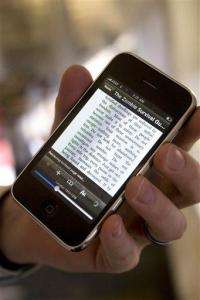
(AP) -- A few weeks ago, Pasquale Castaldo was waiting at the Dallas-Fort Worth airport for a delayed flight, when a man sitting across from him pulled out an Amazon Kindle book-reading device.
"Gee, maybe I should think about e-books myself," Castaldo thought.
He didn't have a Kindle, but he did have a BlackBerry. He pulled it out and looked for available applications. Sure enough, Barnes & Noble Inc. had just put up an e-reading program. Castaldo, 54, downloaded it, and within a minute, began reading Jane Austen's "Pride and Prejudice."
As others are also discovering, the North Haven, Conn., banker found e-books quite accessible without a Kindle.
"The BlackBerry is always with me," Castaldo said. "Rather than just sitting there, if I can fill that time by reading a good book, I might do that, in addition to doing the other things I might do, like reading e-mail and Twittering."
Thanks to Amazon.com Inc.'s Kindle, e-book sales are finally zooming, after more than a decade in the doldrums.
But the pioneering device may not dominate the market for long. As Castaldo found, many phones are now sophisticated enough, and have good enough screens, to be used as e-book reading devices. In addition, e-book reading on computers is already surprisingly popular.
E-book sales reported to the Association of American Publishers have been rising sharply since the beginning of 2008, just after the release of the Kindle. It's the best sustained growth the industry has seen since the International Digital Publishing Forum began tracking sales in 2002 - a sign that e-books finally could be about to break into the mainstream.
U.S. trade e-book sales in the April to June period this year more than tripled from the amount a year ago, as reported by about a dozen publishers.
Total reported sales at wholesale prices were $37.6 million. That's less than 2 percent of the overall book market, but the number understates e-book sales, because not all publishers contribute to the report. The figure also excludes textbooks, an area where e-books have made substantial inroads.
While other digital media like CDs, DVDs and MP3 songs showed sharp growth rates from the get-go, e-books have puttered around as a tiny fraction of overall book sales for more than a decade. In several periods, sales actually declined from year to year as publishers wavered in their commitment and interest.
The technology has also faced unique resistance from consumers because printed books work so well.
The most well-known dedicated reading devices, the Kindle and Sony Corp.'s Reader, try to emulate the look of the printed page with a display technology known as "electronic ink."
While many find the result pleasant to read, e-ink also imposes significant limitations on the devices. They can't be backlit like other screens. They can't show color. They're also slow to update, making them difficult to use for Web browsing or other computer activities.
The Kindle has a wireless connection directly to Amazon's store, meaning users can buy and download books to the device within minutes, much like Castaldo could do on his smart phone. The Reader lacks a wireless capability and thus needs to be connected to a computer to load books.
Amazon isn't betting solely on the Kindle. It released an iPhone app for the Kindle store in March. It has snapped up some other developers of book-reading applications for smart phones, but these programs don't use the Kindle store.
Shanna Vaughn, a university worker and voracious reader in Orange County, Calif., has been reading e-books on a computer or handheld organizer for at least ten years, but it was only an occasional habit until she got an iPhone last year. It's mainly the convenience that's winning her over: Because Vaughn can buy and download books nearly instantly to the phone, she doesn't need to plan a trip to the book store.
Vaughn, 35, is not interested in a Kindle or a Reader.
"I never really wanted something that was a single-function device. I just couldn't see spending ... $300 for a device where I'm sort of locked in to one retailer. Whereas my phone, that does everything."
Forrester Research analyst Sarah Rotman Epps said that while the Kindle has sparked interest in e-books, downloads of e-reading applications for smart phones have far outnumbered the Kindles sold.
The Stanza app for the iPhone and the iPod Touch, for instance, has been downloaded more than 2 million times since last summer, compared with Rotman Epps' estimate of more than 900,000 Kindles sold through the first quarter of this year. (Lexcycle Inc., the maker of Stanza, was acquired in April by Amazon, which does not disclose Kindle sales.)
"There will be a market for dedicated reading devices, but there's potentially an even bigger market for reading on devices that people already own, like smart phones," she said.
According to a survey of 2,600 adults by research firm Simba Information this spring, the most common way to read e-books is on another general-purpose device: the personal computer. It found that 8 percent of adults had bought an e-book last year, a high figure considering that Kindle sales were less than half a percent of the adult population.
Bob LiVolsi, the founder and CEO of independent e-book retailer BooksOnBoard, said two-thirds of his customers read their books on their PCs. Romance, thriller and mystery titles costing $5 to $7 are the big draw for his customers, who aren't high earners and have trouble justifying the cost of a dedicated device.
Though adoption has been slow, PCs have had a big head start in e-books, said Michael Norris, senior publishing analyst at Simba. Their ubiquity also means they provide some camouflage to avid readers who want to "read a romance novel at work while pretending to work," he said.
Robert Lisi, a construction estimator in Charleston, S.C., reads on his BlackBerry when he doesn't have his Sony Reader handy.
He's even signed up for The Daily Lit, a service that sends out books in e-mail every day, broken up into chunks that take about five minutes to read on a BlackBerry or computer screen.
"I have books on tape, and then I have books on paper and as e-books," Lisi said. "I want to get to where I'm reading a book a week, but I work, so I can't do that."
©2009 The Associated Press. All rights reserved. This material may not be published, broadcast, rewritten or redistributed.


