Some mice stem cells divide in unexpected ways
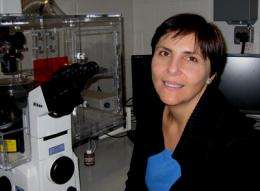
(PhysOrg.com) -- Using new genetic tools, Cornell researchers have found that some stem cells in mice behave dramatically different than in fruit flies, where most of the pioneering stem cell work has been conducted. The findings could have important implications for understanding how some cancers might be initiated, say the researchers.
The prevailing evidence for fruit flies (Drosophila) shows that normal adult stem cells generate two daughter cells with different fates; one becomes another stem cell, and the other becomes a differentiated cell with a fixed number of cell divisions left in its life. This is called an "asymmetric fate decision" because the daughter cells do not have identical fates.
The new study, published online Aug. 6 in the journal Cell Stem Cell, indicates that dividing hair follicle stem cells in adult mice, on the other hand, can undergo symmetric fates -- the daughter cells can both become either stem cells or differentiated cells.
The study is among the first to consider directly how dividing stem cells choose their fate in undamaged mouse tissues. The findings imply that certain previously held assumptions about stem cell behavior in mammals may not be applicable to stem cells in all organ systems.
"A great deal of our understanding of how stem cells function is based on work done in Drosophila , where stem cells divide asymmetrically," said Tudorita Tumbar, professor of molecular biology and genetics and the study's lead author. "Employing new genetic tools that allow us to follow the fate of single hair follicle stem cells throughout the life of a higher organism -- the mouse -- we found that, in fact, a majority, if not all fate decisions in the hair follicle mouse model system, are symmetric," Tumbar added.
Tumbar stopped short of saying that other stem cells in mice and humans make symmetric fate decisions. Rather, she stressed that the hair-follicle study shows that previous assumptions in the field don't always hold, and it will be important to study stem cells in their native contexts on a case-by-case basis.
The researchers discovered the symmetric fate decisions using a technique that genetically marked single stem cells in mouse hair follicles; Tumbar and her colleagues could track all the progeny of the marked cells because the technique prompted them to turn blue under experimental conditions.
Tumbar avoided having to transplant stem cells, which can cause tissue damage that affects how the cells behave. "I wanted to study stem cells in mammals in the absence of injury or stress," said Tumbar. "Ultimately we hope to understand how genetic perturbations of normal stem cell behavior might lead to disease."
In agreement with previously obtained evidence for stem cells in other model system, Tumbar also found that the hair follicle stem cells divided infrequently. Normally, cells in our bodies divide a fixed number of times. Cancerous tumors occur when cells divide indefinitely, even when signaled to stop. Stem cells can also divide indefinitely, but they do so in a controlled manner. This loss of control is thought to lead to cancer in some cases.
Now that Tumbar has a general picture of "how stem cell daughters choose their fate," she hopes to determine how this fate is selected at the molecular level.
Provided by Cornell University (news : web)


