Braille Displays Get New Life With Artificial Muscles
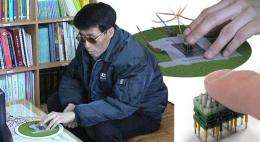
(PhysOrg.com) -- Research with tiny artificial muscles may yield a full-page active Braille system that can refresh automatically and come to life right beneath your fingertips.
Yosi-Bar Cohen, a senior researcher at NASA's Jet Propulsion Laboratory in Pasadena, Calif, was inspired during a business trip to Washington, D.C., where a convention for people with visual impairments was taking place.
Bar-Cohen came up with an idea to create a "living Braille," a digital, refreshable Braille device using electroactive polymers, also known as artificial muscles. He wrote up a technology report and included information in a related book that he published. His writings inspired other scientists and engineers to create active displays using this technology, and prototypes are now under development around the world.
"I hope that sometime in the future we will have Braille on an iPhone. It will be portable and able to project a picture of a neighborhood popping up in front of you in the form of raised dots," said Bar-Cohen. "A digital Braille operated by artificial muscles could provide for rapid information exchange, such as e-mail, text messaging and access to the web and other electronic databases or archives."
According to the World Health Organization, about 314 million people are visually impaired worldwide; 45 million of them are blind.
Recently, Bar-Cohen was contacted by the Center for Braille Innovation of the Boston-based National Braille Press to reach out to the Electroactive Polymer community and take advantage of his role in this field. The National Braille Press is a non-profit Braille printing and publishing house that promotes the literacy of blind children through Braille.
Current Braille Display Technologies
The challenge for creating an active Braille display is in packing many small dots into a tiny volume.
Unlike hardcopy Braille, a refreshable display requires the raising and lowering of a large number of densely packed dots that allow a person to quickly read them. Currently, commercial active Braille devices are limited to a single line of characters. A full page of Braille typically has 25 lines of up to 40 characters per line. Characters are represented by six or eight dots per cell, arranged in two columns. To produce a page of refreshable Braille using electroactive polymers requires individually activating and controlling thousands of raiseable dots.
Developing New Braille Technologies
Some of the leading-edge work in Braille technology was developed at SRI in Menlo Park, Calif. Richard Heydt, a senior research engineer there who was involved in developing a prototype says, "The electroactive polymer technology seems to be a natural fit for Braille and tactile display applications."
The Braille display developed at SRI is based on activating a type of polymer consisting of a thin sheet of acrylic that deforms in response to voltage applied across the film. The individual Braille dots are defined by a pattern on this film, and each dot is independently activated to produce the dot combinations for Braille letters and numbers.
In currently available active refreshable Braille displays, each dot is a pin driven by a small motor or electromagnetic coil. In contrast, in the SRI display the actuators are defined regions on a single sheet of film. Thus, while each dot is raised or lowered by its own applied voltage, there are no motors, bulky actuators, or similar components. Since the system has far fewer discrete components for a Braille dot array, it would be potentially much lower in cost.
"The contributions of the developers of electroactive materials to making a low-cost, active Braille display would significantly improve the life of many people with visual impairments, while advancing the field to benefit other applications" said Bar-Cohen.
Looking for the 'Holy Braille'
The Boston-based National Braille Press has recently established a Center for Braille Innovation. They're looking for the "Holy Braille," a full-page electronic Braille display, at a low cost.
"We feel that the exciting field of electroactive polymer technology has matured to the point where it can provide real solutions for Braille displays. We welcome and encourage anyone who wants to take part in Braille innovation," said Noel H. Runyan, National Braille Press, Center for Braille Innovation
In the spring of 2010, Bar-Cohen is including a special session on tactile displays at an SPIE conference. SPIE is the international society for optics and photonics. Tactile displays will be presented and possibly demonstrated at the conference. He hopes these baby steps may someday lead to a full-page Braille system that will allow people to feel and "see" the universe beneath their fingers.
Provided by JPL/NASA (news : web)


