Tiny Flares Responsible for Outsized Heat of Sun's Atmosphere
August 14, 2009 by Laura Layton Tiny flares responsible for outsized heat of sun's atmosphere

Enlarge

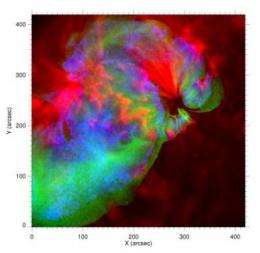
This false-color temperature map shows solar active region AR10923, observed close to center of the sun's disk. Blue regions indicate plasma near 10 million degrees K. Credit: Reale, et al. (2009)

(PhysOrg.com) -- Solar physicists at NASA have confirmed that small, sudden bursts of heat and energy, called nanoflares, cause temperatures in the thin, translucent gas of the sun's atmosphere to reach millions of degrees.

"Why is the sun's corona so darned hot?" asks James Klimchuk, an astrophysicist at the Goddard Space Flight Center's Solar Physics Laboratory in Greenbelt, Md.

The mystery of why temperatures in the solar corona, the sun's outer atmosphere, soar to several million degrees Kelvin (K) —much hotter than temperatures nearer the sun's surface—has puzzled scientists for decades. New observations made with instruments aboard Japan's Hinode satellite reveal the culprit to be nanoflares.

Nanoflares are small, sudden bursts of heat and energy. "They occur within tiny strands that are bundled together to form a magnetic tube called a coronal loop," says Klimchuk. Coronal loops are the fundamental building blocks of the thin, translucent gas known as the sun's corona.

Scientists previously thought steady heating explained the corona's million degree temperatures. The steady heating model indicates that a coronal loop of a given length and temperature should have a specific density. However, observations showed that coronal loops have much higher density than the steady heating model predicts. Newer models based on nanoflares can explain the observed density. But no direct evidence of the nanoflares existed until now.

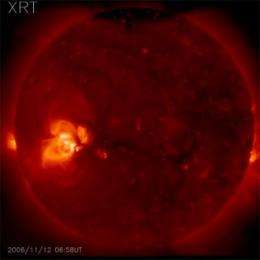
Observations from the NASA-funded X-Ray Telescope (XRT) and Extreme-ultraviolet Imaging Spectrometer (EIS) instruments aboard Hinode reveal that ultra-hot plasma is widespread in solar active regions. The XRT measured plasma at 10 million degrees K, and the EIS measured plasma at 5 million degrees K. "These temperatures can only be produced by impulsive energy bursts,"says Klimchuk, who presented the findings on August 6 at the International Astronomical Union General Assembly meeting in Rio de Janeiro, Brazil.

"Coronal loops are bundles of unresolved strands that are heated by storms of nanoflares."
Tiny flares responsible for outsized heat of sun's atmosphere
Enlarge

Two active regions appear as bright areas on this full-disk image of the sun, taken with the Hinode spacecraft's X-Ray Telescope. Credit: NASA

Coronal heating is a dynamic process. The brightness of the observed X-ray and ultraviolet emission is strongly dependent on the density of the coronal plasma. Where there's low density, there isn't much brightness. Where there's high density, there's a lot of brightness. The corona is mostly bright at about 1 million degrees K.

Klimchuk and colleagues constructed a theoretical model to explain how plasma evolves within these coronal tubes and what causes temperatures to skyrocket. "We simulate a burst of heating and see how the corona responds," says Klimchuk. "Then we make predictions about how much emission we should see from plasma of different temperatures."

Klimchuk surmises that when a nanoflare suddenly releases its energy, the plasma in the low-temperature, low-density strands becomes very hot—around 10 million degrees K—very quickly. The density remains low, however, so the emission, or brightness, remains faint. Heat flows from up in the strand, where it's hot, down to the base of the coronal loop, where it's not as hot. This heats up the dense plasma at the loop’s base. Because it is so dense at the base, the temperature only reaches about 1 million degrees K. This dense plasma expands up into the strand. Thus, a coronal loop is a collection of 5-10 million degree K faint strands and 1 million degree K bright strands.

"What we see is 1 million degree K plasma that has received its energy from the heat flowing down from the superhot plasma," says Klimchuk. "For the first time, we have detected this 10 million degree plasma, which can only be produced by the impulsive energy bursts of nanoflares."

The observations and the scientists' analysis verify that nanoflares are occurring on the sun and that they explain much and perhaps most coronal heating. The observations also confirm "there is some nanoflare activity everywhere" in the sun's active regions, says Klimchuk.

Nanoflares are responsible for changes in the X-ray and ultraviolet (UV) radiation that happen as an active region evolves. X-ray and UV get absorbed by Earth's upper atmosphere, which heats up and expands. Changes in the upper atmosphere can affect the orbits of satellites and space debris by slowing them down, an effect known as "drag." It is important to know the changing orbits so that maneuvers can be made to avoid space collisions. The X-ray and UV also affect the propagation of radio signals and thereby adversely affect communication and navigation systems.

The discovery that nanoflares play an important and perhaps dominant role in coronal heating paves the way to understanding how the affects Earth, our place in the universe.

Source: NASA/Goddard Space Flight Center


Rate this story - 4.4 /5 (9 votes)

Rank Filter

Move the slider to adjust rank threshold, so that you can hide some of the comments.


Display comments: newest first

  • Slotin - Aug 14, 2009
    • Rank: 3 / 5 (2)
    heres another explanation based on Alphven waves, which are driving X-ray spikes
    http://www.iop.or...ext.html
    http://www.scienc...856/1580

  • omatumr - Aug 15, 2009
    • Rank: 1 / 5 (3)
    EARTH'S HEAT SOURCE - THE SUN

    It is great that NASA has a renewed interest in the Sun, the object that heats planet Earth and sustains life here.

    Welcome to reality!

    For decades NASA has steadfastly refused to even consider experimental data that showed our Sun is not the ball of Hydrogen (H) described by the standard solar model (ssm).

    Now an astrophysicist at NASA's Goddard Space Flight Center's Solar Physics Laboratory in Greenbelt, Md finally asks, [quote] Why is the sun's corona so darned hot? [end quote]

    [quote] These temperatures can only be produced by impulsive energy bursts,[end quote] he answers.

    Deep-seated magnetic fields that produce energy outbursts from the Iron Sun have already been explained:

    1. Superfluidity in the solar interior: Implications for solar eruptions and climate, Journal of Fusion Energy 21 (2002) 193-198; http://arxiv.org/...501441v1

    2. Observational confirmation of the Sun's CNO cycle, Journal of Fusion Energy 25 (2006) 107-114; http://arxiv.org/...512633v2

    3. Earth's Heat Source - The Sun, Energy and Environment 20 (2009) 131-144 [SPECIAL ISSUE: Natural drivers of weather and climate] http://arxiv.org/pdf/0905.0704

    With kind regards,
    Oliver K. Manuel
    http://www.omatumr.com

August 14, 2009 all stories

Comments: 2

4.4 /5 (9 votes)

  • hide
  • Related Stories

  • Warm Coronal Loops Offer Clue to Mysteriously Hot Solar Atmosphere
    created May 29, 2008 | popularity not rated yet | comments 0
  • 'Focused' Solar Explosions Get Hotter
    created Apr 02, 2008 | popularity not rated yet | comments 0
  • The Sun's X-file under the Spotlight
    created Sep 03, 2004 | popularity not rated yet | comments 0
  • Skeleton Of Sun's Atmosphere Reveals Its True Nature
    created Apr 16, 2007 | popularity not rated yet | comments 0
  • The Spooky Sun
    created Oct 31, 2006 | popularity not rated yet | comments 0


  • hide
  • Relevant PhysicsForums posts

Other News

Orion in a New Ligh

Orion in a New Ligh (w/ Video)

Space & Earth / Astronomy

created 29 minutes ago | popularity not rated yet | comments 0 | with audio podcast

(PhysOrg.com) -- The Orion Nebula reveals many of its hidden secrets in a dramatic image taken by ESO’s new VISTA survey telescope. The telescope’s huge field of view can show the full splendour of the whole ...


India announces long-range nuclear-capable missile test

Space & Earth / Space Exploration

created 1hour ago | popularity 5 / 5 (1) | comments 0

India will test a nuclear-capable missile with a range of over 5,000 kilometres (3,000 miles) within a year, its top military scientist said Wednesday, risking a rise in regional tensions.


Space shuttle Endeavour pulls in at space station (AP)

Space shuttle Endeavour pulls in at space station

Space & Earth / Space Exploration

created 6 hours ago | popularity 5 / 5 (1) | comments 0

(AP) -- Shuttle Endeavour arrived to a warm welcome at the International Space Station early Wednesday, delivering a new room and observation deck that will come close to completing construction 200 miles ...


Climate 'Tipping Points' May Arrive Without Warning, Says Top Forecaster

Space & Earth / Environment

created 16 hours ago | popularity 3.5 / 5 (11) | comments 11 | with audio podcast

(PhysOrg.com) -- A new University of California, Davis, study by a top ecological forecaster says it is harder than experts thought to predict when sudden shifts in Earth's natural systems will occur -- a worrisome finding ...


38 percent of world's surface in danger of desertification

38 percent of world's surface in danger of desertification

Space & Earth / Environment

created 13 hours ago | popularity 2 / 5 (4) | comments 6

A team of Spanish researchers has measured the degradation of the planet's soil using the Life Cycle Assessment (LCA), a scientific methodology that analyses the environmental impact of human activities, and ...