New nanolaser -- spaser -- key to future optical computers and technologies
August 16, 2009 by Emil Venere New nanolaser key to future optical computers and technologies

Enlarge

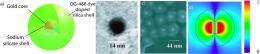
Researchers have created the tiniest laser since its invention nearly 50 years ago. Because the new device, called a "spaser," is the first of its kind to emit visible light, it represents a critical component for possible future technologies based on "nanophotonic" circuitry. The color diagram (a) shows the nanolaser's design: a gold core surrounded by a glasslike shell filled with green dye. Scanning electron microscope images (b and c) show that the gold core and the thickness of the silica shell were about 14 nanometers and 15 nanometers, respectively. A simulation of the SPASER (d) shows the device emitting visible light with a wavelength of 525 nanometers. (Birck Nanotechnology Center, Purdue University)

(PhysOrg.com) -- Because the new device, called a "spaser," is the first of its kind to emit visible light, it represents a critical component for possible future technologies based on "nanophotonic" circuitry, said Vladimir Shalaev, the Robert and Anne Burnett Professor of Electrical and Computer Engineering at Purdue University.

Such circuits will require a laser-light source, but current lasers can't be made small enough to integrate them into electronic chips. Now researchers have overcome this obstacle, harnessing clouds of electrons called "surface plasmons," instead of the photons that make up light, to create the tiny spasers.

Findings are detailed in a paper appearing online Sunday (Aug. 16) in the journal Nature, reporting on work conducted by researchers at Purdue, Norfolk State University and Cornell University.

Nanophotonics may usher in a host of radical advances, including powerful "hyperlenses" resulting in sensors and microscopes 10 times more powerful than today's and able to see objects as small as DNA; computers and consumer electronics that use light instead of electronic signals to process information; and more efficient solar collectors.

"Here, we have demonstrated the feasibility of the most critical component - the nanolaser - essential for nanophotonics to become a practical technology," Shalaev said.

The "spaser-based nanolasers" created in the research were spheres 44 , or billionths of a meter, in diameter - more than 1 million could fit inside a . The spheres were fabricated at Cornell, with Norfolk State and Purdue performing the optical characterization needed to determine whether the devices behave as lasers.

The findings confirm work by physicists David Bergman at Tel Aviv University and Mark Stockman at Georgia State University, who first proposed the spaser concept in 2003.

"This work represents an important milestone that may prove to be the start of a revolution in , with applications in imaging and sensing at a scale that is much smaller than the wavelength of visible light," said Timothy D. Sands, the Mary Jo and Robert L. Kirk Director of the Birck Nanotechnology Center in Purdue's Discovery Park.

The spasers contain a gold core surrounded by a glasslike shell filled with green dye. When a light was shined on the spheres, plasmons generated by the gold core were amplified by the dye. The plasmons were then converted to photons of , which was emitted as a .

Spaser stands for surface plasmon amplification by stimulated emission of radiation. To act like lasers, they require a "feedback system" that causes the surface plasmons to oscillate back and forth so that they gain power and can be emitted as light. Conventional lasers are limited in how small they can be made because this feedback component for photons, called an optical resonator, must be at least half the size of the wavelength of .

The researchers, however, have overcome this hurdle by using not photons but surface plasmons, which enabled them to create a resonator 44 nanometers in diameter, or less than one-tenth the size of the 530-nanometer wavelength emitted by the spaser.

"It's fitting that we have realized a breakthrough in laser technology as we are getting ready to celebrate the 50th anniversary of the invention of the laser," Shalaev said.

The first working laser was demonstrated in 1960.

The research was conducted by Norfolk State researchers Mikhail A. Noginov, Guohua Zhu and Akeisha M. Belgrave; Purdue researchers Reuben M. Bakker, Shalaev and Evgenii E. Narimanov; and Cornell researchers Samantha Stout, Erik Herz, Teeraporn Suteewong and Ulrich B. Wiesner.

Future work may involve creating a spaser-based nanolaser that uses an electrical source instead of a light source, which would make them more practical for computer and electronics applications.

Source: Purdue University (news : web)


print this article email this article download pdf blog this article bookmark this article     Stumble it Digg this share on Facebook retweet share on Reddit add to delicious
Rate this story - 5 /5 (23 votes)

Rank Filter

Move the slider to adjust rank threshold, so that you can hide some of the comments.


Display comments: newest first

  • SmartK8 - Aug 17, 2009
    • Rank: not rated yet
    Nice work! The lasers called spasers. I'd really like to see a DNA molecule in my lifetime.
  • jselin - Aug 17, 2009
    • Rank: not rated yet
    I'd really like to see a DNA molecule in my lifetime.


    http://www.nanopi...Pics/DNA Up Close.htm

    There you go... now you owe me a beer :)

    But what does this work have to do with that?

August 16, 2009 all stories

Comments: 2

5 /5 (23 votes)
  • Stumble this up

  • Digg this

  • share this

  • hide
  • Related Stories


  • hide
  • Relevant PhysicsForums posts

  • Shouldn't railgun gave any recoil?
    created 1hour ago
  • wavelengths for ionization
    created 2 hours ago
  • atomic isolation
    created 2 hours ago
  • LED Headlights do not work
    created 4 hours ago
  • strange 'weight-lifting' machine in Feynman's lectures on physics book..
    created 4 hours ago
  • tonometer experiment
    created 9 hours ago
  • More from Physics Forums - General Physics

Other News

First Neutrino Events Observed at T2K Near Detector

First Neutrino Events Observed at T2K Near Detector

Physics / General Physics

created 22 hours ago | popularity 4.8 / 5 (22) | comments 1

(PhysOrg.com) -- Physicists from the Japanese-led multi-national T2K neutrino collaboration announced today that over the weekend they detected the first events generated by their newly built neutrino beam ...


Researchers develop virtual streams to help restore real ones

Physics / General Physics

created 18 hours ago | popularity not rated yet | comments 0

Researchers at the University of Minnesota have developed a unique new computer model called the Virtual StreamLab, designed to help restore real streams to a healthier state. The Virtual StreamLab, which demonstrates the ...


Scientists react as they stand in front of a screen at CERN

First atoms reported smashed in Large Hadron Collider (Update)

Physics / General Physics

created Nov 23, 2009 | popularity 4.6 / 5 (29) | comments 21

Two circulating beams on Monday produced the first particle collisions in the world's biggest atom smasher, the Large Hadron Collider (LHC), three days after its restart, scientists announced.


Restored machine to explore mysteries of Big Bang (AP)

Restored machine to explore mysteries of Big Bang

Physics / General Physics

created Nov 21, 2009 | popularity 4.6 / 5 (18) | comments 26

(AP) -- Scientists are preparing the world's largest atom smasher to explore the depths of matter after successfully restarting the $10 billion machine following more than a year of repairs.


In the Brain, Seven Is A Magic Number

In the Brain, Seven Is A Magic Number

Physics / General Physics

created Nov 23, 2009 | popularity 4.5 / 5 (31) | comments 8

Having a tough time recalling a phone number someone spoke a few minutes ago or forgetting items from a mental grocery list is not a sign of mental decline; in fact, it's natural.