Arabic chemists from the 'Golden Age' given long overdue credit
August 17, 2009 Arabic chemists from the 'Golden Age' given long overdue credit

Enlarge

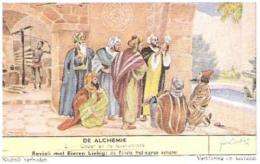
The Arabic chemist Geber is shown in his laboratory. Credit: "From Alchemy to Chemistry," by Arthur Greenberg, 2007, Wiley-Interscience

You've heard of Louis Pasteur and George Washington Carver, no doubt. And probably Joseph Priestley, one of the founders of modern chemistry. Names like Antoine Lavoisier, John Dalton, and Amadeo Avogadro may even bring a twinkle of recognition to the eye for their famous roles in establishing chemistry as a modern science.

But what about Muhammad ibn Zakariya al-Razi ("Rhazes")? Or Jabir ibn Hayyan ("Geber")? Or Abu Jusuf Yaqub ibn Ishaq al-Kindi. Huh?

"You should know them," Benjamin Huddle, Ph.D., declared in a report presented here today at the 238th National Meeting of the American Chemical Society. They're chemists from the Golden Age of Arabic-Islamic Science, which stretched from the 8th to the 13th centuries. During this era, science and medicine in Muslim countries — from southern Europe through North Africa to Central Asia and India — flourished and was unrivaled anywhere in the world. Muslim physicians and scientists made advancements that built the foundations for the emergence of modern science and medicine in Europe.

"Science in the early Muslim period is largely forgotten today in the Western world, or relegated to pseudo-science," Huddle said. "We are rediscovering the fact that from 750 to 1258 A.D. the best science in the world was being done by Arabic-speaking peoples. In we use language from the Arabs, apparatus and techniques, many chemicals (especially perfumes), and many materials."

Huddle did his research on the Golden Age, which produced a portrait of Arabic-Islamic love for learning and reverence for education and knowledge that defies popular modern stereotypes. His ACS abstract, non-technical summary, and contact information appear below.

Source: American Chemical Society (news : web)


print this article email this article download pdf blog this article bookmark this article     Stumble it Digg this share on Facebook retweet share on Reddit add to delicious
Rate this story - 4.5 /5 (15 votes)

Rank Filter

Move the slider to adjust rank threshold, so that you can hide some of the comments.


Display comments: newest first

  • Doug_Huffman - Aug 17, 2009
    • Rank: not rated yet
    Now that's history! It was followed by cultural and technological decline.
  • croghan27 - Aug 17, 2009
    • Rank: not rated yet
    Would that our school spent more time on these scientists - the now demonized Iran protected ancient learning from the early Christians who considered everything God-given, and so burnt and destroyed the godlessness.

    Much like the much more sensible Christian Irish, who protected learning for hundred of years from the orthodoxy of the Roman church.
  • Birger - Aug 18, 2009
    • Rank: not rated yet
    It is interesting that the early intellectual tradition of the islamic countries succumbed to a two-front assault, from both fundamentalists (which corrupt rulers tend to support to get an excuse for repressing new ideas) and mysticists (sufi and others). Today, the west has plenty of both.....

August 17, 2009 all stories

Comments: 3

4.5 /5 (15 votes)
  • Stumble this up

  • Digg this

  • share this

  • hide
  • Related Stories


  • hide
  • Relevant PhysicsForums posts

Other News

Researcher: Faint writing seen on Shroud of Turin (AP)

Researcher: Faint writing seen on Shroud of Turin (Update)

Other Sciences / Archaeology & Fossils

created Nov 20, 2009 | popularity 2.3 / 5 (35) | comments 52

(AP) -- A Vatican researcher has rekindled the age-old debate over the Shroud of Turin, saying that faint writing on the linen proves it was the burial cloth of Jesus. Experts say the historian may be reading ...


Climate change could boost incidence of civil war in Africa

Other Sciences / Social Sciences

created Nov 23, 2009 | popularity 2.4 / 5 (16) | comments 10

Climate change could increase the likelihood of civil war in sub-Saharan Africa by over 50 percent within the next two decades, according to a new study led by a team of researchers at University of California, Berkeley, ...


Explained: The Discrete Fourier Transform

Explained: The Discrete Fourier Transform

Other Sciences / Mathematics

created Nov 25, 2009 | popularity 4.1 / 5 (27) | comments 8

(PhysOrg.com) -- In 1811, Joseph Fourier, the 43-year-old prefect of the French district of Isčre, entered a competition in heat research sponsored by the French Academy of Sciences. The paper he submitted ...


Political views may skew perception of skin tone, new study finds

Other Sciences / Social Sciences

created Nov 24, 2009 | popularity 3.6 / 5 (5) | comments 7

(PhysOrg.com) -- Political affinity could influence how some people view the skin tone of biracial political candidates, according to a new study from the University of Chicago Booth School of Business, New York University ...


Museum: Galileo's fingers, tooth are found (AP)

Museum: Galileo's fingers, tooth are found

Other Sciences / Archaeology & Fossils

created Nov 21, 2009 | popularity 4 / 5 (5) | comments 7

(AP) -- Two fingers and a tooth removed from Galileo Galilei's corpse in a Florentine basilica in the 18th century and given up for lost have been found again and will soon be put on display, an Italian museum ...