Researchers find genetic link between physical pain and social rejection
August 17, 2009
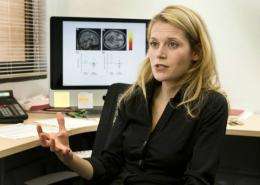
Naomi Eisenberger
(PhysOrg.com) -- UCLA psychologists have determined for the first time that a gene linked with physical pain sensitivity is associated with social pain sensitivity as well.
Their study indicates that variation in the mu-opioid receptor gene (OPRM1), often associated with physical pain, is related to how much social pain a person feels in response to social rejection. People with a rare form of the gene are more sensitive to rejection and experience more brain evidence of distress in response to rejection than those with the more common form.
The research was published Aug. 14 in the early online edition of Proceedings of the National Academy of Sciences and will appear in the print version in the coming weeks.
The findings give weight to the common notion that rejection "hurts" by showing that a gene regulating the body's most potent painkillers — mu-opioids — is involved in socially painful experiences too, said study co-author Naomi Eisenberger, UCLA assistant professor of psychology and director of UCLA's Social and Affective Neuroscience Laboratory.
In the study, researchers collected saliva samples from 122 participants to assess which form of the OPRM1 gene they had and then measured sensitivity to rejection in two ways. First, participants completed a survey that measured their self-reported sensitivity to rejection. They were asked, for example, how much they agreed or disagreed with statements like "I am very sensitive to any signs that a person might not want to talk to me."
Next, a subset of this group, 31 participants, was studied using functional magnetic resonance imaging (fMRI) at UCLA's Ahmanson-Lovelace Brain Mapping Center during a virtual ball-tossing game in which participants were ultimately socially excluded. Subjects were told that they would be connected over the Internet with two other players who were also in fMRI scanners and that they would all be playing the interactive ball-tossing game. In reality, however, participants were playing with a preset computer program, not other people.
Initially, participants were included in the activity but were then excluded when the two other "players" stopped throwing the ball to them.
"What we found is that individuals with the rare form of the OPRM1 gene, who were shown in previous work to be more sensitive to physical pain, also reported higher levels of rejection sensitivity and showed greater activity in social pain-related regions of the brain — the dorsal anterior cingulate cortex and anterior insula — in response to being excluded," Eisenberger said.
The dorsal anterior cingulate cortex and anterior insula are brain regions often associated with the distress of physical pain. Previous research by Eisenberger and her colleagues has shown that these brain regions are also involved in the pain of social rejection.
"Although it has long been suggested that mu-opioids play a role in social pain — and there are convincing animal models that show this — this is the first human study to link this mu-opioid receptor gene with social sensitivity in response to rejection," Eisenberger said.
"These findings suggest that the feeling of being given the cold shoulder by a romantic interest or not being picked for a schoolyard game of basketball may arise from the same circuits that are quieted by morphine," said Baldwin Way, a UCLA postdoctoral scholar and the lead author on the paper.
Eisenberger argues that this overlap in the neurobiology of physical and social pain makes good sense.
"Because social connection is so important, feeling literally hurt by not having social connections may be an adaptive way to make sure we keep them," she said. "Over the course of evolution, the social attachment system, which ensures social connection, may have actually borrowed some of the mechanisms of the pain system to maintain social connections."
Source: University of California - Los Angeles
-
Rejection for $500, please: Money and its symbolic powers
Jul 15, 2009 |
not rated yet |
0
-
Sticks and stones: A new study on social and physical pain
Aug 27, 2008 |
not rated yet |
0
-
Handling rejection: New study sheds light on why it hurts
Dec 09, 2008 |
not rated yet |
0
-
Study shows that chronic grief activates pleasure areas of the brain
Jun 20, 2008 |
not rated yet |
0
-
Thinking the pain away?
Aug 24, 2005 |
not rated yet |
0
-
Engineers build first sub-10-nm carbon nanotube transistor
Feb 01, 2012 |
4.9 / 5 (30) |
30
-
Something old, something new: Evolution and the structural divergence of duplicate genes
Jan 31, 2012 |
4.6 / 5 (7) |
1
-
The hidden nanoworld of ice crystals: Revealing the dynamic behavior of quasi-liquid layers
Jan 30, 2012 |
5 / 5 (3) |
1
-
Stock market network reveals investor clustering
Jan 27, 2012 |
3.9 / 5 (23) |
8
-
Of microchemistry and molecules: Electronic microfluidic device synthesizes biocompatible probes
Jan 26, 2012 |
5 / 5 (1) |
0
-
Is Everyday Technology Killing Us?
Feb 08, 2012
-
Exercise and weight loss
Feb 08, 2012
-
Why do we have head aches? Our brains can't feel anything.
Feb 07, 2012
-
"The end of diseases" by David Agus, interview from Daily Show with Jon Stewart
Feb 04, 2012
-
Oncolytic adenovirus
Feb 04, 2012
-
Nutrition label stuffs and diets
Feb 02, 2012
- More from Physics Forums - Medical Sciences
More news stories
A novel method for simultaneously measuring blood pressure and arterial stiffness
Arterial stiffness due to is a major contributor to cardiovascular disease but is very difficult to measure. It also can influence blood pressure readings since these rely on the time taken for arteries to return to normal ...
37 minutes ago |
not rated yet |
0
India's global pharmacy role threatened by EU pact
(AP) -- Efforts by India and the European Union to strengthen trade are threatening India's ability to deliver lifesaving medicines to the world's poorest, analysts say as the two sides push through protracted ...
Medicine & Health / Medications
14 minutes ago |
not rated yet |
0
Metastatic breast cancer hitches a free ride from the immune system
Inflammatory breast cancer (IBC) is the most lethal form of breast cancer . It spreads easily through the lymphatic and blood vessels, forming metastasis which can lead to multi-organ failure. New research published in BioMed ...
14 minutes ago |
not rated yet |
0
Study finds that red blood cell transfusion decreases fatigue in women with acute postpartum anemia
In a study to be presented today at the Society for Maternal-Fetal Medicine's annual meeting, The Pregnancy Meeting , in Dallas, Texas, researchers will report findings that show that in women with acute postpartum ...
30 minutes ago |
not rated yet |
0
4.5 million Americans living with total knee replacement
New research presented at the 2012 Annual Meeting of the American Academy of Orthopaedic Surgeons (AAOS) found that more than 4.5 million Americans are living with a total knee replacement (TKR), as the number of TKR surgeries ...
22 minutes ago |
not rated yet |
0
Japan scientist makes 'Avatar' robot
A Japanese-developed robot that mimics the movements of its human controller is bringing the Hollywood blockbuster "Avatar" one step closer to reality.
Fighting crimes against biodiversity: How to catch a killer weed
Invasive species which have the potential to destroy biodiversity and influence global change could be tracked and controlled in the same way as wanted criminals, according to new research from Queen Mary, University of London.
US video game sales fall 34 percent in January
(AP) -- U.S. retail sales of video game hardware, software and accessories fell 34 percent in January from a year earlier to $751 million due to the lack of new game titles, according to market researcher NPD Group.
Study weighs risks and benefits of birthing facilities
In a study to be presented today at the Society for Maternal-Fetal Medicine's annual meeting, The Pregnancy Meeting , in Dallas, Texas, researchers will report findings that indicate that the risk of obstetric intervention ...
Study finds in women with prior cesarean, optimal gestational age for elective delivery is week 39
In a study to be presented today at the Society for Maternal-Fetal Medicine's annual meeting, The Pregnancy Meeting, in Dallas, Texas, researchers will report findings that indicate that for women with prior delivery via ...
Study finds preterm labor diagnostic markers not universal, diagnosis and interventions should not be generalized
In a study to be presented today at the Society for Maternal-Fetal Medicine's annual meeting, The Pregnancy Meeting, in Dallas, Texas, researchers will report findings that indicate that preterm birth interventions should ...