First discovery of life's building block in comet made
August 17, 2009 by Bill Steigerwald
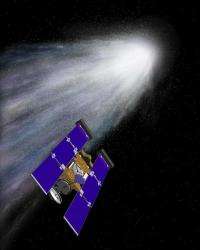
This is an artist's concept of the Stardust spacecraft beginning its flight through gas and dust around comet Wild 2. The white area represents the comet. The collection grid is the tennis-racket-shaped object extending out from the back of the spacecraft. Credit: NASA JPL
(PhysOrg.com) -- NASA scientists have discovered glycine, a fundamental building block of life, in samples of comet Wild 2 returned by NASA's Stardust spacecraft.
"Glycine is an amino acid used by living organisms to make proteins, and this is the first time an amino acid has been found in a comet," said Dr. Jamie Elsila of NASA's Goddard Space Flight Center in Greenbelt, Md. "Our discovery supports the theory that some of life's ingredients formed in space and were delivered to Earth long ago by meteorite and comet impacts."
Elsila is the lead author of a paper on this research accepted for publication in the journal Meteoritics and Planetary Science. The research will be presented during the meeting of the American Chemical Society at the Marriott Metro Center in Washington, August 16.
"The discovery of glycine in a comet supports the idea that the fundamental building blocks of life are prevalent in space, and strengthens the argument that life in the universe may be common rather than rare," said Dr. Carl Pilcher, Director of the NASA Astrobiology Institute which co-funded the research.
Proteins are the workhorse molecules of life, used in everything from structures like hair to enzymes, the catalysts that speed up or regulate chemical reactions. Just as the 26 letters of the alphabet are arranged in limitless combinations to make words, life uses 20 different amino acids in a huge variety of arrangements to build millions of different proteins.
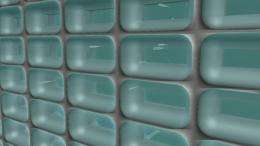
This is an artist's concept of particle hits on the aerogel collection grid. The greenish areas represent the aerogel. Hits are the light green teardrop-shaped areas. Particles are represented by dots at the tips of the teardrops. Credit: NASA/JPL
Stardust passed through dense gas and dust surrounding the icy nucleus of Wild 2 (pronounced "Vilt-2") on January 2, 2004. As the spacecraft flew through this material, a special collection grid filled with aerogel - a novel sponge-like material that's more than 99 percent empty space - gently captured samples of the comet's gas and dust. The grid was stowed in a capsule which detached from the spacecraft and parachuted to Earth on January 15, 2006. Since then, scientists around the world have been busy analyzing the samples to learn the secrets of comet formation and our solar system's history.
"We actually analyzed aluminum foil from the sides of tiny chambers that hold the aerogel in the collection grid," said Elsila. "As gas molecules passed through the aerogel, some stuck to the foil. We spent two years testing and developing our equipment to make it accurate and sensitive enough to analyze such incredibly tiny samples."
Earlier, preliminary analysis in the Goddard labs detected glycine in both the foil and a sample of the aerogel. However, since glycine is used by terrestrial life, at first the team was unable to rule out contamination from sources on Earth. "It was possible that the glycine we found originated from handling or manufacture of the Stardust spacecraft itself," said Elsila. The new research used isotopic analysis of the foil to rule out that possibility.
Isotopes are versions of an element with different weights or masses; for example, the most common carbon atom, Carbon 12, has six protons and six neutrons in its center (nucleus). However, the Carbon 13 isotope is heavier because it has an extra neutron in its nucleus. A glycine molecule from space will tend to have more of the heavier Carbon 13 atoms in it than glycine that's from Earth. That is what the team found. "We discovered that the Stardust-returned glycine has an extraterrestrial carbon isotope signature, indicating that it originated on the comet," said Elsila.
The team includes Dr. Daniel Glavin and Dr. Jason Dworkin of NASA Goddard. "Based on the foil and aerogel results it is highly probable that the entire comet-exposed side of the Stardust sample collection grid is coated with glycine that formed in space," adds Glavin.
"The discovery of amino acids in the returned comet sample is very exciting and profound," said Stardust Principal Investigator Professor Donald E. Brownlee of the University of Washington, Seattle, Wash. "It is also a remarkable triumph that highlights the advancing capabilities of laboratory studies of primitive extraterrestrial materials."
More information: To learn more about the mission, visit http://stardustnex … pl.nasa.gov/ .
Source: NASA/Goddard Space Flight Center
-
UW astronomer hits cosmic paydirt with Stardust
Jan 18, 2006 |
not rated yet |
0
-
Stardust Finds A Gem Of A Space Particle
Feb 28, 2006 |
not rated yet |
0
-
Stardust Logs A Decade Under The Stars
Feb 09, 2009 |
not rated yet |
0
-
NASA Prepares For Arrival Of Comet Samples To Houston
Oct 17, 2005 |
not rated yet |
0
-
NASA Stardust Capsule To Go On Display At Smithsonian
Sep 26, 2008 |
not rated yet |
0
-
Engineers build first sub-10-nm carbon nanotube transistor
Feb 01, 2012 |
4.9 / 5 (30) |
30
-
Something old, something new: Evolution and the structural divergence of duplicate genes
Jan 31, 2012 |
4.6 / 5 (7) |
1
-
The hidden nanoworld of ice crystals: Revealing the dynamic behavior of quasi-liquid layers
Jan 30, 2012 |
5 / 5 (3) |
1
-
Stock market network reveals investor clustering
Jan 27, 2012 |
3.9 / 5 (23) |
8
-
Of microchemistry and molecules: Electronic microfluidic device synthesizes biocompatible probes
Jan 26, 2012 |
5 / 5 (1) |
0
-
Titan's lack of impact craters
22 hours ago
-
Real pictures of black hole eating a star?
Feb 08, 2012
-
Hypothetical way to travel faster than light, but not technically exceed lightspeed
Feb 06, 2012
-
How do scientists monitor the Sun's activity?
Feb 05, 2012
-
Search patterns in observational studies
Feb 05, 2012
-
Derivation of Pogson's law
Feb 03, 2012
- More from Physics Forums - General Astronomy
More news stories
Clam fields found at deep, low-temperature Mariana vents
(PhysOrg.com) -- Scientists have marveled at the unusual life forms thriving at high temperature hydrothermal vents of the deep ocean.
Space & Earth / Earth Sciences
48 minutes ago |
not rated yet |
0
|
Could Venus be shifting gear?
(PhysOrg.com) -- ESAs Venus Express spacecraft has discovered that our cloud-covered neighbour spins a little slower than previously measured. Peering through the dense atmosphere in the infrared, the ...
Space & Earth / Space Exploration
16 minutes ago |
5 / 5 (1) |
0
|
Streams need trees to withstand climate change
(PhysOrg.com) -- More than twenty years of biological monitoring have confirmed the importance of vegetation for protecting Australia's freshwater streams and rivers against the ravages of drought and climate ...
57 minutes ago |
not rated yet |
0
The turbulent birth of super star clusters in galaxy mergers
By combining two of the most advanced telescopes in the world -- the new Atacama Large Millimeter Array (ALMA) and the Very Large Telescope (VLT) of ESO -- a team of French astronomers from the Institut d'astrophysique ...
39 minutes ago |
not rated yet |
0
What does a nebula sound like?
What do things sound like out in the cosmos? Of course, sound waves cant travel through the vacuum of space; however, electromagnetic waves can. These electromagnetic waves can be recorded by devices called spectrographs ...
Space & Earth / Space Exploration
23 minutes ago |
5 / 5 (1) |
0
Seeing colors in music, tasting flavors in shapes may happen in life's early months
Famed violinist Itzhak Perlman sees a deep forest green whenever he plays a B-flat on his Stradivarius' G string. The A on the E string is red.
Is that sleepiness during pregnancy normal or a sign of sleep apnea?
(Medical Xpress) -- Most pregnant women complain of being tired. Some of them however, could be suffering more than normal fatigue associated with their pregnancy; they may have developed obstructive sleep apnea (OSA), a ...
Engineering images bring life to submerged city
(PhysOrg.com) -- Photo-realistic 3D mapping and digital reconstruction of an ancient underwater city in Greece have earned a team from the University of Sydney's Faculty of Engineering and Information Technologies ...
Numeracy: The educational gift that keeps on giving?
(Medical Xpress) -- Cancer risks. Investment alternatives. Calories. Numbers are everywhere in daily life, and they figure into all sorts of decisions. A new article published in Current Directions in Psychological Science, a journal of the Association for Psychological Science, examin ...
New power source discovered
(PhysOrg.com) -- Researchers at the Massachusetts Institute of Technology (MIT) and RMIT University have made a breakthrough in energy storage and power generation.
Measurements from high-energy collisions lead to better understanding of why meson particles disappear
For several years, physicists at the Relativistic Heavy Ion Collider (RHIC) at Brookhaven National Laboratory (BNL), USA, have studied an unusual state of matter called the quarkgluon plasma, which they ...

Aug 17, 2009
Rank: 1.5 / 5 (6)
AT THE BIRTH OF THE SOLAR SYSTEM
One of the mysteries of the early solar system is the process that separated d- and l-amino acids.
The question is whether this was initiated by PPL (circular polarized light) from the pulsar remnant of the supernova that gave birth to the solar system. See: "The origin, composition, and energy source for the Sun," http://arxiv.org/...411255v1
With kind regards,
Oliver K. Manuel
http://www.omatumr.com
Aug 17, 2009
Rank: 1 / 5 (1)
"aerogel - a novel sponge-like material". Yeah, novel. It was only invented 75 years ago.
Aug 17, 2009
Rank: 1 / 5 (5)
The question is whether the separation of d- and l-amino acids was initiated by CPL (circular polarized light) from the pulsar remnant of the supernova that gave birth to the solar system. See: "The origin, composition, and energy source for the Sun," 32nd Lunar & Planetary Science Conference, March 2001 http://tinyurl.com/peglnx
With kind regards,
Oliver K. Manuel
http://www.omatumr.com
Aug 18, 2009
Rank: not rated yet
This discovery is not by any means the first
The Murchison meteorite in September 1969 named after an Australian town north of Melbourne was found to have seventy four types of amino acids, 8 of which were known to be involved with the formation of earthly protiens. This was announced in 2001 by Ames Research Centre in California.
Aug 18, 2009
Rank: 2 / 5 (5)
That's like saying we found aluminium in some rock, so can a space shuttle be far behind? The same goes double for the discovery of water outside the s. syst. Evolutionists equate liquid water anywhere with a *probable* advanced civilization, and maybe they have an intergalactic organization we can join . . . and maybe . . . .
Aug 18, 2009
Rank: 2.5 / 5 (2)
Aug 18, 2009
Rank: 2 / 5 (4)
Aug 18, 2009
Rank: 5 / 5 (1)
Aug 19, 2009
Rank: 3.7 / 5 (3)
Nothing incredible about it. It is just a statement regarding the odds of life on other planets. If the resources are everywhere the odds go up.
Life is not a space shuttle. It grows and evolves it isn't built. So the metaphor is bogus.
Interesting the way you invent Straw Men to attack. It looks like you are aware that you don't have reason behind you. I have yet to see anyone, except YOU, claim that liquid water equals high probability for an advanced civ.
Our planet had liquid water for billions of years and advanced civilization only recently. Assuming our civ counts as advanced. We have yet to establish human life of the Earth much less outside the Solar System so I don't count it as advanced yet. We are still subject to inhalation via global disaster.
Ethelred
Sorry for the new signature. But It Needed Killun.
From QubitTamer's fake profile
Qubitwit gets the rest of August in my signature for aiming his idiocy at me. Again.
Aug 19, 2009
Rank: 2 / 5 (4)
Aug 20, 2009
Rank: 3.7 / 5 (3)
No, you have shown what is well known already by most here, at best. That is, that how life began is not understood yet. Yet is the key word. It is possible that it will never be known even in principle but there is no reason to suppose that as of the moment. That we will never know all the details is certain since the evidence was eaten by the descendants of whatever started life off. This does not in any way mean that there is no way to understand how things COULD have happened.
As for Shapiro he doesn't agree with your claim that we will stay at square one. Not even sure that he thinks we are at square one.
http://www.scient...for-life
That does not follow from what preceded. In other words you made it up.
You clearly didn't understand what he was talking about. He was proposing that a quantum computer could do the calculations for simulations for how life began in a reasonable length of time.
Programming the thing has to come after the thing is invented. Doesn't actually have to be built to start programming just designed. It has been done that way once before. Ada, the daughter of Lord Byron wrote programs for Babbage's Difference Engine and that was never built just designed.
Sounds a bit like you. Are you ever going to answer ANY question I ask of you, or even reply in any way at all. For instance I asked if you are a Young Earth or an Old Earth Creationist. Or do you just follow the Discovery Institutes dictate to NEVER discuss what YOU think and only invent controversies?
Ethelred
Sorry for the new signature. But It Needed Killun.
From QubitTamer's fake profile
Qubitwit gets the rest of August in my signature for aiming his idiocy at me. Again.
Aug 26, 2009
Rank: 1 / 5 (2)
A. "Comet dust harbors life's building blocks"
http://www.scienc...g_blocks
Samples collected from a comet%u2019s halo suggest comets could have carried amino acids - building block of proteins - to the early Earth...
B. Proteins NOT early life's building blocks
Proteins have nothing to do with the initiation and evolution of early Earth's life, the biosphere. RNA's, followed with DNA's, were "life's building blocks", the constituents of the early independent genes, Earth's primal organisms.
Earliest and present primary Earth life are, obviously and commonsensibly, and therefore scientifically, genes. Plain and simple. All other organisms, regardless of complexity, are take-offs of genes. Early life was formed and maintained with DIRECT sunlight. Hence ubiquitous life sleep. Biometabolism, dependence of life on INDIRECT sunlight energy, was a very late phase of Earth's life evolution.
See "Updated Life's Manifest May 2009"
http://www.the-sc...age#2321
Dov Henis
(Comments From The 22nd Century)
Aug 26, 2009
Rank: 5 / 5 (1)
Probably wrong. It IS likely that proteins were involved in the beginning of life. Possibly in combination with RNA. DNA had to come after RNA as it can do nothing on its own. Ribosomes are a mix of RNA and proteins and are clearly one of the oldest remaining parts of life on Earth.
Now that it is even less likely. Genes are in DNA and DNA could not have been first as, again, it cannot do anything on its own.
Here is the link that Mabarker is ignoring. I found it interesting. Might even be right.
http://www.scient...for-life
Ethelred
Sorry for the new signature. But It Needed Killun.
From QubitTamer's fake profile
Qubitwit gets the rest of August in my signature for aiming his idiocy at me. Again.