Newly discovered mechanism in cell division has implications for chromosome's role in cancer
"A biologist, a physicist, and a nanotechnologist walk into a..." sounds like the start of a joke. Instead, it was the start of a collaboration that has helped to decipher a critical, but so far largely unstudied, phase of how cells divide. Errors in cell division can cause mutations that lead to cancer, and this study could shed light on the role of chromosome abnormalities in uncontrolled cell replication.
The biologist in question is University of Pennsylvania School of Medicine Associate Professor of Cell and Developmental Biology, Phong Tran, PhD. With physicist Francois Nedelec of the European Molecular Biology Laboratory in Heidelberg, Germany, and Guilhem Velve-Casquillas, PhD, a postdoc in Tran's lab who helped develop a device requiring nano-scale technology used in the study, Tran uncovered the molecular players and mechanism underlying a little-studied stage of cellular division called Anaphase B.
Anaphase B is just one part of the complex molecular choreography that is cell division. The process is akin to two children dividing up their Halloween candy: collect your candy, pile it in the middle, and divide it into two equal portions.
In cell division - the creation of two daughter cells from one -- it is the doubled chromosomes that are piled in the middle to be sorted. The cell condenses the chromosomes, arranges them at the midpoint of the dividing cell, sends half to either end of the cell, and then forms a new cell membrane around each pool. Anaphase is the step in cellular division during which the chromosomes physically separate and are dragged to either end of the cell. And it's during this coming together and pulling apart of the chromosomes that such mistakes as breakages and uneven sorting can lead to cancerous mutations.
The physical structure that both organizes and facilitates the steps of Anaphase is the spindle, and it is comprised of molecular struts called microtubules, as well as microtubule-associated proteins, or MAPs, and molecular motors, which provide the required physical force to move chromosomes. From fixed points called spindle poles, at either end of the cell, microtubules extend towards the midline of the cell, some capturing and positioning chromosomes at the midline, others reaching further to overlap with microtubules originating from the other side of the cell. What happens next - Anaphase -- is actually two discrete processes. During Anaphase A, the chromosome-associated microtubules drag the chromosomes towards either spindle pole; Anaphase B occurs as the overlapping microtubules at the midzone move past one another to physically push the spindle poles apart.
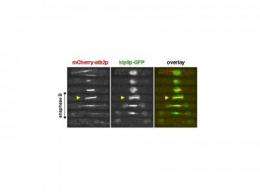
In the August 14 issue of Developmental Cell, the team reports that a molecular motor protein called Klp9p and the microtubule-associated protein Ase1p form a complex and bind to the midzone of the spindle - a sort of molecular scaffold that ensures a critical step: equal division of genetic material between two daughter cells of cell division. They also found that this interaction is regulated by a molecular switch, which is coordinated by two other proteins Cdc2p and Clp1p.
"We now have a mechanism to describe Anaphase B, which was not well described up to now," Tran says.
Anaphase A, Tran notes, has been extensively studied. He wanted to understand what happens during Anaphase B. So his team, led by postdoctoral fellow Chuanhai Fu, PhD, began systematically mutating molecular motors in the fission yeast, Schizosaccharomyces pombe and then clocking each mutant's cell division. Only in cells containing mutant Klp9p was Anaphase B significantly slower. The team then showed that Klp9p and Ase1p come together at the midzone during Anaphase B and that this interaction is required for proper spindle architecture and function. What's more, this necessary Klp9p-Ase1p complex is blocked by Cdc2p. But, taking away phosphates from Klp9p and Ase1p by the other protein Clp1p just prior to Anaphase B releases the block, enabling the two proteins to form their complex so cellular division can continue.
"Many molecules have been implicated with the spindle midzone, but no details have been brought up in terms of molecular motors, microtubule-associated proteins, and their binding and regulation by the phosphate switch," Tran says. Now, however, "we have a very detailed and complete description of four molecules" -- Klp9p, Ase1p, Cdc2p, and Clp1p - each playing a role in one aspect of cellular division, Anaphase B."
The molecular machinery, Tran concludes, "is mechanically very beautiful."
According to Tran, the findings have potential implications for cancer biology, in that inappropriate chromosomal segregation can lead to aneuploidies (cells lacking the proper number of chromosomes), which is a hallmark of many cancers.
Source: University of Pennsylvania School of Medicine (news : web)


