Asia faces food shortage by 2050 without water reform
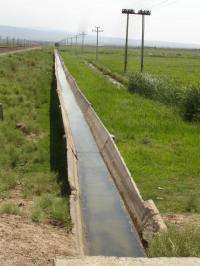
A comprehensive new study of irrigation in Asia warns that, without major reforms and innovations in the way water is used for agriculture, many developing nations face the politically risky prospect of having to import more than a quarter of the rice, wheat and maize they will need by 2050.
This warning, along with related forecasts and possible solutions, appear in a report entitled, "Revitalizing Asia's Irrigation: To Sustainably Meet Tomorrow's Food Needs", which was presented today at 2009 World Water Week in Stockholm by the International Water Management Institute (IWMI). IWMI, FAO and partner researchers obtained the findings using a computer model called WATERSIM, which helps examine difficult tradeoffs between food security and the environment, specifically in relation to water supplies.
The study was carried out by IWMI and the United Nations Food and Agriculture Organization (FAO) along with researchers from partner organizations with funding from the Asian Development Bank (ADB). It outlines three options for meeting the food needs of Asia's population, which will expand by one and a half billion people over the next 40 years. The first is to import large quantities of cereals from other regions; the second to improve and expand rainfed agriculture; and the third to focus on irrigated farmlands.
"In the wake of a major global food crisis in 2007 and 2008, cereal prices are expected to be higher and more volatile in the coming years," said Colin Chartres, director general of IWMI, whose research is supported by the Consultative Group on International Agricultural Research (CGIAR). "Asia's food and feed demand is expected to double by 2050. Relying on trade to meet a large part of this demand will impose a huge and politically untenable burden on the economies of many developing countries. The best bet for Asia lies in revitalizing its vast irrigation systems, which account for 70 percent of the world's total irrigated land."
Asian agriculture registered dramatic advances during the 1960s and 1970s through a combination of irrigation, improved crop varieties and fertilizers. The resulting Green Revolution made it possible to avert widespread hunger and raise living standards. From 1970 to 1995, the area under irrigation in Asia more than doubled, according to the IWMI-FAO report, making this the world's most intensively irrigated continent.
"Today, the option of expanding irrigated land area in Asia to feed a growing population is becoming increasingly problematic due to land or water constraints," explained Aditi Mukherji, IWMI scientist and one of the lead authors of the report.
To meet expected cereal demand by 2050, IWMI's projections show that, with present trends of yield growth, we would have to increase by 30 percent the amount of irrigated farmland in South Asia, and 47 percent in East Asia. Without water productivity gains South Asia would need 57 percent more water for irrigated agriculture and East Asia 70 percent more. Given the existing scarcity of land and water, and growing water needs of cities, such a scenario is untenable. This clearly points to a need for dramatic increases in water productivity, which can only be achieved with a complete revitalization of irrigation infrastructure, management and policy.
The scenarios presented in the IWMI-FAO report do not factor in climate change, which will likely make rainfall more erratic and increase the strain on already overstretched irrigation systems. As a result, even the study's pessimistic assumptions may prove overly optimistic, according to modeling experts.
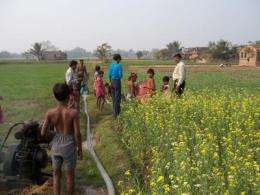
The potential for improvement is particularly great in South Asia, where more than half of the harvested area is irrigated yet yields are low. Asia as a whole could obtain as much as three-quarters of the additional food it will need by improving the performance of irrigated crop production, and South Asia could satisfy all of its additional demand.
"Another option is to shift more land to rainfed farming," said Mukherji. "But the scope for expansion is extremely limited."
In South Asia, for example, 94 percent of the land suitable for farming is already in production. As a consequence, significant expansion of rainfed farming would come largely at the expense of fragile marginal areas with high environmental costs in terms of biodiversity loss and greenhouse gas emissions.
In the report, IWMI and FAO propose a comprehensive and innovative strategy to improve the performance of Asia's irrigated agriculture. "This involves a comprehensive transition from outdated models, technologies and institutions to a more economically sustainable, service-oriented approach," said Thierry Facon, FAO's senior irrigation expert.
The key element of the strategy is to modernize the region's large-scale irrigation systems, which were built to rely on surface water. Constructed throughout much of Asia in the 1970s and 1980s, these systems are currently in poor condition. As cereal prices declined during the period of infrastructure expansion, investments in irrigation became less attractive. Furthermore, agriculture diversified toward high-value crops, such as vegetables and fruits, which required more flexible approaches to irrigation.
A recent project in Sri Lanka, which takes into account lessons learned from many years of experience, offers a model for improving irrigation management. It combines the best of traditional and new technologies in schemes referred to locally as "village tank cascade systems."
Another critical measure is to selectively support rather than thwart the trend toward individual farmers' use of inexpensive pumps to extract groundwater for irrigation. In India, an estimated 19 million such pumps are providing water for more than 60 percent of the nation's total irrigated area. South Asia as a whole uses about 250 cubic kilometers of groundwater annually, accounting for almost half the world's total groundwater use.
"Governments' inability to regulate this practice is giving rise to scary scenarios of groundwater over-exploitation, which could lead to regional food crises and widespread social unrest," said Tushaar Shah of IWMI and a co-author of the report. "Rather than condemn such a widespread practice, governments should actively support innovative initiatives."
Another important component of the IWMI-FAO strategy is to involve the private sector more actively in publicly managed irrigation systems. Positive experiences in China and elsewhere attest to the potential of that approach.
"Irrigation and the water sector more generally have direct links with energy, trade, labor and other sectors that are crucial to Asia's larger political economy," Shah added. "To address challenges of food security and water management, we must look beyond the irrigation sector for solutions."
Source: IWMI


