Honey-bee aggression study suggests nurture alters nature
August 17, 2009
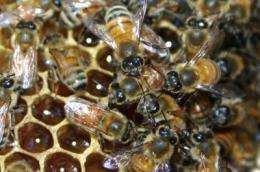
The study looked at bee aggression in European (pictured) and Africanized honey bees. Credit: Photo by Diana Yates.
A new study reveals that changes in gene expression in the brain of the honey bee in response to an immediate threat have much in common with more long-term and even evolutionary differences in honey-bee aggression. The findings lend support to the idea that nurture (an organism's environment) may ultimately influence nature (its genetic inheritance).
The study, appearing this week in the Proceedings of the National Academy of Sciences, used microarray analysis to measure changes in gene expression in the brains of European honey bees and the much more aggressive Africanized honey bees. Microarrays offer a snapshot of the thousands of genes that are activated at a given point in time. By comparing microarrays of bees in different environmental and social conditions, the researchers were able to look for patterns of gene expression that coincided with aggression.
Honey bees respond aggressively only if their hive is disturbed. But when disturbed they mount a vigorous defense - the all too familiar bee sting. The researchers observed that changes that occur in the brain of a European honey bee after it is exposed to alarm pheromone (a chemical signal that the hive is in danger) look a lot like the more gradual changes that occur over the bee's lifetime. (Old bees are more aggressive than young bees.)
Even more striking was the finding of a very similar pattern of brain gene expression in Africanized honey bees. In terms of brain gene expression, Africanized bees "look" like they were just exposed to a whiff of alarm pheromone, even though they weren't.
"Microarray analysis is revealing large-scale gene expression patterns that are giving us new insights into the relationships between genes and social behavior," said Gene Robinson, a professor of neuroscience and of entomology at the University of Illinois, who led the study. "Some of the same genes associated with aggression that vary due to heredity also vary due to environment. This shows how nature and nurture both act on the genome, which provides an alternative to the old 'nature versus nurture' dichotomy."
The new findings may begin to explain how the evolutionary diversity of behavioral traits is achieved, he said.
"We suggest that the molecular processes underlying environmental effects on aggression - that is, responsiveness to alarm pheromone - could have evolved into molecular processes underlying inherited differences in aggression exhibited by Africanized honey bees and European honey bees - nurture begets nature," the authors wrote.
The study was made possible by a National Science Foundation Frontiers in Biological Research grant, led by University of Illinois medical information science professor and department head Bruce Schatz, who is also an affiliate of the Institute for Genomic Biology.
"The study is one of the most exciting to emerge yet from 'BeeSpace,' an NSF-sponsored project which is the first of its kind to use genomics and new bioinformatics on a massive scale to understand how nature and nurture influence behavior," Schatz said.
Source: University of Illinois at Urbana-Champaign (news : web)
-
Honey bee genome holds clues to social behavior
Oct 23, 2006 |
not rated yet |
0
-
Social interactions can alter gene expression in the brain, and vice versa
Nov 06, 2008 |
not rated yet |
0
-
Honey bee chemoreceptors found for smell and taste
Oct 25, 2006 |
not rated yet |
0
-
Honey bee invaders exploit the genetic resources of their predecessors
Feb 25, 2008 |
not rated yet |
0
-
Greek experts look out for lost honey bees
Jan 28, 2008 |
not rated yet |
0
-
Engineers build first sub-10-nm carbon nanotube transistor
Feb 01, 2012 |
4.9 / 5 (30) |
30
-
Something old, something new: Evolution and the structural divergence of duplicate genes
Jan 31, 2012 |
4.6 / 5 (7) |
1
-
The hidden nanoworld of ice crystals: Revealing the dynamic behavior of quasi-liquid layers
Jan 30, 2012 |
5 / 5 (3) |
1
-
Stock market network reveals investor clustering
Jan 27, 2012 |
3.9 / 5 (23) |
8
-
Of microchemistry and molecules: Electronic microfluidic device synthesizes biocompatible probes
Jan 26, 2012 |
5 / 5 (1) |
0
-
Any books/articles for evolutionary stable strategy models in humans?
7 hours ago
-
Science behind the bore feeling?
13 hours ago
-
Homo Sapien vs. Chimpanzee - Divergence Timeline
18 hours ago
-
a single mRNA strand is attached to sevaral ribosomes?
Feb 08, 2012
-
Oestrogen and FSH
Feb 07, 2012
-
Linear Blood Vessel Network Examples in Animals or Plants
Feb 07, 2012
- More from Physics Forums - Biology
More news stories
Ultraviolet protection molecule in plants yields its secrets
Lying around in the sun all day is hazardous not just for humans but also for plants, which have no means of escape. Ultraviolet (UV) radiation from the sun can damage proteins and DNA inside cells, leading ...
3 hours ago |
5 / 5 (3) |
0
|
Deadly bird parasite evolves at exceptionally fast rate
A new study of a devastating bird disease that spread from poultry to house finches in the mid-1990s reveals that the bacteria responsible for the disease evolves at an exceptionally fast rate. What's more, ...
2 hours ago |
5 / 5 (2) |
0
|
Decoding the molecular machine behind E. coli and cholera
Scientists from Queen Mary, University of London have discovered the workings behind some of the bacteria that kill hundreds of thousands every year, possibly paving the way for new antibiotics that could treat infections ...
2 hours ago |
not rated yet |
0
|
New research reveals why fishermen keep fishing despite dwindling catches
Half of fishermen would not give up their livelihood in the face of drastically declining catches according to research led by the University of East Anglia (UEA).
2 hours ago |
not rated yet |
0
WWF urges banks to block Sakhalin oil plan and save whales
Environment group WWF on Thursday urged three European banks to block Russian giant Sakhalin Energy's plan to build an oil drilling platform that the group claims could harm the endangered grey whale.
1 hour ago |
not rated yet |
0
Cannabis use doubles chances of vehicle crash
Drivers who consume cannabis within three hours of driving are nearly twice as likely to cause a vehicle collision as those who are not under the influence of drugs or alcohol claims a paper published today in the British ...
Study says children of women exposed to chemotherapy in pregnancy develop as well as other children
A study published Online First by The Lancet Oncology, and linked to The Lancet Series on cancer in pregnancy, shows that children of women exposed to chemotherapy while pregnant develop as well as children in the genera ...
Current trend is to preserve pregnancy in patients diagnosed with cervical or ovarian cancer
The first paper in The Lancet Series on cancer in pregnancy explores the issues around gynaecological cancers, with cervical and ovarian being the most common. The current trend is to preserve pregnancy wherever possible. The fi ...
Surgery and chemotherapy are possible for pregnant women with breast cancer
Breast cancer in pregnant women is as common as in non-pregnant women of the same age, with no evidence to suggest pregnancy increases the risk of such cancer. In the majority of cases, pregnant women can have their breast ...
Complications of blood cancers make termination advisable at early stages of pregnancy
Lymphoma is the fourth most common cancer in pregnancy, affecting one in 6000 pregnancies. Non-Hodgkin lymphoma, acute leukaemia, and other blood cancers, while also rare, can also occur in pregnancy. The need for urgent ...
'Dark plasmons' transmit energy
Microscopic channels of gold nanoparticles have the ability to transmit electromagnetic energy that starts as light and propagates via "dark plasmons," according to researchers at Rice University.