NASA's WISE Mission Arrives at Launch Site
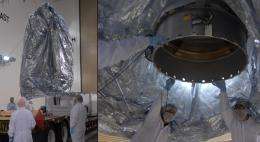
August 17, 2009 NASA's WISE Mission Arrives at Launch Site

Enlarge

WISE arrives at Vandenberg Air Force Base. Credit: NASA

(PhysOrg.com) -- NASA's Wide-field Infrared Survey Explorer, or WISE, has arrived at its last stop on Earth -- Vandenberg Air Force Base, Calif.

WISE is scheduled to blast into space in December, aboard a United Launch Alliance Delta II rocket from NASA's Space Launch Complex 2. Orbiting around Earth, it will scan the entire sky at infrared wavelengths, unveiling hundreds of thousands of asteroids, and hundreds of millions of stars and .

The spacecraft arrived at Vandenberg along the central California coast today, after a winding journey via truck from Ball Aerospace & Technologies Corporation in Boulder, Colo. Ball built the mission's spacecraft; its telescope and science instrument were built by Space Dynamics Laboratory in Logan, Utah.

"WISE has arrived and is almost ready to go," said William Irace, the mission's project manager at NASA's Jet Propulsion Laboratory, Pasadena, Calif. "After we check the out and fill the telescope cooling tanks with solid hydrogen, we'll mate it to the rocket and launch."

WISE is an infrared space telescope like two currently orbiting missions, NASA's Spitzer Space Telescope and the Herschel Space Observatory, a European Space Agency mission with important participation. But, unlike these missions, WISE will survey the entire sky. It is designed to cast a wide net to catch all sorts of unseen cosmic treasures. Millions of images from the survey will serve as rough maps for other observatories, such as Spitzer and NASA's upcoming James Webb , guiding them to intriguing targets.

"WISE will survey the cosmic landscape in the infrared so that future telescopes can home in on the most interesting 'properties,'" said Edward Wright, the principal investigator for the mission at UCLA.

The infrared surveyor will pick up the heat from a cornucopia of objects, both near and far. It will find hundreds of thousands of new asteroids in our main belt, and hundreds of near-Earth objects, which are comets and asteroids with orbits that pass relatively close to Earth. The mission will uncover the coldest stars, called brown dwarfs, perhaps even one closer to us than our closest known neighbor, Proxima Centauri, which is 4 light-years away. More distant finds will include nurseries of , swirling planet-building disks and the universe's most luminous galaxies billions of light-years away.

The data will help answer fundamental questions about how solar systems and galaxies form, and will provide the astronomical community with mountains of data to mine.

"WISE will create a legacy that endures for decades," said Peter Eisenhardt, the mission's project scientist at JPL. "Today, we still refer to the catalogue of our predecessor, the Infrared Astronomical Satellite, which operated in 1983."

The Infrared Astronomical Satellite was a joint infrared survey mission between NASA, the United Kingdom and the Netherlands. WISE's survey, thanks to next-generation technology, will be hundreds of times more sensitive.

The mission will scan the sky from a sun-synchronous orbit, 500 kilometers (about 311 miles) above Earth. After a one-month checkout period, it will map the whole sky over a period of six months. Onboard frozen hydrogen, which will cool the infrared detectors, is expected to last several months longer, allowing WISE to map much of the sky a second time and see what has changed.

Provided by JPL/NASA (news : web)


print this article email this article download pdf blog this article bookmark this article     Stumble it Digg this share on Facebook retweet share on Reddit add to delicious
Rate this story - 5 /5 (1 vote)

Rank Filter

Move the slider to adjust rank threshold, so that you can hide some of the comments.


Display comments: newest first


August 17, 2009 all stories

Comments: 1

5 /5 (1 vote)
  • Stumble this up

  • Digg this

  • share this

  • hide
  • Related Stories

  • Wide-field Infrared Survey Explorer Coming Together
    created May 20, 2009 | popularity not rated yet | comments 0
  • NASA OKs construction of satellite
    created Oct 25, 2006 | popularity not rated yet | comments 0
  • NASA approves construction of satellite to scan galaxies
    created Oct 19, 2006 | popularity not rated yet | comments 0
  • Hats Off to Space Day From NASA's Spitzer Space Telescope
    created May 05, 2005 | popularity not rated yet | comments 0
  • Spitzer Finds Life Components in Young Universe
    created Jul 29, 2005 | popularity not rated yet | comments 0


  • hide
  • Relevant PhysicsForums posts

  • Question about 2-body gravity
    created Nov 24, 2009
  • life on Mars
    created Nov 24, 2009
  • Semi-major axis from cartesian co-ordinates
    created Nov 23, 2009
  • Primary Mirror grinding
    created Nov 23, 2009
  • dark energy can escape black holes.
    created Nov 23, 2009
  • Are there green, purple and pink stars?
    created Nov 22, 2009
  • More from Physics Forums - General Astronomy

Other News

Aqua satellite sees Tropical Storm Bongani approaching Mozambique Channel

Aqua satellite sees Tropical Storm Bongani approaching Mozambique Channel

Space & Earth / Earth Sciences

created 25 minutes ago | popularity not rated yet | comments 0

NASA's Aqua satellite flew over Cyclone Bongani today and provided some important data that have helped forecasters figure out where the storm is headed, and helped them see that it has changed course.


NASA Aircraft Flies Calif. Wildfire Post-Burn Mission

Space & Earth / Environment

created 1hour ago | popularity not rated yet | comments 0

(PhysOrg.com) -- NASA's remotely piloted Predator B aircraft, named Ikhana, recently conducted post-burn assessments of two Southern California wildfire sites, the Piute Fire in Kern County and the Station Fire in the Angeles ...


Cosmic 'dig' reveals vestiges of the Milky Way's building blocks

Cosmic 'Dig' Reveals Vestiges of the Milky Way's Building Blocks

Space & Earth / Astronomy

created 2 hours ago | popularity 5 / 5 (6) | comments 0

(PhysOrg.com) -- Peering through the thick dust clouds of our galaxy's "bulge" (the myriads of stars surrounding its center), a team of astronomers has unveiled an unusual mix of stars in the stellar grouping ...


Oceanic crust formation is dynamic after all

Oceanic crust formation is dynamic after all

Space & Earth / Earth Sciences

created 1hour ago | popularity 4 / 5 (1) | comments 0

Imagine the Earth's crust as the planet's skin: Some areas are old and wrinkled while others have a fresher, more youthful sheen, as if they had been regularly lathered with lotion.


NASA's Aqua satellite sees Nida explode into a category 5 Super typhoon

NASA's Aqua satellite sees Nida explode into a category 5 Super typhoon

Space & Earth / Earth Sciences

created 1hour ago | popularity 5 / 5 (1) | comments 0

Typhoon Nida is in a favorable environment that has enabled it to intensify faster and stronger than previously forecast, and has now exploded into a Super typhoon. NASA's Aqua satellite passed over Nida and ...