Future angst? Brain scans show uncertainty fuels anxiety
August 17, 2009 Future angst? Brain scans show uncertainty fuels anxiety

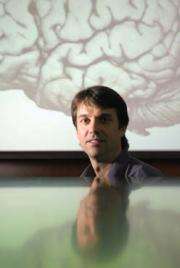
ck Nitschke, a UW-Madison professor of psychiatry, has found that uncertainty intensifies a person’s perception of a bad experience. Photo: Jeff Miller

(PhysOrg.com) -- Anyone who has spent a sleepless night anguishing over a possible job loss has experienced the central finding of a new brain scan study: Uncertainty makes a bad event feel even worse.

A new study by University of Wisconsin-Madison researcher Jack Nitschke shows that the emotional centers in the brain respond much more strongly to disturbing photos if the person didn't know what was coming.

"These results have obvious relevance to our current economic times," says Nitschke, a professor of psychiatry in the UW-Madison School of Medicine and Public Health. "Expectations have a dramatic impact on many aspects of our lives, including performance at work and school, interpersonal relationships and health. Expectations can alter perceptions of negative events as well as neural and emotional responses."

The study used (fMRI) to chart the reaction in two parts of the brain important for emotional responding: the insula and the amygdala. The study, published online Aug. 13 by the journal , shows much stronger neural responses to negative stimuli when the event is preceded by uncertainty.

"This line of research is helping us understand how expectations influence our emotional responses to events," Nitschke says.

For the study, 36 UW-Madison student volunteers had their charted in a fMRI machine at the UW-Madison Waisman Center. The students wore goggles that presented a series of pictures that were either neutral, such as a chair, or aversive, such as a badly wounded person. Before each image, the subject saw a symbol signaling one of three things about the image that would follow: a circle to show it would be neutral, an "X" to signal it would be disturbing or a question mark, which indicated uncertainty.

The insula and the amygdala both responded more strongly to the actual aversive picture if it was preceded by the question mark. Interestingly, those brain areas brain responded less strongly to aversive pictures if they received a cue warning that the disturbing picture was coming. Nitschke, a psychiatrist who treats people with anxiety disorders, says the results have clinical implications.

"If we can reduce people's feelings of uncertainty, we can reduce their anxiety and their response to bad experiences," Nitschke says. "Given that uncertain expectations are paramount in clinical and subclinical anxiety, these data suggest that more attention be paid to targeting those expectations in treatment."

After the test, subjects were asked how often the question mark was followed by an aversive picture. While they saw an equal number of neutral and aversive photos, nearly 75 percent of subjects overestimated the frequency of aversive pictures following uncertain cues. The brain's increased response to uncertainty explained these overestimations.

Nitschke's co-authors are former and current members of his lab and include Issidoros Sarinopoulos, of Michigan State University; Daniel Grupe, of the UW-Madison departments of Psychiatry and Psychology; Kristen Mackiewicz of the University of Colorado; John Herrington of Children's Hospital of Philadelphia; Mai Youa Lor of the Columbia University School of Social Work; and Eric Steege of West Virginia University.

More information: An abstract of the paper is at http://cercor.oxfordjournals.org/cgi/content/abstract/bhp155 and the full paper will be published in the journal's September edition.

More information: University of Wisconsin-Madison


Rate this story - 5 /5 (6 votes)

Rank Filter

Move the slider to adjust rank threshold, so that you can hide some of the comments.


Display comments: newest first

  • marjon - Aug 18, 2009
    • Rank: not rated yet
    One reason why combat soldiers train extensively, to minimize anxiety.
  • cakmn - Aug 18, 2009
    • Rank: not rated yet
    One change for myself that has made a huge difference in my life was simply becoming perfectly comfortable with being able to say "I don't know." This allows one to relax, stay loose, flexible and adaptable so one can meet whatever life has to offer with one's maximum capacity and capabilities to deal with whatever happens as best one is able. It also helps to be able to say "OK, here's how things are right here and right now. Where do I/we go from here?"

August 17, 2009 all stories

Comments: 2

5 /5 (6 votes)

  • hide
  • Related Stories

  • Expectant brains help predict anxiety treatment success
    created Jan 02, 2009 | popularity not rated yet | comments 0
  • Anticipation Plays a Powerful Role in Human Memory
    created Sep 05, 2006 | popularity not rated yet | comments 0
  • Brain’s 'fear center' may underlie autistic behaviors
    created Dec 13, 2006 | popularity not rated yet | comments 0
  • Uncertainty can be more stressful than clear negative feedback
    created Nov 20, 2008 | popularity not rated yet | comments 0
  • Uncertainty can be more stressful than clear negative feedback
    created Nov 20, 2008 | popularity not rated yet | comments 0


  • hide
  • Relevant PhysicsForums posts

Other News

Blocking cell movement for cancer, MS treatment

Medicine & Health / Research

created 5 minutes ago | popularity not rated yet | comments 0

University of Adelaide researchers in Australia are finding new ways to block the movement of cells in the body which can cause autoimmune diseases and the spread of cancer.


A face is more than the sum of its parts

Medicine & Health / Psychology & Psychiatry

created 13 minutes ago | popularity 5 / 5 (1) | comments 0

You stop at a shop window and wonder why someone inside is blatantly staring at you -- until you realize this person is you. Scenarios like this are impossible for us to imagine, but quite common for sufferers of acquired ...


IQ among strongest predictors of cardiovascular disease -- second only to cigarette smoking

Medicine & Health / Health

created 4 hours ago | popularity 5 / 5 (2) | comments 6 | with audio podcast

as reflected by low results on written or oral tests of IQ - have been associated with a raised risk of cardiovascular disease, no study has so far compared the relative strength of this association with other established ...


Communication breakdown: What happens to nerve cells in Parkinson's disease

Medicine & Health / Neuroscience

created 5 hours ago | popularity not rated yet | comments 0 | with audio podcast

A new study from The Montreal Neurological Institute and Hospital - The Neuro - at McGill University is the first to discover a molecular link between Parkinson's disease and defects in the ability of nerve cells to communicate. ...


Whooping cough vaccine may be losing its punch: study

Medicine & Health / Diseases

created 2 hours ago | popularity not rated yet | comments 0

(PhysOrg.com) -- Vaccination programs against whooping cough may not be fully effective because the bacteria that cause the disease have evolved new strains, a new study has found. A team of Australian scientists has ...