Asian competitors shadow German solar industry
August 18, 2009 by Richard Carter
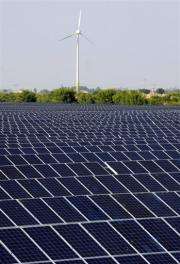
A field with solar cells made by German manufacturer Q-Cells

Enlarge

A field with solar cells made by German manufacturer Q-Cells. The company produces silicon-based photovoltaic cells and supplies manufacturers of solar modules. Germany's solar power industry, until recently the world leader in the technology, is facing an unprecedented crisis, analysts say, outshone by cheaper competitors from Asia, most notably Chinese firms.

Germany's solar power industry, until recently the world leader in the technology, is facing an unprecedented crisis, analysts say, outshone by cheaper competitors from Asia, most notably Chinese firms.

Q-Cells, the world's biggest solar cell producer, last week issued a far from glowing set of results, with losses of 700 million euros (984 million dollars) in the first half of the year.

As a result, the German firm said it would cut 500 jobs from its workforce of 2,600 and put others on part-time working arrangements.

The crisis in the German solar industry is affecting small companies as well as giants such as Q-Cells. Only three months ago, start-up Sunline declared bankruptcy with the loss of all its 78 employees.

A glance at the TecDax, Germany's tech-heavy index, nicknamed "SunDax" for the predominance of solar firms, tells the story, with some companies losing around 30 percent of their value since the start of 2008.

"The fact is that is losing more and more of its market leading position in production to the United States and China," said Matthias Fawer from Swiss bank Sarasin, quoted in German weekly Die Zeit.

"Asian cell and module producers are going to squeeze out the Germans," Anne Kreutzmann, the chief editor of solar trade newspaper Photon, told the Financial Times Deutschland.

The main reason is simple: Chinese companies are able to produce cells much more cheaply, due to lower labour costs and also the plummeting price for silicon, the raw material for solar cell manufacture.

Whereas German firms are tied in to long-term contracts for silicon deliveries, Chinese firms have been sourcing it from the spot market, where the price has dropped by around 70 percent in the past few months.

According to a survey from Photon Consulting, while it costs a German firm such as Ersol 1.01 dollars per watt to produce a solar cell, Chinese company Suntech can manufacture the same cell for 35 cents per watt.

All in all, production costs for the solar industry are as much as 30 percent lower in China than in Germany, according to a UBS study.

Chinese firms also benefit from state support and the effect has been to push prices for solar cells down significantly in the past few years.

Adding to its troubles, the German solar industry's export market, which accounts for over 40 percent of turnover, is beginning to dry up in key areas.

For example, following the decision by the Spanish government to stop subsidies for installing solar panels, the market there, which had previously enjoyed 200-percent growth rates, has crashed.

The consequences could be severe for the industry, which in 2008 employed around 75,000 people and turned over approximately seven billion euros, according to the latest data from industry association BSW.

"A large proportion of German solar cell and solar module producers will not survive," Patrick Hummel, an analyst from UBS, told the Financial Times Deutschland.

China's market share for solar cells is already on the increase, with around one in three cells already produced there, according to industry estimates.

And faced with this competition from the east, the attitude of many firms has been: if you can't beat them, join them.

Q-Cells is shipping to to transform them into solar modules and recently announced a tie-up with Chinese solar wafer firm LDK Solar. The firm has also opened a production line in Malaysia.

Another German firm, Solarworld, has already built a factory in South Korea.

Kreutzmann, from Photon magazine, said German industry will be pushed out of the way "unless the Germans in future also shift their production to Asia."

(c) 2009 AFP


Rank 4 /5 (8 votes)
Relevant PhysicsForums posts
  • How to calculate total compressibility in liquid porous solid system
    created4 hours ago
  • Need help reading 3-D
    created23 hours ago
  • A way to send and receive wireless data
    createdFeb 11, 2012
  • Calling function with no input argument
    createdFeb 10, 2012
  • Force free body diagram problem on gym equipment
    createdFeb 10, 2012
  • Empirical data regarding shower heads and water
    createdFeb 10, 2012
  • More from Physics Forums - General Engineering

More news stories

Google might launch Drive for cloud storage soon

(PhysOrg.com) -- Google's next big move, according to the Wall Street Journal, is a cloud storage service called Drive. Hardly first to the plate, Google is simply catching up to introducing its cloud reposi ...

Technology / Internet

created 12 hours ago | popularity 4.8 / 5 (5) | comments 4 | with audio podcast report

Iran blocks email, restricts net access: reports

Iran has further restricted access to the Internet and blocked popular email services for the past few days, in a move a top lawmaker said could "cost the regime dearly," media reports said on Sunday.

Technology / Internet

created 5 hours ago | popularity 5 / 5 (1) | comments 3

Love a click away in Indonesia's Twitter Republic

He was a geeky kid from Yogyakarta, she a glamorous city girl in Jakarta. In a country with one of the world's most vibrant social networking scenes they fell in love on Twitter.

Technology / Internet

created 13 hours ago | popularity 4 / 5 (1) | comments 0

Walney offshore wind farm is world's biggest (for now)

(PhysOrg.com) -- The Walney wind farm on the Irish Sea--characterized by high tides, waves and windy weather--officially opened this week. The farm is treated in the press as a very big deal as the Walney ...

Technology / Energy & Green Tech

created Feb 11, 2012 | popularity 4.2 / 5 (13) | comments 47 | with audio podcast weblog

Navy to begin tests on electromagnetic railgun prototype launcher

The Office of Naval Research (ONR)'s Electromagnetic (EM) Railgun program will take an important step forward in the coming weeks when the first industry railgun prototype launcher is tested at a facility ...

Technology / Engineering

created Feb 06, 2012 | popularity 4.5 / 5 (17) | comments 94 | with audio podcast


Declining health-care productivity in England: Who says so?

Reports that the National Health Service in England has been declining in productivity in the last decade appear to have been accepted as fact. However, a Viewpoint published Online First by The Lancet disputes this. The Vi ...

Scientists discover molecular secrets of 2,000-year-old Chinese herbal remedy

For roughly two thousand years, Chinese herbalists have treated Malaria using a root extract, commonly known as Chang Shan, from a type of hydrangea that grows in Tibet and Nepal. More recent studies suggest that halofuginone, ...

New method to examine batteries -- MRI from the inside

There is an ever-increasing need for advanced batteries for portable electronics, such as phones, cameras, and music players, but also to power electric vehicles and to facilitate the distribution and storage of energy derived ...

Overeating may double risk of memory loss

New research suggests that consuming between 2,100 and 6,000 calories per day may double the risk of memory loss, or mild cognitive impairment (MCI), among people age 70 and older. The study was released today and will be ...

A mitosis mystery solved: How chromosomes align perfectly in a dividing cell

Although the process of mitotic cell division has been studied intensely for more than 50 years, Whitehead Institute researchers have only now solved the mystery of how cells correctly align their chromosomes during symmetric ...

Lab study raises questions over nano-particle impact

Tests involving chickens have raised questions about the impact on health from engineered nano-particles, the ultra-fine grains commonly used in drugs and processed foods, scientists said on Sunday.