Scientists Use DNA Scaffolding To Build Tiny Circuit Boards
August 18, 2009 Scientists Use DNA Scaffolding To Build Tiny Circuit Boards

Enlarge

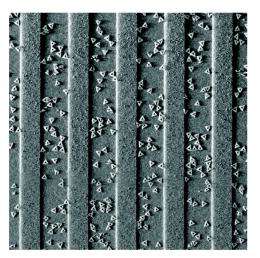
IBM scientists are using DNA origami to build tiny circuit boards; in this image, low concentrations of triangular DNA origami are binding to wide lines on a lithographically patterned surface. Image: IBM

(PhysOrg.com) -- Today, scientists at IBM Research and the California Institute of Technology announced a scientific advancement that could be a major breakthrough in enabling the semiconductor industry to pack more power and speed into tiny computer chips, while making them more energy efficient and less expensive to manufacture.

IBM researchers and collaborator Paul W.K. Rothemund, of the California Institute of Technology, have made an advancement in combining lithographic patterning with self assembly - a method to arrange DNA origami structures on surfaces compatible with today’s equipment.

Today, the semiconductor industry is faced with the challenges of developing lithographic technology for feature sizes smaller than 22 nm and exploring new classes of transistors that employ carbon nanotubes or silicon nanowires. IBM’s approach of using DNA molecules as scaffolding -- where millions of carbon nanotubes could be deposited and self-assembled into precise patterns by sticking to the DNA molecules - may provide a way to reach sub-22 nm lithography.
Scientists Use DNA Scaffolding To Build Tiny Circuit Boards
Enlarge

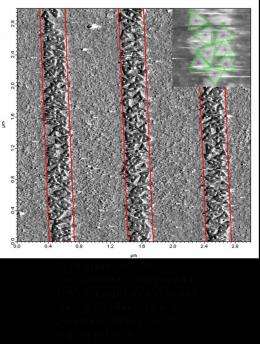
IBM scientists are using DNA scaffoldingi to build tiny circuit boards; this image shows high concentrations of triangular DNA origami binding to wide lines on a lithographically patterned surface; the inset shows individual origami structures at high resolution. Image: IBM

The utility of this approach lies in the fact that the positioned DNA nanostructures can serve as scaffolds, or miniature circuit boards, for the precise assembly of components - such as carbon nanotubes, nanowires and nanoparticles - at dimensions significantly smaller than possible with conventional semiconductor fabrication techniques. This opens up the possibility of creating functional devices that can be integrated into larger structures, as well as enabling studies of arrays of nanostructures with known coordinates.

“The cost involved in shrinking features to improve performance is a limiting factor in keeping pace with Moore’s Law and a concern across the semiconductor industry,” said Spike Narayan, manager, Science & Technology, IBM Research - Almaden. “The combination of this directed with today’s fabrication technology eventually could lead to substantial savings in the most expensive and challenging part of the chip-making process.”

The techniques for preparing DNA origami, developed at Caltech, cause single DNA molecules to self assemble in solution via a reaction between a long single strand of viral DNA and a mixture of different short synthetic oligonucleotide strands. These short segments act as staples - effectively folding the viral DNA into the desired 2D shape through complementary base pair binding. The short staples can be modified to provide attachment sites for nanoscale components at resolutions (separation between sites) as small as 6 nanometers (nm). In this way, DNA nanostructures such as squares, triangles and stars can be prepared with dimensions of 100 - 150 nm on an edge and a thickness of the width of the DNA double helix.
Scientists Use DNA Scaffolding To Build Tiny Circuit Boards
Enlarge

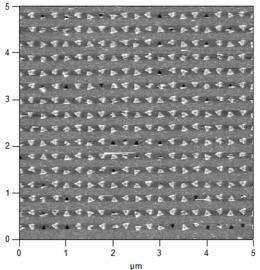
IBM scientists are using DNA scaffolding to build tiny circuit boards; in this image, individual triangular DNA origami are adhering to a template with properly sized triangular features. Image: IBM

The lithographic templates were fabricated at IBM using traditional semiconductor techniques, the same used to make the chips found in today's computers, to etch out patterns. Either electron beam or optical were used to create arrays of binding sites of the proper size and shape to match those of individual origami structures. Key to the process were the discovery of the template material and deposition conditions to afford high selectivity so that origami binds only to the patterns of "sticky patches" and nowhere else.

The paper on this work, “Placement and orientation of DNA nanostructures on lithographically patterned surfaces,” by scientists at IBM Research and the California Institute of Technology, will be published in the September issue of Nature Nanotechnology and is currently available at: http://www.nature.com/nnano/journal/vaop/ncurrent/abs/nnano.2009.220.html .

Provided by IBM


print this article email this article download pdf blog this article bookmark this article     Stumble it Digg this share on Facebook retweet share on Reddit add to delicious
Rate this story - 4.9 /5 (8 votes)

Rank Filter

Move the slider to adjust rank threshold, so that you can hide some of the comments.


Display comments: newest first

  • sender - Aug 18, 2009
    • Rank: not rated yet
    photocomputing via DNA within the decade to do one time snapshot sequencing of life's building blocks?
  • guiding_light - Aug 18, 2009
    • Rank: not rated yet
    These don't look very robust as etch masks.
  • Ant - Aug 18, 2009
    • Rank: not rated yet
    There is greater probability that this work will produce working products than a quantum computer research ever will
  • gongii - Aug 20, 2009
    • Rank: not rated yet
    This may be a silly question but whose DNA is it? I never heard of "generic" DNA, doesn't DNA always code for some biological function if not some organism?

    The research is valuable for its architectural concept; it would be nice to demonstrate it on some other substance besides DNA, like another helical molecule. DNA is very fashionable but could get legal very quickly.

August 18, 2009 all stories

Comments: 4

4.9 /5 (8 votes)
  • Stumble this up

  • Digg this

  • share this

  • hide
  • Related Stories

  • DNA used as a template for nanolithography
    created Aug 31, 2007 | popularity not rated yet | comments 0
  • Self-assembling nanostructures of DNA -- a biotechnologist's dream
    created Feb 05, 2007 | popularity not rated yet | comments 0
  • AMD, Partners Produce Test Chip Using EUV Lithography
    created Feb 26, 2008 | popularity not rated yet | comments 0
  • IBM builds first IC around a single carbon nanotube
    created Mar 24, 2006 | popularity not rated yet | comments 0
  • For low-cost DNA nanostructures, recycle sticky ends
    created Mar 02, 2007 | popularity not rated yet | comments 0


  • hide
  • Relevant PhysicsForums posts

  • avoidance of admitting that we dont know somethin
    created 4 hours ago
  • Speed of light : missing energy
    created 7 hours ago
  • Can light produce darkness and can noise procude quiteness 4
    created 10 hours ago
  • Magnetic Oscillation Equations
    created 16 hours ago
  • US Physics Test Eligibility
    created 17 hours ago
  • Are Active Noise Control Stereo Possible?
    created 22 hours ago
  • More from Physics Forums - General Physics

Other News

Using superconducting probes to get a picture of what it's like inside CNTs

Nanotechnology / Nanophysics

created Nov 20, 2009 | popularity 4.9 / 5 (7) | comments 0

(PhysOrg.com) -- "Carbon nanotubes are exciting for fundamental physics, and for potential technological applications," Nadya Mason tells PhysOrg.com. "However, we are generally limited in the way that we can study them. ...


Nanoparticles used in common household items caused genetic damage in mice

Nanotechnology / Bio & Medicine

created Nov 16, 2009 | popularity 4.7 / 5 (22) | comments 11

Titanium dioxide (TiO2) nanoparticles, found in everything from cosmetics to sunscreen to paint to vitamins, caused systemic genetic damage in mice, according to a comprehensive study conducted by researchers at UCLA's Jonsson ...


Nanotube defects equal better energy and storage systems

Nanotube defects equal better energy and storage systems

Nanotechnology / Nanomaterials

created Nov 19, 2009 | popularity 4.4 / 5 (9) | comments 2

(PhysOrg.com) -- Most people would like to be able to charge their cell phones and other personal electronics quickly and not too often. A recent discovery made by UC San Diego engineers could lead to carbon ...


When It Comes to Drug Delivery, Size Matters

Nanotechnology / Bio & Medicine

created Nov 20, 2009 | popularity 5 / 5 (1) | comments 0

(PhysOrg.com) -- One of the great promises of nanotechnologies lies in its ability to create drug-containing nanoparticles decorated with targeting molecules that recognize and bind to cancer cells, providing drug delivery ...


Scientists synthesize graphene-like material: Polymer with honeycomb structure

Scientists synthesize graphene-like material: Polymer with honeycomb structure

Nanotechnology / Nanomaterials

created Nov 19, 2009 | popularity 4.5 / 5 (6) | comments 1

Two-dimensional carbon layers, so-called graphenes, are regarded as a possible substitute for silicon in the semiconductor industry. The electronic properties of these layers can be varied by "building in" ...