Scrubbing sulfur: New process removes sulfur components, CO2 from power plant emissions (w/ Video)
August 18, 2009
Scrubbing sulfur

Enlarge

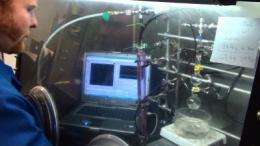
Pacific Northwest National Laboratory scientist David Heldebrant demonstrates how a new process called reversible acid gas capture works to pull more than just carbon dioxide out of power plant emissions. Credit: DOE/Pacific Northwest National Laboratory

The Department of Energy's Pacific Northwest National Laboratory has developed a reusable organic liquid that can pull harmful gases such as carbon dioxide or sulfur dioxide out of industrial emissions from power plants. The process could directly replace current methods and allow power plants to capture double the amount of harmful gases in a way that uses no water, less energy and saves money.

This video is not supported by your browser at this time.

Pacific Northwest National Laboratory scientist David Heldebrant demonstrates how a new process called reversible acid gas capture works to pull more than just carbon dioxide out of power plant emissions. Credit: Pacific Northwest National Laboratory

"Power plants could easily retrofit to use our process as a direct replacement for existing technology," said David Heldebrant, PNNL's lead research scientist for the project.

Harmful gases such as carbon dioxide or sulfur dioxide are called "acid gases". The new scrubbing process uses acid gas-binding organic liquids that contain no water and appear similar to oily compounds. These liquids capture the acid gases near . Scientists then heat the liquid to recover and dispose of the acid gases properly.

These recyclable liquids require much less energy to heat but can hold two times more harmful gases by weight than the current leading liquid absorbent used in power plants. It is a combination of water and monoethanolamine, a basic organic molecule that grabs the carbon dioxide.

PNNL's previous work with the all-organic liquids focused on pulling only carbon dioxide out of emissions from power plants. New work will show how the process can be applied to other acid gases such as sulfur dioxide.

"Current methods used to capture and release carbon dioxide emissions from use a lot of energy because they pump and heat an excess of water during the process," said Heldebrant. He notes the monoethanolamine component is too corrosive to be used without the excess water.

In PNNL's process called "Reversible Acid Gas Capture," the molecules that grab onto the acid gases are already in liquid form, and don't contain water. The acid gas-binding organic liquids require less heat than water does to release the captured gases.

Heldebrant and colleagues demonstrated the process in previous work with a carbon dioxide-binding organic liquid, called CO2BOL. In this process, scientists mix the CO2BOL solution into a holding tank with emissions that contain carbon dioxide. The CO2BOL chemically binds with the carbon dioxide to form a liquid salt solution.

In another tank, scientists reheat the salt solution to strip out the . Non-hazardous gases such as nitrogen would not be captured and are released back into the atmosphere. The toxic compounds are captured separately for storage. At that point, the CO2BOL solution is back in its original state and ready for reuse.

Heldebrant and colleagues have developed organic liquid systems that bind three additional acid gases found in emissions. He will talk about new work with , carbonyl sulfide, and carbon disulfide -- all acid gases that are environmentally harmful -- at the American Chemical Society Fall 2009 Meeting and Exposition, Tuesday, August 18.

Source: Pacific Northwest National Laboratory (news : web)

Filter


Move the slider to adjust rank threshold, so that you can hide some of the comments.


Display comments: newest first

jcrow
Aug 24, 2009

Rank: not rated yet
But But, Why strip CO2 from exhaust when global warming does not exist. It is only a sneaky liberal strategy to socialize America and steal money from your grandparents after beating them up with a baseball bat. Waahhhh Waaahhhhhh.....
Fox news told me so.
Rank 5 /5 (4 votes)
Relevant PhysicsForums posts
  • Stoichiometry
    created19 hours ago
  • Boiling and melting point of impure substances
    created20 hours ago
  • Safe nitrogen compound to decompose a 500 deg C in a furnace?
    createdFeb 09, 2012
  • [ask]electron inside drinking water
    createdFeb 08, 2012
  • How to avoid formation of Lithium Chromate ???
    createdFeb 08, 2012
  • how to choose a reduced or oxidated form in a redox
    createdFeb 08, 2012
  • More from Physics Forums - Chemistry

More news stories

Fool's gold may prove an unlikely alternative to overexploited catalytic materials

Catalytic materials, which lower the energy barriers for chemical reactions, are used in everything from the commercial production of chemicals to catalytic converters in car engines. However, with current catalytic materials ...

Chemistry / Materials Science

created 11 hours ago | popularity 4.3 / 5 (6) | comments 3 | with audio podcast

Unpicking HIV’s invisibility cloak

Drug researchers hunting for alternative ways to treat human immunodeficiency virus (HIV) infections may soon have a novel target—its camouflage coat. HIV hides inside a cloak unusually rich in a sugar ...

Chemistry / Biochemistry

created 11 hours ago | popularity 5 / 5 (4) | comments 0

No entry without protein recycling: Researchers discover new coherence in enzyme transport

The group of Prof. Dr. Ralf Erdmann at the Ruhr-Universität Bochum, Germany, discovered a connection of peroxisomal protein import and receptor export. In the Journal of Biological Chemistry, they disclo ...

Chemistry / Biochemistry

created 11 hours ago | popularity not rated yet | comments 0

Under the microscope #7

In this video Dr Ingrid Graz shows us a thin layer of gold on top of rubber. Cracks in the gold allow it to stretch and we can use this for stretchable electronics.

Chemistry / Other

created 13 hours ago | popularity not rated yet | comments 0

Hydrogen from acidic water: Researchers develop potential low cost alternative to platinum for splitting water

A technique for creating a new molecule that structurally and chemically replicates the active part of the widely used industrial catalyst molybdenite has been developed by researchers with the Lawrence Berkeley ...

Chemistry / Materials Science

created Feb 09, 2012 | popularity 5 / 5 (12) | comments 13 | with audio podcast


Google users warned of threat to smartphone wallets

Users of Google smartphone wallets were being warned on Friday that there is a way to crack pass codes intended to thwart thieves from going on illicit shopping sprees.

Anonymous knocks CIA website offline (Update)

The website of the Central Intelligence Agency was inaccessible on Friday after the hacker group Anonymous claimed to have knocked it offline.

Complex wiring of the nervous system may rely on a just a handful of genes and proteins

Researchers at the Salk Institute have discovered a startling feature of early brain development that helps to explain how complex neuron wiring patterns are programmed using just a handful of critical genes. ...

New error-correcting codes guarantee the fastest possible rate of data transmission

Error-correcting codes are one of the triumphs of the digital age. They’re a way of encoding information so that it can be transmitted across a communication channel — such as an optical fiber o ...

The power of estrogen -- male snakes attract other males

A new study has shown that boosting the estrogen levels of male garter snakes causes them to secrete the same pheromones that females use to attract suitors, and turned the males into just about the sexiest ...

Putting the squeeze on planets outside our solar system

(PhysOrg.com) -- Using high-powered lasers, scientists at Lawrence Livermore National Laboratory and collaborators discovered that molten magnesium silicate undergoes a phase change in the liquid state, abruptly ...