A chemist's discovery breathes new life into the old South
August 18, 2009
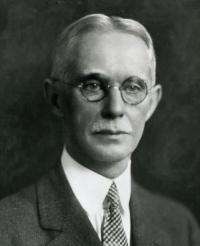
Charles Holmes Herty, Ph.D., sparked the paper industry in the South. Credit: Chemical Heritage Foundation
One chemist plus one new scientific discovery yields. . . an economic and environmental miracle. Almost overnight, a whole new industry springs up and breathes life into an economically-devastated region of the country. It creates millions of new jobs and pumps billions of dollars into the economy. Thousands of miles away, the discovery helps avert the potential decimation of old growth forests, where millions of spruce, fir, poplar, and other trees were being cut each year.
"That scenario actually happened and it is a history lesson about the value of chemistry research to the real world economy," Georgia chemist Donald Hicks, Ph.D., said here today at the 238th National Meeting of the American Chemical Society. Hicks was describing how a little-known discovery in 1932 by Georgia chemist Charles Holmes Herty engendered the huge pulp and paper industry in the southeastern United States. In doing so, it revived the South's economy, devastated by the Great Depression and damage to its mainstay cotton crop by the boll weevil.
Herty, then 64, turned conventional scientific wisdom on its ear by showing that high quality paper could be made from rapidly renewable southern pine. At the time, paper for newspapers and other applications that required white paper was made from slow growth trees in the North. Demand was slowly decimating northern forests.
"Herty planned to use fast growing southern pine trees to create the very high value commodity white paper as well as cellulose and rayon," Hicks explained. "But when he said that he wanted to use a sulfite solution chemical pulping process, every expert in the paper-making field said it couldn't be done because of too much sticky resin in these trees."
All of the experts were wrong. Herty's innovative theory, which proved to be valid, was that older pine trees might secrete resin as a defense mechanism, and, thus, young pines might contain much less resin.
"Herty succeeded, driven by an idea he believed in and by the nobility of the cause of helping the poor economy of his native South, and with no personal financial investment gain ever coming from his work," Hicks said. Fifteen southern pulp and paper mills were reported built from 1935 to 1940, resulting in thousands of new jobs.
Hicks, a retired chemistry professor with Georgia State University, said that the Savannah, Ga., mill alone created 4,400 jobs, and 70 years later, 11 percent of the jobs in six states were connected to this industry. Paper mills proved the southern USA industrial potential, and led to the region's rapid industrialization by the 1950s. Herty's 1932 paper-making efforts also created the tree farming industry with 4.5 million citizens involved in 2002, and decimation of the great northern hardwood forests was slowed dramatically.
To test his theory, Herty performed chemical analyses on trees of varying ages to prove that pines less than 20 years old had no more sticky resin than old northern trees used then for making white paper. He used a well-known sulfite solution pulping process he had heard about 30 years earlier.
Based on common chemistry separation principles, the analysis procedure involved first dissolving the resin in a weighed sawdust sample into a volatile organic solvent that did not dissolve other wood components. After filtering and gently evaporating the volatile solvent, the resin containing residue was weighed and its percentage calculated. This chemical analysis provided the "eureka moment" that created tens of thousands of pulp and paper industry jobs in the depression era South.
-
Frankincense trees overexploited for Christmas scent
Dec 12, 2006 |
not rated yet |
0
-
Beetle suspect in deaths of red bay trees
Feb 27, 2006 |
not rated yet |
0
-
U.N.: Effects of bio-tech trees not known
Jul 14, 2005 |
not rated yet |
0
-
Researcher looking for way to minimize spread of mountain pine beetle
Aug 11, 2009 |
not rated yet |
0
-
Paper from sugar cane saves trees and money
Mar 06, 2009 |
not rated yet |
0
-
Engineers build first sub-10-nm carbon nanotube transistor
Feb 01, 2012 |
4.9 / 5 (33) |
30
-
Something old, something new: Evolution and the structural divergence of duplicate genes
Jan 31, 2012 |
4.6 / 5 (7) |
1
-
The hidden nanoworld of ice crystals: Revealing the dynamic behavior of quasi-liquid layers
Jan 30, 2012 |
5 / 5 (5) |
1
-
Stock market network reveals investor clustering
Jan 27, 2012 |
3.9 / 5 (23) |
8
-
Of microchemistry and molecules: Electronic microfluidic device synthesizes biocompatible probes
Jan 26, 2012 |
5 / 5 (2) |
0
-
How to tell if ionic compound has a higher melting point?
3 hours ago
-
How to determine zinc in a plant.
Feb 11, 2012
-
Boiling and melting point of impure substances
Feb 10, 2012
-
Safe nitrogen compound to decompose a 500 deg C in a furnace?
Feb 09, 2012
-
[ask]electron inside drinking water
Feb 08, 2012
-
How to avoid formation of Lithium Chromate ???
Feb 08, 2012
- More from Physics Forums - Chemistry
More news stories
Scientists discover molecular secrets of 2,000-year-old Chinese herbal remedy
For roughly two thousand years, Chinese herbalists have treated Malaria using a root extract, commonly known as Chang Shan, from a type of hydrangea that grows in Tibet and Nepal. More recent studies suggest that halofuginone, ...
15 hours ago |
4.5 / 5 (19) |
16
|
New method to examine batteries -- MRI from the inside
There is an ever-increasing need for advanced batteries for portable electronics, such as phones, cameras, and music players, but also to power electric vehicles and to facilitate the distribution and storage of energy derived ...
Chemistry / Analytical Chemistry
15 hours ago |
5 / 5 (7) |
0
|
Hydrogen from acidic water: Researchers develop potential low cost alternative to platinum for splitting water
A technique for creating a new molecule that structurally and chemically replicates the active part of the widely used industrial catalyst molybdenite has been developed by researchers with the Lawrence Berkeley ...
Feb 09, 2012 |
4.8 / 5 (16) |
21
|
Fool's gold may prove an unlikely alternative to overexploited catalytic materials
Catalytic materials, which lower the energy barriers for chemical reactions, are used in everything from the commercial production of chemicals to catalytic converters in car engines. However, with current catalytic materials ...
Feb 10, 2012 |
4.4 / 5 (8) |
9
|
Research provides octagonal window of opportunity for carbon capture
(PhysOrg.com) -- Filtering carbon dioxide, a greenhouse gas, from factory smokestacks is a necessary, but expensive part of many manufacturing processes. However, a collaborative research team from the National ...
Feb 08, 2012 |
5 / 5 (2) |
6
|
Rapunzel, Leonardo and the physics of the ponytail
(PhysOrg.com) -- New research provides the first mathematical understanding of the shape of a ponytail and could have implications for the textile industry, computer animation and personal care products.
Cognitive impairment in older adults often unrecognized in the primary care setting
A new study published in the Journal of the American Geriatrics Society reveals that brief cognitive screenings combined with offering further evaluation increased new diagnoses of cognitive impairment in older veterans two to ...
Climate change causes harmful algal blooms in North Atlantic: study
Warming oceans and increases in windiness could be causing of an abundance of harmful algal blooms in the North Atlantic Ocean and North Sea, according to new research.
Hacker claims porn site users compromised
A hacker claims to have compromised the personal information of more than 350,000 users after breaking into a disused website operated by pornography provider Brazzers.
Primary care program helps obese teen girls manage weight, improve body image and behavior
Teenage girls gained less weight, improved their body image, ate less fast food, and had more family meals after participating in a 6- month program that involved weekly peer meetings, consultations with primary care providers ...
AT&T customers surprised by 'unlimited data' limit
(AP) -- Mike Trang likes to use his iPhone 4 as a GPS device, helping him get around in his job. Now and then, his younger cousins get ahold of it, and play some YouTube videos and games.
Aug 18, 2009
Rank: 5 / 5 (1)