Guam Navy and University of Guam partner to conserve native tree
August 18, 2009 Guam Navy and University of Guam partner to conserve native tree

Enlarge

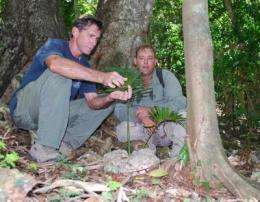
UOG Professor Thomas Marler (left) and Navy Natural Resources Specialist Paul Wenninger inspect a healthy fadang plant growing safely in the Navy's conservation planting in Tinian. Credit: Thomas Marler

The University of Guam has completed the establishment of a conservation planting of Guam's endangered fadang tree on the island of Tinian. Guam Navy has funded the entire project and provided access to their lands in northern Tinian for implementing this important effort to help stave off the ongoing threats to survival of the species.

"The Navy has demonstrated exemplary commitment to the conservation of Guam's resources by funding this project," said UOG professor Thomas Marler. Dr. Marler has administered the project and is managing the conservation planting. "The novel idea was initiated several years ago, long before we knew for sure that the death rate among Guam's fadang population would be so extreme," said Marler.

The fadang tree is called 'Cycas micronesica' by scientists, and belongs to a unique group of plants called cycads. It has grown for thousands of years in the forests on Guam and Rota with no real threats. But two exotic insect species have recently invaded Guam and Rota, and their voracious appetite for fadang has pushed the tree into the endangered status.

"We felt that the remote locations on Tinian were ideal for establishing a safe haven for Guam's fadang plants," said Navy Natural Resources Program Manager Anne Brooke. Dr. Brooke was responsible for coming up with the initial idea and successfully establishing the project. The premise behind this sort of conservation effort is that the threats within the natural range of the endangered species are absent from the new location. This new safe zone then becomes a repository for the species even if the entire population is killed within its natural range.

"This project is a great example of a highly coordinated effort to conserve a valuable natural resource," said Marler. "It combined the contributions of UOG, the U.S. Navy, the CNMI government, and a private landowner." According to Marler, the CNMI Department of Lands and Natural Resources contributed extensively by fast-tracking the permitting process and providing materials and space for many of the activities, and the Fleming family in Tinian donated space for growing the fadang plants until they were ready for planting.

Fadang is the only plant of its kind in the Mariana Islands, and this extensive planting in Tinian has become a crucial component of the ongoing efforts to save the species.

Source: University of Guam


print this article email this article download pdf blog this article bookmark this article     Stumble it Digg this share on Facebook retweet share on Reddit add to delicious
Rate this story - 5 /5 (2 votes)


August 18, 2009 all stories

Comments: 0

5 /5 (2 votes)
  • Stumble this up

  • Digg this

  • share this

  • hide
  • Related Stories

  • High construction cost for cycads
    created Jul 23, 2009 | popularity not rated yet | comments 0
  • Brown tree snake could mean Guam will lose more than its birds
    created Aug 08, 2008 | popularity not rated yet | comments 0
  • Researchers help save rare venomous mammal from extinction
    created Mar 31, 2009 | popularity not rated yet | comments 0
  • Complete 'family tree' of all British birds gives clues about which species might be endangered next
    created Jun 11, 2008 | popularity not rated yet | comments 0
  • Preserving the Hemlock
    created Mar 04, 2008 | popularity not rated yet | comments 0


  • hide
  • Relevant PhysicsForums posts

  • Selenocysteine in pH=7
    created Nov 26, 2009
  • What is the formula for calculating the speed of thought?
    created Nov 26, 2009
  • What does word "absorption" mean in the intestine?
    created Nov 26, 2009
  • What is transpulmonary pressure?
    created Nov 24, 2009
  • More from Physics Forums - Biology

Other News

Golden Oldie: Key Role for Ancient Protein in Algae Photosynthesis

Golden Oldie: Key Role for Ancient Protein in Algae Photosynthesis

Biology / Biotechnology

created 6 hours ago | popularity not rated yet | comments 1

The discovery that an ancient light harvesting protein plays a pivotal role in the photosynthesis of green algae should help the effort to develop algae as a biofuels feedstock. Researchers with the Lawrence ...


Hammerhead shark

Wide heads give hammerheads exceptional stereo view

Biology / Plants & Animals

created 14 hours ago | popularity 4.4 / 5 (5) | comments 4

Hammerhead sharks are some of the Ocean's most distinctive residents. 'Everyone wants to understand why they have this strange head shape,' says Michelle McComb from Florida Atlantic University. One possible ...


Indonesia rejects Bali plan for turtle sacrifices (AP)

Indonesia rejects Bali plan for turtle sacrifices

Biology / Ecology

created 12 hours ago | popularity not rated yet | comments 0

(AP) -- Indonesia has rejected a push by the resort island of Bali for rare turtles to be legally slain in Hindu ceremonies, siding with conservationists of the protected reptiles against religious advocates, ...


Tough yet stiff deer antler is materials scientist's dream

Biology / Plants & Animals

created 14 hours ago | popularity 3 / 5 (1) | comments 2

Prized for their impressive antlers, red deer have been caught in the hunters' sights for generations. But a deer's antlers are much more than decorative. They are lethal weapons that stags crash together when duelling. John ...


Ecologists sound out new solution for monitoring cryptic species

Biology / Ecology

created 15 hours ago | popularity not rated yet | comments 0

Ecologists have at last worked out a way of using recordings of birdsong to accurately measure the size of bird populations. This is the first time sound recordings from a microphone array have been translated into accurate ...