They're alive! Megacities breathe, consume energy, excrete wastes and pollute
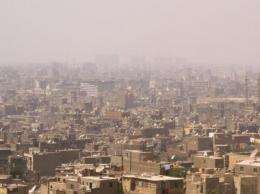
A scientific trend to view the world's biggest cities as analogous to living, breathing organisms is fostering a deep new understanding of how poor air quality in megacities can harm residents, people living far downwind, and also play a major role in global climate change. That's the conclusion of a report on the "urban metabolism" model of megacities presented here today at the 238th National Meeting of the American Chemical Society (ACS).
Charles Kolb, Ph.D., reports that the concept of urban metabolism has existed for decades. It views large cities as living entities that consume energy, food, water, and other raw materials, and release wastes. The releases include carbon dioxide, the main greenhouse gas; air pollutants, sewage and other water pollutants; and even excess heat that collects in vast expanses of concrete pavement and stone buildings. Humans directly produce a significant share of this waste, but emissions from industrial, power generation and transportation systems respire the largest quantities of greenhouse gases and other air pollutants. Other urban metabolizers include sewage systems, landfills, domestic pets and pests like rats, which in some cities outnumber people.
During the last five years, this body of knowledge has drawn into sharper focus the hazards of poor air quality in megacities, not just on the large local populations but also on population centers, agricultural activities and natural ecosystems located downwind from these sprawling areas, Kolb said. He is with the Center for Atmospheric and Environmental Chemistry and the Center for Aerosol and Cloud Chemistry of Aerodyne Research Inc. in Billerica, Mass.
"Carbon dioxide and other pollutants in megacities make them immense drivers of climate change," he said. "They impact climate on both a regional and global level because these long-lived greenhouse gases are dispersed around the world."
More than half the world's population today lives in cities, and the world's largest urban areas are growing rapidly. The number of megacities — metropolitan areas with populations exceeding 10 million — has grown from just three in 1975 to about 20 today.
Kolb said that the most highly polluted megacities are in developing countries. They include Dhaka, Bangladesh; Cairo, Egypt; and Karachi, Pakistan. Some megacities in less developed regions have recently mounted air quality management campaigns that have resulted in lower levels of pollution; they include Mexico City, Mexico; Beijing, China; Sao Paulo, Brazil; and Buenos Aires, Argentina. Even the cleanest megacities like Tokyo/Osaka in Japan and New York City and Los Angeles in the United States — all in the developed world — still have serious problems, Kolb said.
The hot weather and frequent atmospheric inversions in southern California, for instance, foster Los Angeles' legendary smog problem. Mexico City's high altitude/low latitude location produces high levels of solar ultraviolet radiation that drive photochemical smog production, and the even higher surrounding mountains trap the resulting pollutants in and over the city on most days.
"That causes a very serious situation for residents of Mexico City," he said. "You get very unhealthful levels of ozone and fine particle pollutants that produce large numbers of premature deaths each year. Studies show that for each increase of 10 micrograms per cubic meter of these particles, you get roughly a 10 percent increase in premature deaths, producing a decrease in average life expectancy of about 0.8 years. Hospital visits, including bronchitis and asthma cases, also rise."
Controlling urban growth in the developing world is key to improving the world's air quality, Kolb said. Urban pollutant levels in poor countries will remain high, with increased emissions expected as the city populations and economic activities increase. Until megacities are rich enough to devote significant funds to reduce their emissions, two factors will invariably increase the stresses on their environment — increasing vehicular traffic and industrial growth.
Southern California, however, has taken successful action to modify its urban metabolism, pioneering efforts to reduce motor vehicle emissions. Kolb noted that Mexico City — unlike most megacities in less-developed countries — has also taken successful steps to partially address poor air quality. In the past two decades, the Mexican Government has introduced policies to improve air quality, including requiring pollution control devices like catalytic converters on newer vehicles, reducing sulfur levels in gasoline and diesel fuel and relocating some large industrial emitters outside the Valley of Mexico. Kolb says that megacities in Asia and Africa urgently need to modify their urban metabolism in similar ways. A few fundamental changes could pay off quickly.
"We need to start with low-hanging fruit," he said. "In some cities in Asia and Africa, they still have lead in their gasoline. In the developed world, we can institute emissions controls on diesel vehicles, which create hazardous fine particles, and we can also reduce pollution by using more rail-based mass transport or setting up specialized bus routes."
The urban metabolism model can reveal how developed-world megacities, such as Tokyo, New York and Los Angeles, have improved their air quality despite a rise in population. The study also assesses how developing-world megacities are seriously grappling with the problem.
Source: American Chemical Society (news : web)


