The Edge of a Black Hole
August 18, 2009
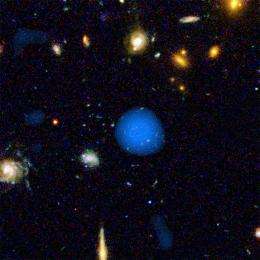
This combined optical and X-ray deep image shows some of the faintest galaxies ever seen, along with the X-ray glow (in blue) from heated material in the environment of a black hole that is in the same region of the sky. Credit: NASA, Hubble Space Telescope, and Chandra X-ray Observatory
The existence of black holes is one of the most amazing and bizarre predictions of Einstein's theory of gravity. Despite his original misgivings about their reality, massive black hole holes are today believed to lie at the centers of most galaxies and to be the inevitable consequence of the demise of massive stars.
A black hole is point-like in dimension, but one of its more mysterious aspects is that it has an "event horizon": an imaginary surface, or "edge," of finite size around it within which anything (except information) that ventures becomes lost forever to the rest of the universe. The existence and nature of event horizons are much less well understood than black holes themselves.
Some proposed, variant theories of gravity to Einstein's, for example, differ in their predicted properties of event horizons, while in some other scenarios event horizons might not even exist. Since black holes are seemingly so common, astronomers want to understand these curious surfaces around them. Their findings could also help refine or suppliant Einstein's theory, and would offer clues to the fundamental nature of physical forces and particles by virtue of the extreme environment of black holes.
Observations of event horizons are extraordinarily difficult because they are comparatively so small - our own galactic center's black hole has one estimated to be less than 40 astronomical units in diameter - and faint because light passing through the surface is captured. Nevertheless, accretion of material onto disks or other structures near the event horizon produces radiation at all wavelengths, much of which escapes the region and can be seen, and the environment thus probed.
In the case of our galactic center, recent observations from a team including CfA astronomers with the Submillimeter Array have set some important constraints.
Writing in the latest issue of the Astrophysical Journal, CfA astronomers Avi Loeb and Ramesh Narayan, together with a past post-doc of theirs, have used this and other new results to compute the implications for any putative event horizon.
They show for the first time, making only a few conservative assumptions, that there is now solid evidence for one of the most exotic and fundamental predictions of general relativity: the existence of an event horizon around the galactic center black hole, and therefore around black holes in general.
• Join PhysOrg.com on Facebook!
• Follow PhysOrg.com on Twitter!
Provided by Harvard-Smithsonian Center for Astrophysics (news : web)


- Sanescience paraphrased - he is basically saying that describing a black hole as a singularity in space is an artifact that is caused by ignoring the quantum nature of space. I.e. he says we haven't applied quantum mechanics to understand it yet :P
Nightmare - corrected - "Yes, but that's what Physics is about. We saw something. But then try to give reasons for it, and then compare to the facts." - which is basically saying that even if what Sanescience is saying is corrrect... It forgets the basic puprose that all the Sciences are about trying to understand the world. We have observations, try to reason through them, and compare them with the facts. Trying to correct as we go.
--El Gramador--
I might misinterpret some of the information though.. So feel free to correct me :P
David Hilbert gave birth to the idea by what I know are incorrect assumptions. And Hilbert's equation later became known as "Schwarzschild".
An event horizon is easy to understand, but, IMHO, completely different from Infinite Gravity, which I'd believe is needed to compress stuff to zero volume. (And mathematically, the gravity never reaches infinity before the volume already has become zero, so it's a chicken and egg problem.)
There are many steps of "compressed star matter". (Wikipedia: Exotic star) White dwarfs, neutron stars, etc. all have a distinct density beyond which they get "harder" to compress. Hence some stars have stopped at these stages.
Who says such special densities don't exist also at what's needed within the event horizon? I'd really like an article about this!
Just as a thought experiment, say there exists a, quark-star density (think neutron star, but much harder), which is so dense that light just barely can't escape from its surface to us. How could you know this is different from the "traditional" black hole that has all its matter infinitely compressed to zero volume???
This actually has bothered me for decades.
Beyond a certain point there is no known degeneracy pressure keeping the thing from collapsing. You don't need infinite gravity; there is no chicken and egg problem.
Someone correct me if I'm misunderstanding something.
By the same reasoning, compressing stars leads to white dwarfs, neutron stars, and maybe a whole list of smaller and denser kinds of stars. That we haven't *yet* seen them, is no proof of not having them. (It's like when I went to school, Jupiter had 12 moons, period. Now we know better. And I was considered arrogant for saying "currently we have found 12 moons".)
@ CSharpner: the mass in the center of the Milky Way simply is so huge that the event horizon is at 40AU. It's an unfathomable amount of matter.
But the event horizon is not a sharp edge. A photon emitted upwards by a particle right at the event horizon goes up and at the same time loses energy (thus changing its wawelength to longer) so that by the time the photon reaches infinite distance (mathematically) it has lost all its energy.
If we sit some distance above the particle and observe the photon, then we actually can see it. And if the particle is some distance below the event horizon, then we will have to be very near above the event horizon to see the photon. And another photon that is sent by a particle way below the event horizon, will never even reach the event horizon, because it will lose all its energy before it reaches that altitude.
I'm not sure the two of you are really disagreeing here. Soylent has not said that the matter would collapse down to a zero volume.
From my own (very limited) understanding of the Standard Model, an arbitrary number of particles may inhabit the same point in space *if* they are all at different energy levels. Thus, the final level of compression would be bounded only by the amount of available energy. As the matter compresses further, more energy becomes available (converted from gravitational potential energy, and maybe even from matter/energy conversions?), which opens up new energy levels to facilitate further compression. But even if enough energy is available to give every single particle its own energy level, the volume would still not be zero -- it would be whatever the volume is of whatever fundamental particles you end up with. (Which might be zero, I suppose -- or it might not even make sense to ask what the diameter of a true fundamental particle is; as soon as we have conclusive evidence of what they are, I'll let you know. ;-)
If my understanding of the Standard Model is horribly flawed, then someone please correct me. :-) And of course, the Standard Model is known to be incomplete and will continue to evolve over time, or maybe even be replaced (e.g. by String Theory or some such.) But I think many (most?) physicists at this point agree that the thing at the center of a black hole is likely to be something much more interesting than just a simple, undifferentiated point-mass with a single charge, a single mass, a diameter of zero, and no internal structure.
Okay, it took a lot of looking, but I finally found an external source to back up the above claim: http://en.wikiped...e_matter ) -- this article takes you from electron degeneracy pressure all the way down to the singularity, step by step.
So when people talk about the Pauli Exclusion Principle being "overcome" or "violated" by the collapse to a black hole, they are speaking loosely. Pauli is not violated.
And this reinforces my larger point, that physicists are leaning away from singularities (from http://en.wikiped...ack_hole ):
"The appearance of singularities in general relativity is commonly perceived as signaling the breakdown of the theory. This breakdown, however, is expected; it occurs in a situation where quantum mechanical effects should describe these actions due to the extremely high density and therefore particle interactions. To date it has not been possible to combine quantum and gravitational effects into a single theory. It is generally expected that a theory of quantum gravity will feature black holes without singularities."