Nuclear fusion research key to advancing computer chips
August 18, 2009 by Emil Venere Nuclear fusion research key to advancing computer chips

Enlarge

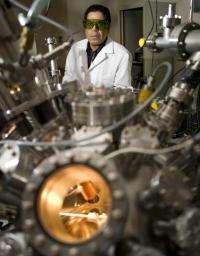
Nuclear engineer Ahmed Hassanein works at his Purdue lab, where researchers are adapting the same methods used in fusion-energy research to develop a new type of "nanolithography" for creating future computer chips. Supercomputers at the US Department of Energy's Argonne National Laboratory are needed to run simulations critical for the research. The technology revolves around extremely thin plasma beams for making tiny features in future computer chips and continuing Moore's law, an unofficial rule stating that the number of transistors on integrated circuits, or chips, doubles about every 18 months. Credit: Purdue University photo/Vincent Walter

(PhysOrg.com) -- Researchers are adapting the same methods used in fusion-energy research to create extremely thin plasma beams for a new class of "nanolithography" required to make future computer chips.

Current technology uses ultraviolet light to create the fine features in in a process called photolithography, which involves projecting the image of a mask onto a light-sensitive material, then chemically etching the resulting pattern.

New nanolithography will be needed to continue advances in computer technology and to extend Moore's law, an unofficial rule stating that the number of transistors on integrated circuits, or chips, doubles about every 18 months.

"We can't make devices much smaller using conventional lithography, so we have to find ways of creating beams having more narrow wavelengths," said Ahmed Hassanein, the Paul L. Wattelet Professor of Nuclear Engineering and head of Purdue's School of Nuclear Engineering.

The new plasma-based lithography under development generates "extreme ultraviolet" light having a of 13.5 nanometers, less than one-tenth the size of current lithography, Hassanein said.

Nuclear engineers and scientists at Purdue and the U.S. Department of Energy's Argonne National Laboratory are working to improve the efficiency of two techniques for producing the plasma: One approach uses a laser and the other "discharge-produced" method uses an .

"In either case, only about 1 to 2 percent of the energy spent is converted into plasma," Hassanein said. "That conversion efficiency means you'd need greater than 100 kilowatts of power for this lithography, which poses all sorts of engineering problems. We are involved in optimizing conversion efficiency - reducing the energy requirements - and solving various design problems for the next-generation lithography."

Findings are detailed in a research paper scheduled to appear in the October-December 2009 issue of the Journal of Micro/Nanolithography, MEMS, and MOEMS. The paper was written by Hassanein, senior research scientist Valeryi Sizyuk, computer analyst Tatyana Sizyuk, and research assistant professor Sivanandan Harilal, all in the School of Nuclear Engineering.

Critical to the research is a computer simulation, called HEIGHTS - for high-energy interaction with general heterogeneous target systems - developed by Hassanein's team. Computations for a single HEIGHTS simulation using Argonne supercomputers can take several months to finish, said Hassanein, a former Argonne senior scientist who led work there to develop HEIGHTS.

The laser method creates plasma by heating xenon, tin or lithium. The plasma produces high-energy packets of light, called photons, of extreme ultraviolet light.

Plasma is a partially ionized gaslike material that conducts electricity. Because of this electrical conductivity, researchers are able to use magnetic fields to shape and control plasmas, forming beams, filaments and other structures. In experimental fusion reactors, magnetic fields are used to keep plasma-based nuclear fuel from touching the metal walls of the containment vessel, enabling the plasma to be heated to the extreme temperatures required to maintain fusion reactions.

HEIGHTS simulates the entire process of the plasma evolution: the laser interacting with the target, and the target evaporating, ionizing and turning into a plasma. The simulation also shows what happens when the magnetic forces "pinch" the plasma cloud into a smaller diameter spot needed to generate the photons.

Findings in the paper detail the laser-produced plasma beams, showing that simulations match data from laboratory experiments recently built at Purdue, Hassanein said.

"It was very exciting to see this match because it means we are on the right track," Hassanein said. "The computer simulations tell us how to optimize the entire system and where to go next with the experiments to verify that."

One design challenge stems from the fact that lenses absorb the photons that make up light, meaning they cannot be used to focus the beam. Instead, mirrors are used in the design. However, plasma condenses on the mirrors, reducing their reflectivity and limiting the efficiency of the process.

"We are trying to help find innovative ways of producing these photons, optimizing the production and mitigating the effects of the plasma on the mirrors," Hassanein said. "So we are trying to improve the entire system."

The simulation tool combines computations in plasma physics, radiation transport, atomic physics, plasma-material interactions and magnetohydrodynamics, or what happens when a target is heated, melts and turns into a .

Source: Purdue University (news : web)


print this article email this article download pdf blog this article bookmark this article     Stumble it Digg this share on Facebook retweet share on Reddit add to delicious
Rate this story - 4.6 /5 (10 votes)

Rank Filter

Move the slider to adjust rank threshold, so that you can hide some of the comments.


Display comments: newest first

  • dirk_bruere - Aug 18, 2009
    • Rank: 3.6 / 5 (5)
    Current state of the art lithography goes down to about 30nm for production, not 130nm
  • PPihkala - Aug 18, 2009
    • Rank: 4 / 5 (4)
    Current UV light used in production is 130nm. With certain tricks they can produce sub wavelenght features onto silicon with that. So having UV at 13.5nm will theoretically make those features 1/10 of what we have today. Assuming that those tricks can be employed with it too.
  • guiding_light - Aug 18, 2009
    • Rank: 5 / 5 (2)
    "In either case, only about 1 to 2 percent of the energy spent is converted into plasma," Hassanein said. "That conversion efficiency means you'd need greater than 100 kilowatts of power for this lithography, which poses all sorts of engineering problems. "

    Gotta appreciate the irony of EUVL research.
  • guiding_light - Aug 18, 2009
    • Rank: 4.2 / 5 (5)
    Current UV light used in production is 130nm. With certain tricks they can produce sub wavelenght features onto silicon with that. So having UV at 13.5nm will theoretically make those features 1/10 of what we have today. Assuming that those tricks can be employed with it too.


    Currently 193 nm light is used to produce features less than 35 nm. In fact you can go even lower (we can get as close to 0 as possible).

    Shorter wavelength starts to have worse resolution because the resist materials responds differently, so you can't just apply the wavelength proportionality.
  • NeilFarbstein - Aug 24, 2009
    • Rank: 3 / 5 (2)
    It not key to nanoelectronics. What baloney!!!!

August 18, 2009 all stories

Comments: 5

4.6 /5 (10 votes)
  • Stumble this up

  • Digg this

  • share this

  • hide
  • Related Stories

  • Lighter gas reduces damage to optics in extreme ultraviolet lithography
    created Sep 12, 2007 | popularity not rated yet | comments 0
  • Reactor upgrades help researchers study nuclear fusion as energy source
    created Feb 09, 2007 | popularity not rated yet | comments 0
  • Stealthy, Versatile, and Jam Resistant Antennas made of Gas
    created Nov 12, 2007 | popularity not rated yet | comments 0
  • Plasma experiment shows how astrophysical jets are formed
    created Jun 29, 2005 | popularity not rated yet | comments 0
  • Taming 900 vortices gives plasma energy insight
    created Jan 05, 2007 | popularity not rated yet | comments 0


  • hide
  • Relevant PhysicsForums posts

  • Some Explanation with Rigid Rotator
    created 1hour ago
  • How to Make a Ferrofluid?
    created 5 hours ago
  • avoidance of admitting that we dont know somethin
    created 10 hours ago
  • Speed of light : missing energy
    created 13 hours ago
  • Can light produce darkness and can noise procude quiteness 4
    created 16 hours ago
  • Magnetic Oscillation Equations
    created 22 hours ago
  • More from Physics Forums - General Physics

Other News

Nanoparticles used in common household items caused genetic damage in mice

Nanotechnology / Bio & Medicine

created Nov 16, 2009 | popularity 4.7 / 5 (22) | comments 11

Titanium dioxide (TiO2) nanoparticles, found in everything from cosmetics to sunscreen to paint to vitamins, caused systemic genetic damage in mice, according to a comprehensive study conducted by researchers at UCLA's Jonsson ...


Using superconducting probes to get a picture of what it's like inside CNTs

Nanotechnology / Nanophysics

created Nov 20, 2009 | popularity 4.9 / 5 (7) | comments 0

(PhysOrg.com) -- "Carbon nanotubes are exciting for fundamental physics, and for potential technological applications," Nadya Mason tells PhysOrg.com. "However, we are generally limited in the way that we can study them. ...


Nanotube defects equal better energy and storage systems

Nanotube defects equal better energy and storage systems

Nanotechnology / Nanomaterials

created Nov 19, 2009 | popularity 4.4 / 5 (9) | comments 2

(PhysOrg.com) -- Most people would like to be able to charge their cell phones and other personal electronics quickly and not too often. A recent discovery made by UC San Diego engineers could lead to carbon ...


When It Comes to Drug Delivery, Size Matters

Nanotechnology / Bio & Medicine

created Nov 20, 2009 | popularity 5 / 5 (1) | comments 0

(PhysOrg.com) -- One of the great promises of nanotechnologies lies in its ability to create drug-containing nanoparticles decorated with targeting molecules that recognize and bind to cancer cells, providing drug delivery ...


Scientists synthesize graphene-like material: Polymer with honeycomb structure

Scientists synthesize graphene-like material: Polymer with honeycomb structure

Nanotechnology / Nanomaterials

created Nov 19, 2009 | popularity 4.5 / 5 (6) | comments 1

Two-dimensional carbon layers, so-called graphenes, are regarded as a possible substitute for silicon in the semiconductor industry. The electronic properties of these layers can be varied by "building in" ...