Toxic Coal Ash Threatens Health And Environment
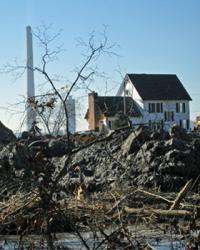
(PhysOrg.com) -- Exposure to dust and river sediment containing toxic metals and radioactivity from a coal ash spill at the Tennessee Valley Authority’s Kingston power plant last December could pose risks to local communities and aquatic ecosystems, according to a new study led by Duke University scientists.
The study, published Aug. 15 in the print version of the journal Environmental Science & Technology, is the first peer-reviewed, double-blind research paper to examine potential environmental and human health impacts in the immediate aftermath of the spill. The study was published in an online version of the journal in May.
Its authors include graduate students and researchers from Duke’s Nicholas School of the Environment and Pratt School of Engineering, the Duke Comprehensive Cancer Center and the Georgia Institute of Technology.
“Our findings emphasize the fact that although you may stop the emission of toxic elements from coal-fired power plants into the air, they remain in the fly ash that gets stored in power plants’ containment ponds, and may still end up in the environment,” said Avner Vengosh, associate professor of earth and ocean sciences at the Nicholas School.
“There are hundreds of similar coal-ash storage ponds located in the United States, and all are located next to rivers,” Vengosh said. “Yet the water in these containment ponds is not regulated.”
On December 22, 2008, the containment pond at the TVA Kingston plant collapsed, spilling more than 4.1 million cubic meters of ash into the surrounding environment.
In the weeks following the spill, the Duke team analyzed toxic elements - including radium, arsenic and mercury - in ash, sediment and water samples they collected from standing water in a tributary of the Emory River in Tennessee that had been dammed by the sludge spill, and from multiple locations downstream and upstream on the Emory and Clinch rivers.
In February, environmental engineers from Duke and Georgia Tech and medical researchers from Duke’s Comprehensive Cancer Center joined Vengosh’s team
to conduct a more detailed assessment of the spill’s potential impacts on environmental and human health.
Their analysis of ash samples revealed that the spilled sludge contained high levels of toxic metals and radioactivity, including 75 parts per million of arsenic, 150 parts per billion of mercury, and eight picocuries of per gram of total radium. A picocurie is a standard measure of radioactivity.
While the sludge remains wet, risk of exposure to its toxic contents via inhalation remains slight, Vengosh stressed. But as it dries, the risk increases.
“Our study highlights the high probability that as the ash dries, fine particulates enriched with these elements will be re-suspended in the air as dust and could have a severe health impact on local residents or workers who inhale them,” said Vengosh. Fine particulates, which are roughly the same size as bacteria, are so small that they easily can be inhaled into the deepest reaches of the lungs.
“The smaller the particulate, the higher the concentration of trace metals and radioactivity it contains,” Vengosh explained. “Particulates small enough to be inhaled into the lungs could potentially have tenfold the concentration of these elements as the samples we measured.”
People with pre-existing pulmonary disease or infections would be more susceptible, he said. However, past studies have shown that fine particulates also can pose risks for people with diabetes or a susceptibility to vascular disease. Duration of exposure to the dust and local weather conditions, as well as the rate at which the particulates are picked up into the atmosphere and the way they react with one another, are among many factors that can influence what a person’s final risk level will be. Further studies are needed, Vengosh said, to sort out the complex interplay of these factors.
In line with these recommendations, the TVA remediation activities have focused directly on preventing the spilled ash from becoming airborne. TVA has implemented an aggressive dust suppression and control program that has included using road vacuums and water trucks to suppress dust generation by vehicle traffic, wetting ash areas with truck-mounted water cannons, and establishing vegetative cover for longer-term dust management.
The TVA, together with the Tennessee Division of Environment and Conservation (TDEC) and the U.S. Environmental Protection Agency, also established a comprehensive air-monitoring program in the spill area. They are searching for airborne dust less than 10 microns in diameter (PM10) in locations throughout the surrounding community. The TVA and TDEC report that results so far have not shown violations of the National Ambient Air Quality Standards for particulates in the air.
In addition to potential human health risks, the new paper highlights the environmental impacts of the spill, particularly to the aquatic system in the Emory and Clinch rivers. The results show that some toxic elements like arsenic are highly mobilized from the ash. While high levels of toxic elements were recorded in the tributary water, the study finds that due to massive dilution these concentrations do not exceed maximum contaminant level for safe drinking water in the downstream river water.
The Duke team has begun a systematic monitoring program funded by a one-year, $105,000 grant from the National Science Foundation to evaluate the origin of high mercury levels found in the river sediments and to monitor the ramifications of high mercury on the aquatic life in the river.
High concentrations of mercury in the downstream river sediment could pose a serious long-term threat for fish populations and aquatic ecosystems in the Clinch and Emory rivers if the mercury converts into a more toxic form of the metal known as methylmercury.
“The transformation of mercury to methylmercury by anaerobic bacteria in river sediments is a concern because methylmercury is a toxin that accumulates in the food web,” Vengosh explained.
“The December 2008 TVA ash spill in Kingston, Tennessee was a wake-up call,” Vengosh said. “We have learned that coal ash can have significant potential environmental and health impacts, yet our understanding of the actual impact of the ash contaminants in hundreds of similar holding ponds is poor. Our research at the Nicholas School is currently focused on building geochemical and isotopic ‘fingerprints’ that will enable reliable quantification of the coal ash impact to the environment.”
Co-authors of the study were Laura Ruhl and Gary S. Dwyer of the Nicholas School, Heileen Hsu-Kim and Amrika Deonarine of the Pratt School of Engineering, Mike Bergin of Georgia Tech, and Julia Kravchenko of the Duke Comprehensive Cancer Center. Initial funding for the research was provided by the Nicholas School, in part through a gift from Fred and Alice Stanback of Salisbury, N.C.
Provided by Duke University


