Modified HDTV screens used for 3-D technology (w/ Video)
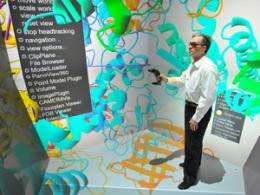
Surround 3-D TV is poised to take over your living room. For the first time, a team of researchers at the California Institute for Telecommunications and Information Technology (Calit2) at the University of California, San Diego, have designed a 9-panel, 3-D visualization display from HDTV LCD flat-screens developed by JVC.
The technology, dubbed "NexCAVE," was inspired by Calit2's StarCAVE virtual reality environment and designed and developed by Calit2 Research Scientist Tom DeFanti, Virtual Reality Design Engineer Greg Dawe, Project Scientist Jürgen Schulze and Visualization Specialist Andrew Prudhomme.
Although the StarCAVE's unique pentagon shape and 360-degree views make it possible for groups of scientists to venture into worlds as small as nanoparticles and as big as the cosmos, its expensive projection system requires constant maintenance — an obstacle DeFanti and Dawe were determined to overcome.
"It's always been our dream to make a projector-free LCD flat panel CAVE," DeFanti says. "The trick was to get the form of the huge StarCAVE into the space of a living room. We took a speculative leap by overlapping 9 panels, and it turned out better than we thought."
DeFanti and his colleagues — who include Dan Sandin, DeFanti's co-founder of the Electronic Visualization Laboratory at the University of Illinois, Chicago — developed the NexCAVE technology at the behest of Saudi Arabia's King Abdullah University of Science and Technology (KAUST), which established a special partnership with UC San Diego last year to collaborate on world-class visualization and virtual-reality research and training activities.
The KAUST campus includes a Geometric Modeling and Scientific Visualization Research Center featuring a 21-panel NexCAVE and several other new visualization displays developed at Calit2. Classes at the brand-new, state-of-the-art, 36-million square meter campus start Sept. 5.
When paired with polarized stereoscopic glasses, the NexCAVE's modular, micropolarized panels and related software will make it possible for a broad range of UCSD and KAUST scientists — from geologists and oceanographers to archaeologists and astronomers — to visualize massive datasets in three dimensions, at unprecedented speeds and at a level of detail impossible to obtain on a myopic desktop display.
"The NexCAVE's technology delivers a faithful, deep 3-D experience with great color saturation, contrast and really good stereo separation," explains DeFanti. "The JVC panels' xpol technology circularly polarizes successive lines of the screen clockwise and anticlockwise and the glasses you wear make you see, in each eye, either the clockwise or anticlockwise images. This way, the data appears in three dimensions. Since these HDTVs are very bright, 3-D data in motion can be viewed in a very bright environment, even with the lights in the room on.
"Lights-on is something that just wasn't possible with the StarCAVE."
The NexCAVE's data resolution is also superb, close to human visual acuity (or 20/20 vision), DeFanti says. The 9-panel, 3-column prototype that his team developed for Calit2's VirtuLab has a 6000x1500 pixel resolution, while the 21-panel, 7-column version being built for KAUST boasts 15,000x1500-pixel resolution.
Furthermore, DeFanti notes that the NexCAVE's LCD screens are scalloped "like turtle shells," which allows the screens' bezels (frames) to be minimized by half because the screens are tucked behind one another.
"This works particularly well with 3-D because virtual reality illusion is so strong," DeFanti notes. "You don't even see the screens or the bezels, just the 3-D images."
The costs for the NexCAVE in comparison to the StarCAVE are also considerably cheaper. The 9-panel version cost DeFanti's team under $100,000 to construct, whereas the StarCAVE is valued at $1 million. One-third of that cost comes from the StarCAVE's projectors, which burn through $15,000 in bulbs per year. Every time a projector needs to be relamped, the research team must readjust the color balance and alignment, which is a long, involved process.
Since the NexCAVE requires no projector, those costs and alignment issues are eliminated.
"The fact is, with the StarCAVE, there's lots of tuning involved if you really want to get it right. It's like tuning a piano," DeFanti says. "With the NexCAVE, you don't have to tune once it's built."
The NexCAVE'S tracker (the device used to manipulate data) is also far less expensive — it's only $5,000 as compared to the StarCAVE's $75,000 tracker, although its range is more limited.
NexCAVE's specially designed COVISE software (developed at Germany's University of Stuttgart) combines the latest developments from the world of real-time graphics and PC hardware to allow users to transcend the capabilities of the machine itself. The machine will also be connected via 10 gigabit/second networks, which allows researchers at KAUST to collaborate remotely with UCSD colleagues. The NexCAVE uses game PCs with high end Nvidia game engines.
"Our next goal is to make an autostereo NexCAVE," says DeFanti (meaning the screens won't require the use of special glasses). "And someday we hope to have organic LED screens with no bezels.
He concludes: "The implications for research and collaboration, and home adoption are, at this point, only limited by the human imagination, content availability, and, as always, your visualization/entertainment budget."
Provided by University of California - San Diego (news : web)


