SKorea delays rocket launch minutes before blast-off
August 19, 2009
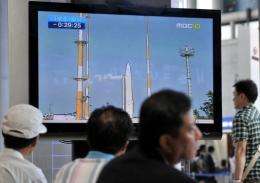
People watch a TV screen broadcasting footage of South Korea's first rocket launch at a railway station in Seoul. South Korea has postponed the launch of its first space rocket minutes before the scheduled blast-off and began dumping its fuel, live TV coverage showed.
South Korea Wednesday postponed the launch of its first space rocket just eight minutes before the scheduled blast-off, due to a technical fault.
Mission controllers suspended the launch at 4:52 pm (0752 GMT) and began dumping the rocket's fuel, the science ministry said. It was the seventh time since 2002 that the project, operated in partnership with Russia, has been delayed.
The Korea Space Launch Vehicle-1, which was due to put a satellite into orbit, was reattached to the launch pad.
"There was a problem in the automatic launch sequence that caused the launch to be called off," said Korea Aerospace Research Institute head Lee Joo-Jin, without giving details.
Lee Sang-Mock, a science ministry official in charge of the launch, said a new date would be set after consultation with experts from Russia, which manufactured the rocket's first stage.
There might have been a technical fault in a high-pressure tank, he told reporters, adding it would take several days to solve the problem.
A successful launch would make South Korea the tenth country to put a satellite into orbit using its own rocket.
Seoul has invested 502.5 billion won (419 million dollars) and much national pride in the 33-metre (108-foot) rocket, whose second stage was built by local engineers.
Seoul also built the 100-kilogram (220-pound) scientific research satellite atop the rocket at the Naro Space Centre at Goheung, 475 kilometres (300 miles) south of Seoul.
North Korea, smarting over UN Security Council censure of its own rocket launch in April, had said it would watch closely to see whether world powers also refer the South Korean launch to the Council.
Pyongyang insists it was unfairly punished for its April 5 launch, saying it merely put a peaceful communications satellite into orbit.
Washington and its allies say no satellite was detected in orbit and the North's launch was a disguised test of a Taepodong-2 missile.
Seoul has bristled at any comparisons with its neighbour's operation, insisting its own launch is purely for scientific purposes.
"The South Koreans have developed their programme in a very open and transparent way, and in keeping with the international agreements that they have signed on to," US State Department spokesman Ian Kelly said Tuesday.
"This is in stark contrast to the example set by North Korea, which has not abided by its international agreements."
Washington, concerned about a possible arms race in Northeast Asia, has however sought to restrict South Korea's missile development.
A 2001 accord with the United States bars Seoul from developing missiles with a range of more than 300 kilometres (187 miles).
Science ministry officials have denied Seoul is using Russian technology because Washington refused to transfer the necessary know-how.
However Park Jeong-Joo, director of the Korea Aerospace Research Institute, told journalists in July that Seoul "experienced a lot of difficulties in securing technology cooperation from developed countries".
South Korea has previously sent 10 satellites into space using launch vehicles from other countries.
In November 2007 it announced a plan to launch a lunar orbiter by 2020 and send a probe to the moon five years after that.
South Korea unveiled the project one month after China launched its first lunar orbiter and two months after Japan did the same.
In April last year Seoul sent its first astronaut into space aboard a Russian Soyuz rocket.
(c) 2009 AFP
-
S.Korea first rocket launch set for August 11
Aug 02, 2009 |
not rated yet |
0
-
SKorea postpones first space rocket launch: official
Mar 12, 2009 |
not rated yet |
0
-
Moscow, Seoul To Cooperate In Space Exploration
Sep 28, 2005 |
not rated yet |
0
-
In Brief: S. Korea to launch comm satellite Aug. 10
Jun 28, 2006 |
not rated yet |
0
-
South Korea launches satellite
Jul 29, 2006 |
not rated yet |
0
-
Engineers build first sub-10-nm carbon nanotube transistor
Feb 01, 2012 |
4.9 / 5 (31) |
30
-
Something old, something new: Evolution and the structural divergence of duplicate genes
Jan 31, 2012 |
4.6 / 5 (7) |
1
-
The hidden nanoworld of ice crystals: Revealing the dynamic behavior of quasi-liquid layers
Jan 30, 2012 |
5 / 5 (3) |
1
-
Stock market network reveals investor clustering
Jan 27, 2012 |
3.9 / 5 (23) |
8
-
Of microchemistry and molecules: Electronic microfluidic device synthesizes biocompatible probes
Jan 26, 2012 |
5 / 5 (1) |
0
-
Never ending outer space.....
3 hours ago
-
Neutron Star fragments?
5 hours ago
-
stationary or not?
9 hours ago
-
Scale of the Universe
Feb 10, 2012
-
Titan's lack of impact craters
Feb 09, 2012
-
Real pictures of black hole eating a star?
Feb 08, 2012
- More from Physics Forums - General Astronomy
More news stories
Europe stakes billion-dollar bet on new rocket
A pencil-slim rocket is scheduled to lift into space from South America on Monday, carrying a billion-dollar bet that Europe can grab a juicy slice of the market to place satellites in low orbit.
Space & Earth / Space Exploration
16 hours ago |
3.5 / 5 (2) |
0
Political leaders play key role in how worried Americans are by climate change: study
More than extreme weather events and the work of scientists, it is national political leaders who influence how much Americans worry about the threat of climate change, new research finds.
Feb 06, 2012 |
5 / 5 (6) |
72
NASA budget will axe Mars deal with Europe: scientists
US President Barack Obama's budget proposal to be submitted next week for 2013 will cut NASA's budget by 20 percent and eliminate a major partnership with Europe on Mars exploration, scientists said Thursday.
Space & Earth / Space Exploration
Feb 10, 2012 |
5 / 5 (3) |
48
Humans may have helped the decline of African rainforests 3000 years ago
(PhysOrg.com) -- Large areas of rainforests in Central Africa mysteriously disappeared over three thousand years ago, to be replaced by savannas. The prevailing theory has been that the cause was a change ...
High planetary tilt lowers odds for life?
Highly-tilted worlds would have extreme seasons, subjecting life to alternating periods of scorching and subzero temperatures. This could make the development of all but hardiest, simplest creatures a long ...
Space & Earth / Space Exploration
Feb 06, 2012 |
4.8 / 5 (12) |
14
|
Walney offshore wind farm is world's biggest (for now)
(PhysOrg.com) -- The Walney wind farm on the Irish Sea--characterized by high tides, waves and windy weather--officially opened this week. The farm is treated in the press as a very big deal as the Walney ...
GPS court ruling leaves US phone tracking unclear
A US Supreme Court decision requiring a warrant to place a GPS device on the car of a criminal suspect leaves unresolved the bigger issue of police tracking using mobile phones, legal experts say.
Europeans protest controversial Internet pact
Tens of thousands of people marched in protests in more than a dozen European cities Saturday against a controversial anti-online piracy pact that critics say could curtail Internet freedom.
Study finds that anti-diabetic medication can prevent the long-term effects of maternal obesity
In a study to be presented today at the Society for Maternal-Fetal Medicine's annual meeting, The Pregnancy Meeting, in Dallas, Texas, researchers will report findings that show that short therapy with the anti-diabetic medication ...
Netflix settlement trims 14 pct off 4Q earnings
(AP) -- Netflix pressed the rewind button on its fourth-quarter earnings after settling allegations that the video subscription service violated a consumer-privacy law.
Navy to begin tests on electromagnetic railgun prototype launcher
The Office of Naval Research (ONR)'s Electromagnetic (EM) Railgun program will take an important step forward in the coming weeks when the first industry railgun prototype launcher is tested at a facility ...