Homes pollute: Linked to 50 percent more water pollution than previously believed
August 19, 2009 Homes pollute:  Linked to 50 percent more water pollution than previously believed

Enlarge

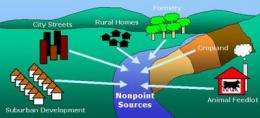
Polluted runoff originates from several sources, and has been linked to fish kills and a loss of aquatic species diversity. A new study suggests current runoff models may underestimate pollution contributed by homes by up to 50 percent. Credit: National Oceanic and Atmospheric Administration

They say there's no place like home. But scientists are reporting some unsettling news about homes in the residential areas of California. The typical house there — and probably elsewhere in the country — is an alarming and probably underestimated source of water pollution, according to a new study reported today at the 238th National Meeting of the American Chemical Society.

In the study, Lorence Oki, Darren Haver and colleagues explain that runoff results from rainfall and watering of lawns and gardens, which winds up in municipal storm drains. The runoff washes fertilizers, pesticides and other contaminants into storm drains, and they eventually appear in rivers, lakes and other bodies of water.

"Results from our sampling and monitoring study revealed high detection frequencies of pollutants such as pesticides and pathogen indicators at all sites," Oki says of their study of eight residential areas in Sacramento and Orange Counties in California.

Preliminary results of the study suggest that current models may underestimate the amount of pollution contributed by homes by up to 50 percent. That's because past estimates focused on rain-based runoff during the wet season. "Use of pesticides, however, increases noticeably during the dry season due to gardening, and our data contains greater resolution than previous studies," Oki says.

Pollutants detected in outdoor runoff included ant-control pesticide products. Previous surveys have shown that the majority of purchased by homeowners are used to control ants. To encourage pollutant reduction, the researchers initiated community outreach programs centered on improving both irrigation control and pest management.

Source: American Chemical Society (news : web)


print this article email this article download pdf blog this article bookmark this article     Stumble it Digg this share on Facebook retweet share on Reddit add to delicious
Rate this story - 3 /5 (1 vote)

Rank Filter

Move the slider to adjust rank threshold, so that you can hide some of the comments.


Display comments: newest first

  • Velanarris - Aug 20, 2009
    • Rank: not rated yet
    Blame the housing authorities there that demand you maintain a lawn or garden in what is essentially an irrigated desert.
  • Choice - Aug 22, 2009
    • Rank: not rated yet
    Maybe we should start eating ants instead?

August 19, 2009 all stories

Comments: 2

3 /5 (1 vote)
  • Stumble this up

  • Digg this

  • share this

  • hide
  • Related Stories

  • Rain gardens touted as pollution removers
    created Jan 26, 2006 | popularity not rated yet | comments 0
  • Study: Pesticides found in wine
    created Apr 04, 2008 | popularity not rated yet | comments 0
  • Many floors in U. S. homes have 'measurable' levels of pesticides
    created Jun 19, 2009 | popularity not rated yet | comments 0
  • Pesticides persist in ground water
    created Jul 01, 2008 | popularity not rated yet | comments 0
  • Pesticide concentrations decreasing
    created Oct 20, 2008 | popularity not rated yet | comments 0


  • hide
  • Relevant PhysicsForums posts

  • Will the Earth really flood when global warming happens?
    created 12 hours ago
  • A question about trends and noisy data
    created Dec 01, 2009
  • Satellite temp data
    created Dec 01, 2009
  • How is the Urban Heat Island Effect accounted for in Temp records?
    created Dec 01, 2009
  • More from Physics Forums - Earth

Other News

Samoan Tsunami wave was 46 feet high

Space & Earth / Earth Sciences

created 4 hours ago | popularity 5 / 5 (2) | comments 0

(AP) -- The tsunami that killed more than 200 people in the Samoan islands and Tonga earlier this year towered up to 46 feet (14 meters) high - more then twice as tall as most of the buildings it slammed into, scientists ...


Greenhouse gas carbon dioxide ramps up aspen growth

Space & Earth / Environment

created 5 hours ago | popularity 1 / 5 (2) | comments 0

The rising level of atmospheric carbon dioxide may be fueling more than climate change. It could also be making some trees grow like crazy.


Sandtrapped Rover Makes a Big Discovery

Sandtrapped Rover Makes a Big Discovery

Space & Earth / Space Exploration

created 16 hours ago | popularity 4.9 / 5 (30) | comments 7

Homer's Iliad tells the story of Troy, a city besieged by the Greeks in the Trojan War. Today, a lone robot sits besieged in the sands of Troy while engineers and scientists plot its escape.


Hawaiian hot spot has deep roots

Hawaiian hot spot has deep roots

Space & Earth / Earth Sciences

created 18 hours ago | popularity 4.9 / 5 (7) | comments 1

(PhysOrg.com) -- Hawaii may be paradise for vacationers, but for geologists it has long been a puzzle. Plate tectonic theory readily explains the existence of volcanoes at boundaries where plates split apart ...


Team using Subaru Telescope makes major discovery

Team using Subaru Telescope makes major discovery

Space & Earth / Astronomy

created 17 hours ago | popularity 4.8 / 5 (16) | comments 2

An international team of scientists that includes an astronomer from Princeton University has made the first direct observation of a planet-like object orbiting a star similar to the sun.