A Look into the Hellish Cradles of Suns and Solar Systems
August 19, 2009 A look into the hellish cradles of suns and solar systems

Enlarge

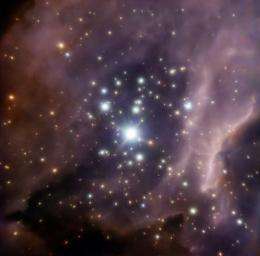
This is a color composite image of the central part of the stellar cluster RCW 38, around the young, massive star IRS2, taken with the NACO adaptive optics instrument attached to ESO's Very Large Telescope. Thanks to this image, astronomers were able to discover that IRS2 is in fact a twin system composed of two almost equally massive stars. The astronomers also found a handful of protostars -- the faintly luminous precursors to fully realised stars - and dozens of other candidate stars that have eked out an existence here despite the powerful ultraviolet light radiated by IRS2. Credit: ESO

The dense star cluster RCW 38 glistens about 5500 light years away in the direction of the constellation Vela (the Sails). Like the Orion Nebula Cluster, RCW 38 is an "embedded cluster", in that the nascent cloud of dust and gas still envelops its stars. Astronomers have determined that most stars, including the low mass, reddish ones that outnumber all others in the Universe, originate in these matter-rich locations. Accordingly, embedded clusters provide scientists with a living laboratory in which to explore the mechanisms of star and planetary formation.

"By looking at star clusters like RCW 38, we can learn a great deal about the origins of our Solar System and others, as well as those stars and planets that have yet to come", said Kim DeRose, first author of the new study that appears in the Astronomical Journal. DeRose did her work on RCW 38 while an undergraduate student at the Harvard-Smithsonian Center for Astrophysics, USA.

Using the NACO on ESO's Very Large Telescope the astronomers obtained the sharpest image yet of RCW 38. They focused on a small area in the centre of the cluster that surrounds the massive star IRS2, which glows in the searing, white-blue range, the hottest surface colour and temperatures possible for stars. These dramatic observations revealed that IRS2 is actually not one, but two stars — a binary system consisting of twin scorching stars, separated by about 500 times the Earth-Sun distance.

In the NACO image, the astronomers found a handful of protostars — the faintly luminous precursors to fully realised stars — and dozens of other candidate stars that have eked out an existence here despite the powerful ultraviolet light radiated by IRS2. Some of these gestating stars may, however, not get past the protostar stage. IRS2's strong radiation energises and disperses the material that might otherwise collapse into new stars, or that has settled into so-called protoplanetary discs around developing stars. In the course of several million years, the surviving discs may give rise to the planets, moons and comets that make up planetary systems like our own.

As if intense ultraviolet rays were not enough, crowded stellar nurseries like RCW 38 also subject their brood to frequent supernovae, as giant stars explode at the ends of their lives. These explosions scatter material throughout nearby space, including rare isotopes — exotic forms of chemical elements that are created in these dying stars. This ejected material ends up in the next generation of stars that form nearby. As these isotopes have been detected in our Sun, scientists have concluded that the Sun formed in a cluster like RCW 38, rather than in a more rural portion of the Milky Way.

"Overall, the details of astronomical objects that adaptive optics reveals are critical in understanding how new stars and planets form in complex, chaotic regions like RCW 38", says co-author Dieter Nürnberger.

More information: This research was presented in a paper that appeared in the Astronomical Journal: A Very Large Telescope / NACO study of star formation in the massive embedded cluster RCW 38, by DeRose et al. (2009, AJ, 138, 33-45).

Source: ESO (news : web)


Rate this story - 4.5 /5 (6 votes)

Rank Filter

Move the slider to adjust rank threshold, so that you can hide some of the comments.


Display comments: newest first


August 19, 2009 all stories

Comments: 1

4.5 /5 (6 votes)

  • hide
  • Related Stories

  • Stellar family in crowded, violent neighborhood proves to be surprisingly normal
    created Jun 04, 2009 | popularity not rated yet | comments 0
  • How do massive stars form?
    created Nov 08, 2005 | popularity not rated yet | comments 0
  • Supernova radioisotopes show sun was born in star cluster
    created Oct 04, 2006 | popularity not rated yet | comments 0
  • Planets Living on the Edge
    created Dec 17, 2008 | popularity not rated yet | comments 0
  • The little man and the cosmic cauldron
    created May 27, 2008 | popularity not rated yet | comments 0


  • hide
  • Relevant PhysicsForums posts

  • Spreading Life in the Universe
    created 16 hours ago
  • Force of Gravity in terms of Density
    created Feb 08, 2010
  • what is the relation between gravity and light?
    created Feb 08, 2010
  • Does the Thermoelectric effect apply in sun?
    created Feb 07, 2010
  • More from Physics Forums - General Astronomy

Other News

Space shuttle Endeavour pulls in at space station (AP)

Space shuttle Endeavour pulls in at space station

Space & Earth / Space Exploration

created 5 hours ago | popularity 5 / 5 (1) | comments 0

(AP) -- Shuttle Endeavour arrived to a warm welcome at the International Space Station early Wednesday, delivering a new room and observation deck that will come close to completing construction 200 miles ...


Climate 'Tipping Points' May Arrive Without Warning, Says Top Forecaster

Space & Earth / Environment

created 15 hours ago | popularity 3 / 5 (8) | comments 10 | with audio podcast

(PhysOrg.com) -- A new University of California, Davis, study by a top ecological forecaster says it is harder than experts thought to predict when sudden shifts in Earth's natural systems will occur -- a worrisome finding ...


38 percent of world's surface in danger of desertification

38 percent of world's surface in danger of desertification

Space & Earth / Environment

created 11 hours ago | popularity 2 / 5 (4) | comments 5

A team of Spanish researchers has measured the degradation of the planet's soil using the Life Cycle Assessment (LCA), a scientific methodology that analyses the environmental impact of human activities, and ...


A new 3-D map of the interstellar gas within 300 parsecs from the sun

A new 3D map of the interstellar gas within 300 parsecs from the Sun

Space & Earth / Astronomy

created 17 hours ago | popularity 5 / 5 (5) | comments 0 | with audio podcast

(PhysOrg.com) -- Astronomy & Astrophysics is publishing new 3D maps of the interstellar gas in the local area around our Sun. A French-American team of astronomers presents new absorption measurements toward ...


URI researcher calls for global effort to monitor marine pollutants

Space & Earth / Environment

created 16 hours ago | popularity 3 / 5 (2) | comments 1

A University of Rhode Island researcher who studies chemical pollutants in the marine environment has called on colleagues around the world to establish a global monitoring network to verify that the chemicals banned by the ...