Scientists develop targeted cancer treatment using nanomaterials
August 19, 2009
Scientists develop targeted cancer treatment using nanomaterials

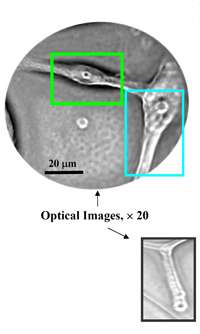
Above: X-ray fluorescent imaging of the TiO2-mAb binding to the single brain cancer cells. The bare titianium dioxide nanoparticle bonds with an antibody and attaches itself to brain cancer cells. When exposed to concentrated white light, the titanium dioxide creates free radicals of oxygen that cause the cancer cells to die.

(PhysOrg.com) -- Scientists from the U.S. Department of Energy's Argonne National Laboratory and the University of Chicago's Brain Tumor Center have developed a way to target brain cancer cells using inorganic titanium dioxide nanoparticles bonded to soft biological material.

Thousands of people die from malignant brain tumors every year, and the tumors are resistant to conventional therapies. This nano-bio technology may eventually provide an alternative form of therapy that targets only cancer cells and does not affect normal living tissue.

"It is a real example of how nano and biological interfacing can be used for biomedical application," said scientist Elena Rozhkova with Argonne's Center for . "We chose brain cancer because of its difficulty in treatment and its unique receptors."

This new therapy relies on a two-pronged approach. is a versatile photoreactive nanomaterial that can be bonded with biomolecules. When linked to an antibody nanoparticles recognize and bind specifically to cancer cells. Focused visible light is shined onto the affected region, and the localized titanium dioxide reacts to the light by creating free oxygen radicals that interact with the mitochondria in the cancer cells. Mitochondria act as cellular energy plants, and when free radicals interfere with their biochemical pathways, mitochondria receive a signal to start cell death.

"The significance of this work lies in our ability to effectively target nanoparticles to specific cell surface receptors expressed on cells," said Dr. Maciej S. Lesniak, Director of Neurosurgical Oncology at University of Chicago Brain Tumor Center. "In so doing, we have overcome a major limitation involving the application of nanoparticles in medicine, namely the potential of these agents to distribute throughout the body. We are now in a position to develop this exciting technology in preclinical models of tumors, with the hope of one day employing this new technology in patients."

X-ray fluorescence microscopy done at Argonne's Advanced Photon Source also showed that the tumors' invadopodia, actin-rich micron scale protrusions that allow the cancer to invade surrounding healthy cells, can be also attacked by the titanium dioxide.

So far, tests have been done only on cells in a laboratory setting, but animal testing is planned for the next phase. Results show an almost 100 percent cancer cell toxicity rate after six hours of illumination, and 80 percent after 48 hours.

Also, since the antibody only targets the , surrounding healthy cells are not affected, unlike other cancer treatments such as chemotherapy and radiotherapy.
Rozhkova said that a proof of concept is demonstrated, and other cancers can be treated as well using different targeting molecules, but research is in the early stages.

More information: This work is published in a Nano Letters and is available online at http://pubs.acs.or … 21/nl901610f .

Source: Argonne National Laboratory (news : web)

Filter


Move the slider to adjust rank threshold, so that you can hide some of the comments.


Display comments: newest first

webitube
Aug 19, 2009

Rank: not rated yet
"Results show an almost 100 percent cancer cell toxicity rate after six hours of illumination, and 80 percent after 48 hours." -- Can someone please explain this? Does this mean that the toxicity rate drops from nearly 100% down to 80% as the treatment proceeds from the 6th hour to the 48th hour?
E_L_Earnhardt
Aug 19, 2009

Rank: not rated yet
COOL the site and the tumor will shrink.
Rank 5 /5 (3 votes)
Relevant PhysicsForums posts
  • Factors affecting beet root cell membrane
    created2 hours ago
  • Stem cell question.
    createdFeb 10, 2012
  • Protease cleavage
    createdFeb 10, 2012
  • Pertubance in a model
    createdFeb 10, 2012
  • Cancer drugs and Alzheimer's, Oh my!
    createdFeb 09, 2012
  • Squishing cells
    createdFeb 09, 2012
  • More from Physics Forums - Biology

More news stories

New kind of solar cell could capture significantly more energy than current cells

New solar cells could increase the maximum efficiency of solar panels by over 25%, according to scientists from the University of Cambridge.

Nanotechnology / Nanophysics

created Feb 08, 2012 | popularity 4.5 / 5 (12) | comments 14 | with audio podcast

Nanoshell whispering galleries improve thin solar panels

Visitors to Statuary Hall in the U.S. Capitol Building may have experienced a curious acoustic feature that allows a person to whisper softly at one side of the cavernous, half-domed room and for another on ...

Nanotechnology / Nanomaterials

created Feb 07, 2012 | popularity 4.3 / 5 (6) | comments 6 | with audio podcast

'Dark plasmons' transmit energy

Microscopic channels of gold nanoparticles have the ability to transmit electromagnetic energy that starts as light and propagates via "dark plasmons," according to researchers at Rice University.

Nanotechnology / Nanophysics

created Feb 09, 2012 | popularity 4.8 / 5 (9) | comments 1 | with audio podcast

Revealing how a battery material works

Since its discovery 15 years ago, lithium iron phosphate (LiFePO4) has become one of the most promising materials for rechargeable batteries because of its stability, durability, safety and ability to deliver ...

Nanotechnology / Nanomaterials

created Feb 08, 2012 | popularity 5 / 5 (5) | comments 0 | with audio podcast

Harnessing plasmonics, engineers weld nanowires with light

At the nano level, researchers at Stanford have discovered a new way to weld together meshes of tiny wires. Their work could lead to exciting new electronics and solar applications. To succeed, they called ...

Nanotechnology / Nanophysics

created Feb 06, 2012 | popularity 4.8 / 5 (11) | comments 1 | with audio podcast


Google might launch Drive for cloud storage soon

(PhysOrg.com) -- Google's next big move, according to the Wall Street Journal, is a cloud storage service called Drive. Hardly first to the plate, Google is simply catching up to introducing its cloud reposi ...

Latin America mining boom clashes with conservation

Latin America is experiencing a mining boom as prices rise fuelled by a hike in global demand, but the region is also being hit by a wave of violent protests, strikes and rallies by environmentalists.

Love a click away in Indonesia's Twitter Republic

He was a geeky kid from Yogyakarta, she a glamorous city girl in Jakarta. In a country with one of the world's most vibrant social networking scenes they fell in love on Twitter.

Europeans protest controversial Internet pact

Tens of thousands of people marched in protests in more than a dozen European cities Saturday against a controversial anti-online piracy pact that critics say could curtail Internet freedom.

Walney offshore wind farm is world's biggest (for now)

(PhysOrg.com) -- The Walney wind farm on the Irish Sea--characterized by high tides, waves and windy weather--officially opened this week. The farm is treated in the press as a very big deal as the Walney ...

Navy to begin tests on electromagnetic railgun prototype launcher

The Office of Naval Research (ONR)'s Electromagnetic (EM) Railgun program will take an important step forward in the coming weeks when the first industry railgun prototype launcher is tested at a facility ...