Breakthrough uses light to manipulate cell movement
August 19, 2009 Breakthrough uses light to manipulate cell movement

Enlarge

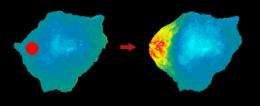
A photoactivatable protein enables control of cell movement in living cells. Activation of Rac in the red circle led to localized cell protrusion and translocation of the kinase PAK to the cell edge (right hand image, Pak in red). Credit: Yi Wu, UNC-Chapel Hill.

One of the biggest challenges in scientists' quest to develop new and better treatments for cancer is gaining a better understanding of how and why cancer spreads. Recent breakthroughs have uncovered how different cellular proteins are turned 'on' or 'off' at the molecular level, but much remains to be understood about how protein signaling influences cell behavior.

A new technique developed by Klaus Hahn, Ph.D. and his colleagues uses light to manipulate the activity of a protein at precise times and places within a living cell, providing a new tool for scientists who study the fundamentals of protein function.

In a paper published today in the journal Nature, Hahn, who is the Thurman Professor of Pharmacology at the University of North Carolina at Chapel Hill and a member of UNC Lineberger Comprehensive Cancer Center, described the technique, which uses light to control protein behavior in and animals simply by shining light on the cells where they want the protein to be active.

"The technology has exciting applications in basic research - in many cases the same protein can be either cancer-producing or beneficial, depending on where in a cell it is activated. Now researchers can control where that happens and study this heretofore inaccessible level of cellular control," said Hahn.

"Because we first tested this new technology on a that initiates cell movement, we can now use light to control where and how cells move. This is quite valuable in studies where cell movement is the focus of the research, including embryonic development, nerve regeneration and ," he added.

The new technology is an advance over previous light-directed methods of cellular control that used toxic wavelengths of life, disrupted the cell membrane or could switch proteins 'on' but not 'off'.

Source: University of North Carolina School of Medicine (news : web)


print this article email this article download pdf blog this article bookmark this article     Stumble it Digg this share on Facebook retweet share on Reddit add to delicious
Rate this story - 5 /5 (6 votes)

Rank Filter

Move the slider to adjust rank threshold, so that you can hide some of the comments.


Display comments: newest first

  • Ethelred - Aug 19, 2009
    • Rank: not rated yet
    Wow, the spammer was exhausted by that last three sentence SPAM and is back to the usual one. This one even more inane than usual.

    Ethelred

    Sorry for the new signature. But It Needed Killun.

    From QubitTamer's fake profile

    Quantum Physicist, torturer of AGW religious zealots like Ethelred because i laugh at his hysterics.


    Qubitwit gets the rest of August in my signature for aiming his idiocy at me. Again.

August 19, 2009 all stories

Comments: 1

5 /5 (6 votes)
  • Stumble this up

  • Digg this

  • share this

  • hide
  • Related Stories


  • hide
  • Relevant PhysicsForums posts

  • Specific Heat experiment
    created 7 hours ago
  • MO diagram of NO
    created 19 hours ago
  • limiting reagent
    created 22 hours ago
  • preparation of acetanilide
    created 22 hours ago
  • More from Physics Forums - Chemistry

Other News

Sandia CR5

Machine Converts CO2 into Gasoline, Diesel, and Jet Fuel

Chemistry / Biochemistry

created Nov 23, 2009 | popularity 4.6 / 5 (31) | comments 20

(PhysOrg.com) -- Researchers at Sandia National Laboratories have built a machine that uses the sun's energy to convert carbon dioxide waste from power plants into transportation fuels such as gasoline, diesel, ...


New hydrogen-storage method discovered

New hydrogen-storage method discovered

Chemistry / Materials Science

created Nov 22, 2009 | popularity 4.3 / 5 (42) | comments 15

Scientists at the Carnegie Institution have found for the first time that high pressure can be used to make a unique hydrogen-storage material. The discovery paves the way for an entirely new way to approach ...


New chemical reaction offers opportunities for drug development

Chemistry / Biochemistry

created Nov 26, 2009 | popularity not rated yet | comments 2

Researchers led by Conway Fellow, Professor Pat Guiry have solved a chemistry problem that has stumped researchers worldwide for more than a decade. The results have earned the group the cover story of the leading scientific ...


Research sheds light on workings of anti-cancer drug

Chemistry / Analytical Chemistry

created Nov 26, 2009 | popularity not rated yet | comments 0

(PhysOrg.com) -- The copper sequestering drug tetrathiomolybdate (TM) has been shown in studies to be effective in the treatment of Wilson disease, a disease caused by an overload of copper, and certain metastatic cancers. ...


Chemists get custom-designed microscopic particles to self-assemble in liquid crystal

Chemists get custom-designed microscopic particles to self-assemble in liquid crystal

Chemistry / Materials Science

created Nov 25, 2009 | popularity 5 / 5 (5) | comments 0

(PhysOrg.com) -- The scientists anticipate their "LithoParticles" will have significant applications in photonics, optical communications and other areas.