The Ultimate Long Distance Communication
August 19, 2009
The Ultimate Long Distance Communication

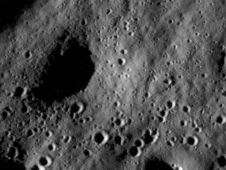
This image shows cratered regions near the moon's Mare Nubium region, as photographed by the Lunar Reconnaissance Orbiter. Credit: NASA

Anyone who's vacationed in the mountains or lived on a farm knows that it's hard to get good internet access or a strong cell phone signal in a remote area. Communicating across great distances has always been a challenge. So when NASA engineers designed the Lunar Reconnaissance Orbiter (LRO), they knew it would need an extraordinary communications system.

Over the next year, the LRO, NASA's diligent robotic scout, will collect more information about the moon's surface and environment than any previous mission. It takes a powerful system to send all of this information more than 238,800 miles back to Earth.

With this new amplifier, LRO can transmit 461 gigabytes of data per day. That's more information than you can find in a four-story library. And it transmits this information at a rate of up to 100 megabytes per second. By comparison, typical high-speed internet service provides about 1 to 3 megabytes per second.

L-3 Communications Electron Technologies built the amplifier under the supervision of NASA's Glenn Research Center in Cleveland. The device uses electrodes in a to amplify microwave signals to high power. It's ideal for sending large amounts of data over a long distance because it provides more power and more efficiency than its alternative, the transistor amplifier.

As the orbiter collects information about the moon's geography, climate and environment, the communication system transmits this information to a receiver at a Ka band antenna network at White Sands Test Facility in New Mexico. Scientists are using the data to compile high-resolution, 3D maps of the lunar surface.

Traveling Wave Tube Amplifiers have been used for other planetary missions, such as Kepler and Cassini, but previous designs were less powerful. According to Rainee Simons, chief of Glenn's Electron and Optoelectronic Device Branch, engineers had to redesign the internal circuitry of the amplifier.

"In order to provide the power and frequency needed to send communications from the vicinity of the moon, it had to be custom designed and handmade," he said.
The Ultimate Long Distance Communication

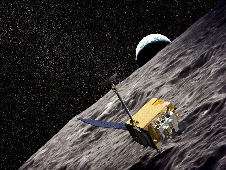
This image shows cratered regions near the moon's Mare Nubium region, as photographed by the Lunar Reconnaissance Orbiter. Credit: NASA

The orbiter's Traveling Wave Tube Amplifier is also more efficient than previous amplifiers. When it comes to launching satellites, weight means money. The heavier the spacecraft, the more fuel it needs to reach orbit. Because the new amplifier packs more power into a lighter design than previous microwave amplifiers, it's cheaper to fly.

The amplifier underwent vigorous spaceflight testing -- including vibration, thermal vacuum, radiation and electromagnetic interference tests -- to ensure that it could withstand the intense conditions of launch and lunar orbit.

Simons, Peterson and other members of the Glenn team were on standby when LRO entered its final orbit and began transmitting data. They were thrilled to hear that it's working properly, not only because LRO is a vital step toward returning humans to the moon, but also because they believe the new amplifier can improve life on Earth in countless ways.

If used on communication satellites, it could allow for much better tracking, monitoring and control of transoceanic flights and ships traveling beyond the reach of radar.

It also could enable real-time data transfer from future Earth-orbiting satellites. Such satellites are used to track migratory animals, endangered species, icebergs, volcanic eruptions and forest fires, and to aid in search and rescue operations. They're used to study climate change and meteorology as well.

According to Simons, by collecting more timely data about the interaction of our atmosphere, ocean and land, we could save lives and property during severe weather.

"This technology has the potential to create a better world," he said.

Source: by Jan Wittry (SGT, Inc.), NASA's Glenn Research Center

4.3 /5 (21 votes)  

Filter


Move the slider to adjust rank threshold, so that you can hide some of the comments.


Display comments: newest first

Damon_Hastings
Aug 19, 2009

Rank: 5 / 5 (1)
And it transmits this information at a rate of up to 100 megabytes per second. By comparison, typical high-speed internet service provides about 1 to 3 megabytes per second.

Hmm... you mean "megabits", right? That's how bandwidth is usually measured -- and most low-to-mid range internet service is 1 to 3 Mbps (megabits per second).
Fazer
Aug 19, 2009

Rank: not rated yet
Hmmm, I think they do mean bytes. 1-3 MBytes times 8 bits is 8-24 Mbits, which is about normal for High Speed Internet. I get about 10 Mbits over cable, and I don't pay for the fastest. I think FIOS is about 25 Mbits.

Either way, that is pretty good service from the moon!
TJ_alberta
Aug 19, 2009

Rank: 1 / 5 (1)
is this an ad for L-3 Communications Electron Technologies' TWTs ?
dachpyarvile
Aug 19, 2009

Rank: not rated yet
I get 12 Mbps but could get 20 Mbps if I wanted it. FIOS can get up to 50 Mbps using current tech.
Uri
Aug 20, 2009

Rank: 5 / 5 (1)
Has to be megabits/sec or the average transmission speed is much lower than the max. Otherwise the 461 Gigabytes / day is way low. @ 100 Megabytes/sec they could transmit 461 Gigabytes in ~ 1 hours 17 minutes.

100 megabytes/sec also could be raw data rate IE not accounting for forward error correction, where the 461 Gigabytes / day could be just the data payload... need more info
dachpyarvile
Aug 20, 2009

Rank: 5 / 5 (1)
Satellites and space communications arrays do not transmit data 24/7. They transmit when given commands to transmit.
John_balls
Aug 20, 2009

Rank: not rated yet
Hmmm, I think they do mean bytes. 1-3 MBytes times 8 bits is 8-24 Mbits, which is about normal for High Speed Internet. I get about 10 Mbits over cable, and I don't pay for the fastest. I think FIOS is about 25 Mbits.

Either way, that is pretty good service from the moon!

I have the 25mbs fios package and they also offer 50mbs if you want to pony up the extra cash.
holoman
Aug 20, 2009

Rank: 4 / 5 (1)
quantum entanglement the ultimate communication ?
Uri
Aug 20, 2009

Rank: 5 / 5 (1)
Satellites and space communications arrays do not transmit data 24/7. They transmit when given commands to transmit.


Understood, but the article claims "it can" transmit that amount of data / day. That would seem to indicate an upper bound. Its also likely behind the moon a fair amount as well so its likely transmitting quite a bit less than 24 hours a day.
stonehat
Aug 20, 2009

Rank: not rated yet
Does the author of the article:
1. Understand the meaning of the word "Ultimate" ?
2. Understand that there are places that are further away than the moon ?

dachpyarvile
Aug 20, 2009

Rank: 5 / 5 (2)
Satellites and space communications arrays do not transmit data 24/7. They transmit when given commands to transmit.


Understood, but the article claims "it can" transmit that amount of data / day. That would seem to indicate an upper bound. Its also likely behind the moon a fair amount as well so its likely transmitting quite a bit less than 24 hours a day.


Yes, the devices will communicate from time to time, likely between two to four times a day and that data will be the total maximum for that day. Most days will not produce that much data unless commanded otherwise.

Additionally, the communications speeds for previous equipment is much less. Even with the new system there will be bandwidth overhead and communication transmission and receipt delays due to the distance between the earth and the moon (and, in the case of use of satellites, additional bandwidth overhead and communications delays due to using satellites as relays for out of line-of-site communication), which will limit the amount of data to be sent overall.

Still, compared to all the outdated technology this is the ultimate long distance communication and command system.

Will they come up with something better in the future? Sure! Something faster? Certainly! But, for now, this new system is the ultimate system that we can have at current technology. I think it a wonderful advance. To me, the article is no exaggeration.
Rank 4.3 /5 (21 votes)
Related Stories
Relevant PhysicsForums posts
  • Titan's lack of impact craters
    createdFeb 09, 2012
  • Real pictures of black hole eating a star?
    createdFeb 08, 2012
  • Hypothetical way to travel faster than light, but not technically exceed lightspeed
    createdFeb 06, 2012
  • How do scientists monitor the Sun's activity?
    createdFeb 05, 2012
  • Search patterns in observational studies
    createdFeb 05, 2012
  • Derivation of Pogson's law
    createdFeb 03, 2012
  • More from Physics Forums - General Astronomy

More news stories

NASA sees wide-eyed cyclone Jasmine

Cyclone Jasmine's eye has opened wider on NASA satellite imagery, as it moves through the Southern Pacific Ocean.

Space & Earth / Earth Sciences

created 20 minutes ago | popularity not rated yet | comments 0

NASA sees Giovanna reach cyclone strength, threaten Madagascar

Tropical Storm 12S built up steam and became a cyclone on February 10, 2012 as NASA's Terra satellite passed overhead. Residents of east-central Madagascar should prepare for this cyclone to make landfall ...

Space & Earth / Earth Sciences

created 19 minutes ago | popularity not rated yet | comments 0

Humans may have helped the decline of African rainforests 3000 years ago

(PhysOrg.com) -- Large areas of rainforests in Central Africa mysteriously disappeared over three thousand years ago, to be replaced by savannas. The prevailing theory has been that the cause was a change ...

Space & Earth / Environment

created 12 hours ago | popularity 4.2 / 5 (5) | comments 10 | with audio podcast report

Could Venus be shifting gear?

(PhysOrg.com) -- ESA’s Venus Express spacecraft has discovered that our cloud-covered neighbour spins a little slower than previously measured. Peering through the dense atmosphere in the infrared, the ...

Space & Earth / Space Exploration

created 8 hours ago | popularity 5 / 5 (5) | comments 7 | with audio podcast

Mars Science Laboratory computer issue resolved

(PhysOrg.com) -- Engineers have found the root cause of a computer reset that occurred two months ago on NASA's Mars Science Laboratory and have determined how to correct it.

Space & Earth / Space Exploration

created 9 hours ago | popularity 5 / 5 (5) | comments 3 | with audio podcast


CIA website offline, Anonymous takes credit

The website of the Central Intelligence Agency was unresponsive on Friday after the hacker group Anonymous claimed to have knocked it offline.

Complex wiring of the nervous system may rely on a just a handful of genes and proteins

Researchers at the Salk Institute have discovered a startling feature of early brain development that helps to explain how complex neuron wiring patterns are programmed using just a handful of critical genes. ...

The power of estrogen -- male snakes attract other males

A new study has shown that boosting the estrogen levels of male garter snakes causes them to secrete the same pheromones that females use to attract suitors, and turned the males into just about the sexiest ...

New error-correcting codes guarantee the fastest possible rate of data transmission

Error-correcting codes are one of the triumphs of the digital age. They’re a way of encoding information so that it can be transmitted across a communication channel — such as an optical fiber o ...

Small modular reactor design could be a 'SUPERSTAR'

(PhysOrg.com) -- Though most of today's nuclear reactors are cooled by water, we've long known that there are alternatives; in fact, the world's first nuclear-powered electricity in 1951 came from a reactor ...

Curry spice component may help slow prostate tumor growth

Curcumin, an active component of the Indian curry spice turmeric, may help slow down tumor growth in castration-resistant prostate cancer patients on androgen deprivation therapy (ADT), a study from researchers ...