Galaxies Demand a Stellar Recount
August 19, 2009 Galaxies Demand a Stellar Recount

Enlarge

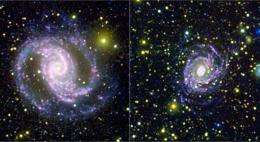
Images from NASA's Galaxy Evolution Explorer spacecraft and the Cerro Tololo Inter-American Observatory in Chile.

(PhysOrg.com) -- For decades, astronomers have gone about their business of studying the cosmos with the assumption that stars of certain sizes form in certain quantities. Like grocery stores selling melons alone, and blueberries in bags of dozens or more, the universe was thought to create stars in specific bundles. In other words, the proportion of small to big stars was thought to be fixed. For every star 20 or more times as massive as the sun, for example, there should be 500 stars with the sun's mass or less.

This belief, based on years of research, has been tipped on its side with new data from NASA's Galaxy Evolution Explorer. The ultraviolet telescope has found proof that small stars come in even bigger bundles than previously believed; for example, in some places in the cosmos, about 2,000 low-mass stars may form for each massive star. The little stars were there all along but masked by massive, brighter stars.

"What this paper is showing is that some of the standard assumptions that we've had - that the brightest stars tell you about the whole population of stars - this doesn't seem to work, at least not in a constant way," said Gerhardt R. Meurer, principal investigator on the study and a research scientist at Johns Hopkins University, Baltimore, Md.

Astronomers have long known that many stars are too dim to be seen in the glare of their brighter, more massive counterparts. Though the smaller, lighter stars outnumber the big ones, they are harder to see. Going back to a grocery story analogy, the melons grab your eyes, even though the total weight of the blueberries may be more.

Beginning in the 1950s, astronomers came up with a method for counting all the stars in a region, even the ones they couldn't detect. They devised a sort of stellar budget, an equation called the "stellar initial mass function," to estimate the total number of stars in an area of the sky based on the light from only the brightest and most massive. For every large star formed, a set number of smaller ones were thought to have been created regardless of where the stars sat in the universe.

"We tried to understand properties of galaxies and their mass by looking at the light we can see," Meurer said.

But this common assumption has been leading astronomers astray, said Meurer, especially in galaxies that are intrinsically small and faint.

To understand the problem, imagine trying to estimate the population on Earth by observing light emitted at night. Looking from above toward North America or Europe, the regions where more people live light up like signposts. Los Angeles, for example, is easily visible to a scientist working on the International Space Station. However, if this method were applied to regions where people have limited electricity, populations would be starkly underestimated, for example in some sections of Africa.

The same can be said of galaxies, whose speckles of light in the dark of space can be misleading. Meurer and his team used ultraviolet images from the Galaxy Evolution Explorer and carefully filtered red-light images from telescopes at the Cerro Tololo International Observatory in Chile to show that many galaxies do not form a lot of , yet still have plenty of lower-mass counterparts. The ultraviolet images are sensitive to somewhat small stars three times or more massive than the sun, while the filtered optical images are only sensitive to the largest stars with 20 or more times the mass of the sun.

The effects are particularly important in parts of the universe where stars are spread out over a larger volume -- the rural Africa of the cosmos. There could be about four times as many stars in these regions than previously estimated.

"Especially in these that seem small and piddling, there can be a lot more mass in lower mass stars than we had previously expected from what we could see from the brightest, youngest ," Meurer said. "But we can now reduce these errors using satellites like the Galaxy Evolution Explorer."

This research was published in the April 10, 2009, issue of .

Provided by JPL/NASA (news : web)


print this article email this article download pdf blog this article bookmark this article     Stumble it Digg this share on Facebook retweet share on Reddit add to delicious
Rate this story - 4.8 /5 (16 votes)

Rank Filter

Move the slider to adjust rank threshold, so that you can hide some of the comments.


Display comments: newest first

  • Mercury_01 - Aug 19, 2009
    • Rank: 5 / 5 (2)
    def, def- definitely 49 billion and thirty two galaxies. definitely.
  • brant - Aug 20, 2009
    • Rank: 5 / 5 (2)
    All the galaxies are ro, ro, - round. Mostly round...
  • rwinners - Aug 20, 2009
    • Rank: 4 / 5 (4)
    Every time we look with better instruments, we see more and farther, the universe becomes bigger and we become even more insignificant. Can't wait for Hubble's successor!
  • visual - Aug 20, 2009
    • Rank: 5 / 5 (2)
    Mercury, brant, forgive my ignorance, but what reference are you trying to make with that stutter?
  • JaguarEye - Aug 20, 2009
    • Rank: 3.3 / 5 (4)
    So what does this mean for the issue of Dark Matter being put forth as an explaination for the discrepancy between 'observed' mass and the mass thats thats calculated to be necessary for the galaxies to gravitationally hold together. Does this mean we have been estimating the mass of galaxies all wrong? would the adjusted figure more properly fit current gravitational models?
  • degojoey - Aug 20, 2009
    • Rank: 2.3 / 5 (3)
    Dark Matter is bull.
  • mysticfree - Aug 20, 2009
    • Rank: 5 / 5 (1)
    Visual, watch the movie "Rainman"
  • AAhhzz - Aug 20, 2009
    • Rank: 2.7 / 5 (3)
    Well Jaquar, sounds like they just admitted that the estimate they were using was off by at least 4

    " In other words, the proportion of small to big stars was thought to be fixed. For every star 20 or more times as massive as the sun, for example, there should be 500 stars with the sun's mass or less.

    ...proof that small stars come in even bigger bundles than previously believed; for example, in some places in the cosmos, about 2,000 low-mass stars may form for each massive star. The little stars were there all along but masked by massive, brighter stars.

    Now if they were that far off on the estimate of the stars, wonder how far off they are on brown dwarfs, and smaller objects still.

    Maybe the Dark Matter that is proving so elusive to find is just regular matter that has been estimated.. " This belief, based on years of research, has been tipped on its side with new data from NASA's Galaxy Evolution Explorer." ... a bit low....based on thier belief
  • El_Nose - Aug 20, 2009
    • Rank: 3 / 5 (2)
    I wonder how this, the number of stars specifically that can now be seen, since we seem sto off by a factor of four in some places, impacts our persection of the amount of observable matter in the universe... is there less dark matter than previously thought?
  • nilbud - Aug 20, 2009
    • Rank: not rated yet
    "Though the smaller, lighter stars outnumber the big ones, they are harder to see. Going back to a grocery story analogy, the melons grab your eyes, even though the total weight of the blueberries may be more. "

    That has to be the most unnecessary and worst analogy in recorded history.
  • Mercury_01 - Aug 20, 2009
    • Rank: 2.7 / 5 (3)
    Dark matter isn't bull, dark energy is bull!
  • DArtagnon - Aug 20, 2009
    • Rank: 3 / 5 (3)
    This article only spoke of numbers of stars, not of the collective mass of the universe.

    If you break all your crayons and put them back in the box, you still have the same amount of wax, but another person guessing how many pieces would be wrong (until they got better tools).
  • JaguarEye - Aug 20, 2009
    • Rank: 3.8 / 5 (4)
    This is not about breaking up the crayons and counting them another way... this is about realizing that many small crayons went uncounted....
  • Au-Pu - Aug 23, 2009
    • Rank: 5 / 5 (1)
    The search for dark matter was initiated because the estimates for total observable matter was only 20% (roughly) of what was needed to support the big bang theory.
    So if this means that they can up their estimates by a factor of 4 that would give them 40% of what they need.
    Almost puts them there.
    If this is correct then the search for dark matter can be lightened to a search for shady matter.
  • Au-Pu - Aug 23, 2009
    • Rank: not rated yet
    Apologies: 40% should have read 80%.
  • Caliban - Aug 23, 2009
    • Rank: not rated yet
    Adding the additional mass of the neutrino ocean that the observable universe swims in, are we now talking about enough mass to make a 'closed' universe?
  • RDD1977 - Aug 24, 2009
    • Rank: not rated yet
    caliban .. im betting closed in 3d, undefined in 4(could go either way). DM is based on flawed observations/models and a determination to waste decades arguing about how many angels can dance on the head of a pin to gain reward from the gods of grants (who are not just retarded, not even has-beens but apeish socio-political never-weres). Which is a vast improvement on the 3 centuries and the burning people for disagreeing thing we did last time around, so hurah for humanity!
    I'm also thinking that the universe isnt expanding, red shift is caused by plasma not by stuff moving. Hubble got it wrong because in his model space is a near perfect vacum, which we know to be false. GO HUMANS! We rock :)

August 19, 2009 all stories

Comments: 17

4.8 /5 (16 votes)
  • Stumble this up

  • Digg this

  • share this

  • hide
  • Related Stories

  • Huge Black Holes Stifle Star Formation
    created Aug 23, 2006 | popularity not rated yet | comments 0
  • 'Big baby' galaxy found in newborn Universe
    created Sep 28, 2005 | popularity not rated yet | comments 0
  • Orphan stars found in long galaxy tail
    created Sep 20, 2007 | popularity not rated yet | comments 0
  • Galaxy Evolution Explorer Mission Celebrates Sixth Anniversary
    created Apr 28, 2009 | popularity not rated yet | comments 0
  • Our Galaxy may be bigger than we thought
    created Aug 10, 2005 | popularity not rated yet | comments 0


  • hide
  • Relevant PhysicsForums posts

  • Question about 2-body gravity
    created Nov 24, 2009
  • life on Mars
    created Nov 24, 2009
  • Semi-major axis from cartesian co-ordinates
    created Nov 23, 2009
  • Primary Mirror grinding
    created Nov 23, 2009
  • dark energy can escape black holes.
    created Nov 23, 2009
  • Are there green, purple and pink stars?
    created Nov 22, 2009
  • More from Physics Forums - General Astronomy

Other News

Cosmic 'dig' reveals vestiges of the Milky Way's building blocks

Cosmic 'Dig' Reveals Vestiges of the Milky Way's Building Blocks

Space & Earth / Astronomy

created 44 minutes ago | popularity 5 / 5 (1) | comments 0

(PhysOrg.com) -- Peering through the thick dust clouds of our galaxy's "bulge" (the myriads of stars surrounding its center), a team of astronomers has unveiled an unusual mix of stars in the stellar grouping ...


Cutting greenhouse pollutants could directly save millions of lives worldwide

Space & Earth / Environment

created 2 hours ago | popularity 1 / 5 (2) | comments 1

Tackling climate change by reducing carbon dioxide and other greenhouse emissions will have major direct health benefits in addition to reducing the risk of climate change, especially in low-income countries, according to ...


Small faults in Southeast Spain reduce earthquake risk of larger ones

Small faults in Southeast Spain reduce earthquake risk of larger ones

Space & Earth / Earth Sciences

created 3 hours ago | popularity not rated yet | comments 0

A team of Spanish scientists, studying recent, active deformations in the Baetic mountain range, have shown that the activity of smaller tectonic structures close to larger faults in the south east of the ...


Mars Reconnaissance Orbite

Mars Reconnaissance Orbite Team Plans Uplink of Protective Files

Space & Earth / Space Exploration

created 5 hours ago | popularity 5 / 5 (1) | comments 0

(PhysOrg.com) -- The team operating NASA's Mars Reconnaissance Orbiter plans to uplink protective files to the spacecraft next week as one step toward resuming the orbiter's research and relay activities.


It's not just dirt!

Space & Earth / Environment

created 2 hours ago | popularity 5 / 5 (1) | comments 0

Soil is the linchpin of the environment, where atmosphere, biosphere, and hydrosphere meet. Despite that, many students see soil as "just dirt" - a place to grow plants, but nothing more. Soil science educators are challenged ...