Solving the Nuclear Pore Puzzle
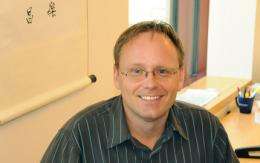
(PhysOrg.com) -- Computational biochemist Frank Alber compares determining the architecture of a macromolecular machine to solving a jigsaw puzzle.
"Let's say the jigsaw puzzle has thousands of pieces," said Alber, assistant professor of molecular and computational biology in USC College. “There are millions of ways to combine the pieces, but there is only one solution.”
Alber will get closer to finding that solution after being named a 2009 Pew Scholar in the Biomedical Sciences. He will receive a $240,000 award over four years to help support his research. Alber was among 17 early-career scholars The Pew Charitable Trusts considers to be America’s most promising scientists. This year, 149 institutions were each invited to nominate one candidate in the field.
The award gives Alber a huge boost in his research, some involving solving structures of large macromolecular assemblies. Using cutting edge computational integration strategies, Alber is trying to combine all available data about them to find one solution for his jigsaw puzzle.
“We take each piece and decide which ones fit together based on what we know about its properties,” Alber said. Replace each puzzle piece with proteins and you have the rough idea behind Alber’s approach to understanding the structural organization of the building blocks in a living cell.
Alber has shown incredible drive since joining the College in 2008. He was also named a 2009 Sloan Research Fellow. The Alfred P. Sloan Foundation awards the two-year fellowships yearly to 118 scientists and scholars, many of whom have gone on to win the Nobel Prize, Fields Medal, John Bates Clark Medal and other distinguished awards.
Prior to his arrival, Alber’s research on the nuclear pore complex was published twice in the international science journal Nature, prominently displayed on the cover. The nuclear pore complex (NPC) contains nearly 500 proteins. The NPCs serve as ports for transporting molecules into and out of cell nucleus. He began studying the nuclear pore complex during his postdoctoral research with Andrej Sali at Rockefeller University, N.Y. He continued with the research when the lab moved to the University of California, San Francisco.
At USC College, Alber joined his fiancé, Jasmine Zhou, an associate professor of computational biology whose office is next door to his. Zhou was named a 2006 Sloan Research Fellow. She leads a number of projects in bioinformatics and genomics, including the development of new data mining tools and software that could lead to insights into the aging process and the origins of cancer and other complex diseases.
Alber and Zhou met as undergraduates at the University of Tübingen in Germany, which has produced many Nobel laureate alumni, particularly in the fields of medicine and chemistry. Alber was born and raised in Horb, a few miles from Tübingen, 19 miles southwest of Stuttgart.
Earning his Ph.D. at the Swiss Federal Institute of Technology Zurich (ETH Zurich), Alber moved to New York to conduct research at Rockefeller while Zhou studied at Harvard University. When USC College hired Zhou in 2003, Alber continued his work in San Francisco.
“We always tried to at least be on the same coast,” Alber said, adding that they are planning their wedding. “This is the first time we’ve been able to be together in 10 years.”
The Pew award as well as the Sloan fellowship will help Alber advance his research including his work on the structural organization of genomic regions in the nucleus and the structural characterization of large protein complexes such as the NPC.
“Knowing where each protein is gives us an idea of the role each protein plays in the global function of the complex,” Alber said. “It gives us insight into how the structure could have evolved.”
Alber’s research may serve as a paradigm for future data-integration methods for a fuller understanding of the large macromolecular machines found in living things from yeast to human beings.
Provided by University of Southern California (news : web)


