Climate change could deepen poverty in developing countries, study finds
Urban workers could suffer most from climate change as the cost of food drives them into poverty, according to a new study that quantifies the effects of climate on the world's poor populations.
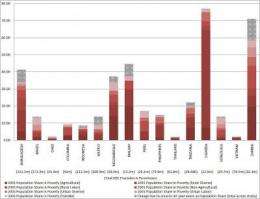
A team led by Purdue University researchers examined the potential economic influence of adverse climate events, such as heat waves, drought and heavy rains, on those in 16 developing countries. Urban workers in Bangladesh, Mexico and Zambia were found to be the most at risk.
"Extreme weather affects agricultural productivity and can raise the price of staple foods, such as grains, that are important to poor households in developing countries," said Noah Diffenbaugh, the associate professor of earth and atmospheric sciences and interim director of Purdue's Climate Change Research Center who co-led the study. "Studies have shown global warming will likely increase the frequency and intensity of heat waves, drought and floods in many areas. It is important to understand which socioeconomic groups and countries could see changes in poverty rates in order to make informed policy decisions."
The team used data from the late 20th century and projections for the late 21st century to develop a framework that examined extreme climate events, comparable shocks to grain production and the impact on the number of impoverished people in each country.
Thomas Hertel, a distinguished professor of agricultural economics and co-leader of the study, said that although urban workers only contribute modestly to total poverty rates in the sample countries, they are the most vulnerable group to changes in grains production.
"Food is a major expenditure for the poor and, while those who work in agriculture would have some benefit from higher grains prices, the urban poor would only get the negative effects," said Hertel, who also is executive director of Purdue's Center for Global Trade Analysis. "This is an important finding given that the United Nations projects a continuing shift in population concentrations from rural to urban areas in virtually all of these developing countries."
With nearly 1 billion of the world's poor living on less than $1 a day, extreme events can have a devastating impact, he said.
"Bangladesh, Mexico and Zambia showed the greatest percentage of the population entering poverty in the wake of extreme drought, with an additional 1.4 percent, 1.8 percent and 4.6 percent of their populations being impoverished by future climate extremes, respectively," Hertel said. "This translates to an additional 1.8 million people impoverished per country for Bangladesh and Mexico and an additional half million people in Zambia."
A paper detailing the work will be published in Thursday's (Aug. 20) issue of Environmental Research Letters. In addition to Diffenbaugh and Hertel, Syud Amer Ahmed, a recent Purdue graduate and a member of the development research group for The World Bank, co-authored the paper. The World Bank's Trust Fund for Environmentally and Socially Sustainable Development funded the research.
The team identified the maximum rainfall, drought and heat wave for the 30-year periods of 1971-2000 and 2071-2100 and then compared the maximums for the two time periods.
The global climate model experiments developed by the Intergovernmental Panel on Climate Change, or IPCC, were used for the future projections of extreme events. The team used an IPCC scenario that has greenhouse gas emissions continuing to follow the current trend, Diffenbaugh said.
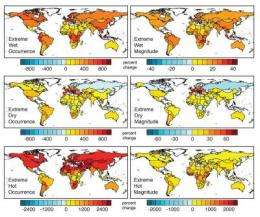
"The occurrence and magnitude of what are currently the 30-year-maximum values for wet, dry and hot extremes are projected to substantially increase for much of the world," he said. "Heat waves and drought in the Mediterranean showed a potential 2700 percent and 800 percent increase in occurrence, respectively, and extreme rainfall in Southeast Asia was projected to potentially increase by 900 percent."
In addition, Southeast Asia showed a projected 40 percent increase in the magnitude of the worst rainfall; central Africa showed a projected 1000 percent increase in the magnitude of the worst heat wave; and the Mediterranean showed a projected 60 percent increase in the worst drought.
A statistical analysis was used to determine grain productivity shocks that would correspond in magnitude to the climate extremes, and then the economic impact of the supply shock was determined. Future predicted extreme climate events were compared to historical agricultural productivity extremes in order to assess the likely impact on agricultural production, prices and wages. Because the projected changes in extreme rainfall and heat wave events were too large for the current model to accept, only the extreme drought events were incorporated into the economic projections, making the projected poverty impacts a conservative estimate, he said.
To assess the potential economic impact of a given change in wages and grains prices, the team used data from each country's household survey. The estimates of likely wage and price changes following an extreme climate event were obtained from a global trade model, called the Global Trade Analysis Project, or GTAP, which is maintained by Purdue's agricultural economics department.
Purdue's GTAP framework is supported by an international consortium of 27 national and international agencies and is used by a network of 6,500 researchers in 140 countries.
Large reductions in grains productivity due to extreme climate events are supported by historical data. In 1991 grains productivity in Malawi and Zambia declined by about 50 percent when southern Africa experienced a severe drought.
Diffenbaugh said this is an initial quantification of how poverty is tied to climate fluctuations, and the team is working to improve the modeling and analysis system in order to enable more comprehensive assessments of the link between climate volatility and poverty vulnerability.
More information: The published version of the paper “Climate volatility deepens poverty vulnerability in developing countries ”, Ahmed S A et al 2009 Environ. Res. Lett. 4 034004, will be available for download here stacks.iop.org/ERL/4/034004
Source: Purdue University (news : web)


