Newly discovered signaling pathway ensures that plants remember to flower
August 20, 2009 Newly discovered signaling pathway ensures that plants remember to flower

Enlarge

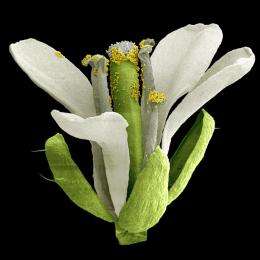
Electron micrograph of the common wallcress, Arabidopsis thaliana. Image: Jürgen Berger

(PhysOrg.com) -- Why do some plants blossom even when days are short and gray? Scientists at the Max Planck Institute for Developmental Biology have found the answer to this question: An endogenous mechanism allows them to flower in the absence of external influences such as long days. A small piece of RNA, a so-called microRNA, has a central role in this process, as a decline of its concentration in the shoot apex triggers flowering.

MicroRNAs are very short RNA snippets that have emerged in recent years as essential regulators of gene function in both plants and animals. By binding to complementary motifs in a , they inhibit its translation into protein. This process thus blunts the activity of the corresponding gene.

In Tübingen, developmental biologists have discovered that the common wallcress, Arabidopsis, uses this to switch from vegetative to reproductive development. A group of related regulators, the SPL proteins, play an important role in promoting the onset of flowering. In young plants, production of SPL proteins is prevented by high levels of microRNA156.

Jia-Wei Wang and colleagues demonstrate that independent of external cues, the concentration of the microRNA declines over time, like sand running through an hourglass. When the concentration falls below a certain level, enough SPL proteins are produced to activate the flowering process even in the absence of other regulators that measure day length or external temperature. This in turns allows a sufficiently old plant to flower, even in an unfavorable environment.

Interestingly, the SPLs do double duty, since they have supporting roles when plants flower in response to long days. Furthermore, both the SPLs and other regulators eventually converge on a similar set of targets crucial for flowering.

"Flowering is crucial for the long-term survival of plants. The redundancy of environment-dependent and -independent mechanisms ensures that do not wait forever until flowering. Better flower once, then never", explains Detlef Weigel, director at the Max Planck Institute for Developmental Biology.

More information: Jia-Wei Wang, Benjamin Czech, Detlef Weigel; miR156-regulated SPL transcription factors define an endogenous flowering pathway in Arabidopsis thaliana; Cell, August 21, 2009; doi: 10.1016/j.cell.2009.06.014 .

Source: Max-Planck-Gesellschaft (news : web)


print this article email this article download pdf blog this article bookmark this article     Stumble it Digg this share on Facebook retweet share on Reddit add to delicious
Rate this story - not rated yet


August 20, 2009 all stories

Comments: 0

not rated yet
  • Stumble this up

  • Digg this

  • share this

  • hide
  • Related Stories

  • Scientists unlock secret of what makes plants flower
    created Apr 18, 2007 | popularity not rated yet | comments 0
  • Formula discovered for longer plant life
    created Sep 23, 2008 | popularity not rated yet | comments 0
  • Molecule tells flower to flower
    created Aug 12, 2005 | popularity not rated yet | comments 0
  • Flowering Signal Found
    created Jun 09, 2007 | popularity not rated yet | comments 0
  • Scientists discover how crops use the length of the day to decide when to flower
    created Nov 14, 2005 | popularity not rated yet | comments 0


  • hide
  • Relevant PhysicsForums posts

  • What is transpulmonary pressure?
    created Nov 24, 2009
  • Is there a gay gene?
    created Nov 23, 2009
  • Super quick question about Starling forces?
    created Nov 22, 2009
  • Questions about diffusion
    created Nov 22, 2009
  • More from Physics Forums - Biology

Other News

Researchers discover biological basis of 'bacterial immune system'

Biology / Cell & Microbiology

created 1minute ago | popularity not rated yet | comments 0

Bacteria don't have easy lives. In addition to mammalian immune systems that besiege the bugs, they have natural enemies called bacteriophages, viruses that kill half the bacteria on Earth every two days.


Redback spiders were first spotted in Japan in 1995

Venomous Aussie redback spiders invading Japan

Biology / Ecology

created 6 hours ago | popularity 5 / 5 (2) | comments 0

Australia's venomous redback spiders are on the march in Japan, where they are believed to have arrived years ago as stowaways on cargo ships, a wildlife expert warned Wednesday.


Sustainable Corn Production Supports Advanced Biofuel Feedstocks

Sustainable Corn Production Supports Advanced Biofuel Feedstocks

Biology / Biotechnology

created 3 hours ago | popularity 3.3 / 5 (3) | comments 1

(PhysOrg.com) -- Researchers worldwide are trying to economically convert cellulosic biomass such as corn stover into "cellulosic ethanol." But Agricultural Research Service (ARS) scientists have found that ...


Study explores violent world of raptors

Biology / Plants & Animals

created 6 hours ago | popularity not rated yet | comments 0

A journey that started with a box of bird feet carried three Montana State University graduate students into the gruesome world of raptors and led to their findings being published in a prominent journal.


Asian carp may have breached barrier protecting Lake Michigan

Biology / Ecology

created 15 hours ago | popularity 5 / 5 (4) | comments 0

Two feared species of Asian carp have zoomed beyond the $9 million electric barriers built to keep them out of Lake Michigan. Now, the only thing left between the carp and the Great Lakes is a lock and dam in southern Chicago.