Scientists discover bioluminescent 'green bombers' from the deep sea
August 20, 2009 Scientists discover bioluminescent 'green bombers' from the deep sea

Enlarge

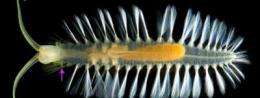
The transparent body of the worm Swima bombiviridisallows examination of internal anatomy without dissection. The purple arrow points to the several bioluminescent bombs still attached to the segments immediately behind the head. Credit: Casey Dunn

(PhysOrg.com) -- In the latest proof that the oceans continue to offer remarkable findings and much of their vastness remains to be explored, scientists at Scripps Institution of Oceanography at UC San Diego and their colleagues have discovered a unique group of worms that live in the depths of the ocean.

The discoveries feature worms—nicknamed "green bombers"—that can release body parts that produce a brilliant green bioluminescent display.

The discovery is described in the August 21 issue of the journal Science and is led by Karen Osborn of Scripps Oceanography.

The researchers introduce seven previously unknown species of swimming worms in the annelid phylum ranging from 18 to 93 millimeters (.7 to 3.6 inches) in length. They were discovered by the scientists using remotely operated vehicles at depths between 1,800 and 3,700 meters (5,900 and 12,140 feet). The first species described in the paper has been given the scientific name Swima bombiviridis, referring to its swimming ability and the green bombs.

Osborn says one key aspect of the discoveries is that the newly found worms are not rare. Opportunities to witness such animals and collect and study them, however, have been extremely rare.
Scientists discover bioluminescent 'green bombers' from the deep sea
Enlarge

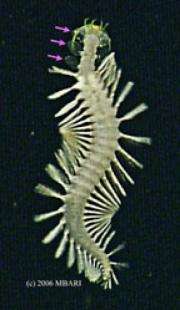
This is a video image of a species of Swima (as yet undescribed) with arrows indicating the animal's large bombs. Credit: Monterey Bay Aquarium Research Institute

"We found a whole new group of fairly large, extraordinary animals that we never knew anything about before," said Osborn, a post-doctoral researcher in the Marine Biology Research Division at Scripps. "These are not rare animals. Often when we see them they number in the hundreds. What's unique is that their habitat is really hard to sample."

Largely transparent except for the gut area, the worms propel themselves with fans of long bristles that form swimming paddles.

"The depths between 1,000 and 4,000 meters (3,280 and 13,120 feet) form the biggest habitat on Earth and also the least explored," said Scripps Professor Greg Rouse, a coauthor of the paper and curator of Scripps Benthic Invertebrate Collection. "With fairly limited time on submersible vehicles, mainly off California, we've picked up seven new species. It goes to show that we have much more exploration ahead and who knows what else we'll discover?"

Each of the species features a variety of elaborate head appendages. Five of them are equipped with luminescent structures, the "bombs," that are fluid-filled spheres that suddenly burst into light when released by the animal, glowing intensely for several seconds before slowly fading.

Due to the bright lights of the submersible, scientists were not able to witness bomb-casting in the worm's natural habitat, but rather on ships after the animals were captured. While the scientists speculate that the bombs are used as a defensive mechanism against potential predators, more studies are needed to fully understand the process.

Rouse says the green bombers in the newly discovered clade, (a common ancestor and all its descendant organisms), are fascinating from an evolutionary standpoint. Looking closely at their relatives that live on the seafloor, it appears the bombs were once gills that evolutionarily transformed over time.

"The relatives have gills that appear to be in exactly the same places as the bombs," said Rouse. "The gills can fall off very easily so there's a similarity of being detachable, but for some reason the gills have transformed to become these glowing little detachable spheres."

Osborn continues to probe many of the various adaptations the worms have made since evolving into swimming species. The challenges faced by animals living in a three-dimensional open water habitat above the seafloor are very different than those faced by animals living on the seafloor. These include locating new food sources, finding ways to maintain optimal depth and grappling with predators that come from various directions.

"I'm interested in how animals have evolved in the water column," said Osborn. "These worms are great examples. How does a worm transform into a wonderful glowing animal?"

Source: University of California - San Diego (news : web)


print this article email this article download pdf blog this article bookmark this article     Stumble it Digg this share on Facebook retweet share on Reddit add to delicious
Rate this story - 5 /5 (8 votes)

Rank Filter

Move the slider to adjust rank threshold, so that you can hide some of the comments.


Display comments: newest first

  • Nartoon - Aug 21, 2009
    • Rank: not rated yet
    At those depths there would be no light, so how do the worms know when they're about to be eaten? Maybe the light is to attract a mate.
  • Transcentity - Aug 21, 2009
    • Rank: not rated yet
    At those depths there would be no light, so how do the worms know when they're about to be eaten? Maybe the light is to attract a mate.


    They don't need to be able to detect visible light in order to see. There are other ways to detect an incoming predators.
  • Zeppy - Aug 21, 2009
    • Rank: not rated yet
    At those depths there would be no light, so how do the worms know when they're about to be eaten? Maybe the light is to attract a mate.


    It's possible that the worm can sense vibrations in the water that indicate the presence of a threat. Also, the soft glowing light might be like a flash-bang grenade, overwhelming the predator's optical receptors (since it's so incredibly dark near at the specified depths).

August 20, 2009 all stories

Comments: 3

5 /5 (8 votes)
  • Stumble this up

  • Digg this

  • share this

  • hide
  • Related Stories

  • Scientists help decode mysterious green glow of the sea
    created Apr 01, 2009 | popularity not rated yet | comments 0
  • Zombie worms found in Britain's North Sea
    created Oct 19, 2005 | popularity not rated yet | comments 0
  • Scientists discover fluorescence in key marine creature
    created Oct 30, 2007 | popularity not rated yet | comments 0
  • Deep-sea jelly uses glowing red lures to catch fish
    created Jul 08, 2005 | popularity not rated yet | comments 0
  • New research reveals deep-sea fish population boom
    created Apr 11, 2006 | popularity not rated yet | comments 0


  • hide
  • Relevant PhysicsForums posts

  • What is transpulmonary pressure?
    created Nov 24, 2009
  • Is there a gay gene?
    created Nov 23, 2009
  • Super quick question about Starling forces?
    created Nov 22, 2009
  • Questions about diffusion
    created Nov 22, 2009
  • Human Leukocyte Antigen (HLA) typing
    created Nov 21, 2009
  • Breeding program
    created Nov 20, 2009
  • More from Physics Forums - Biology

Other News

Variable Temperatures Leave Insects wtih a Frosty Reception

Biology / Plants & Animals

created 11 hours ago | popularity not rated yet | comments 0

(PhysOrg.com) -- For the first time, scientists at The University of Western Ontario have shown that insects exposed to repeated periods of cold will trade reproduction for immediate survival.


When camouflage is a plant's best protection

Rare woodland plant uses 'cryptic coloration' to hide from predators

Biology / Plants & Animals

created 13 hours ago | popularity 4.3 / 5 (3) | comments 0

It is well known that some animal species use camouflage to hide from predators. Individuals that are able to blend in to their surroundings and avoid being eaten are able to survive longer, reproduce, and ...


Cells defend themselves from viruses, bacteria with armor of protein errors

Biology / Cell & Microbiology

created 15 hours ago | popularity 5 / 5 (7) | comments 0

When cells are confronted with an invading virus or bacteria or exposed to an irritating chemical, they protect themselves by going off their DNA recipe and inserting the wrong amino acid into new proteins to defend them ...


Researchers discover biological basis of 'bacterial immune system'

Biology / Cell & Microbiology

created 15 hours ago | popularity 4.7 / 5 (3) | comments 0

Bacteria don't have easy lives. In addition to mammalian immune systems that besiege the bugs, they have natural enemies called bacteriophages, viruses that kill half the bacteria on Earth every two days.


'Safety valve' protects photosynthesis from too much light

Biology / Cell & Microbiology

created 15 hours ago | popularity 4.7 / 5 (3) | comments 0

Photosynthetic organisms need to cope with a wide range of light intensities, which can change over timescales of seconds to minutes. Too much light can damage the photosynthetic machinery and cause cell death. Scientists ...