Ultrathin light-emitting diodes create new classes of lighting and display systems
August 20, 2009 by James E. Kloeppel Ultrathin light-emitting diodes create new classes of lighting and display systems

Enlarge

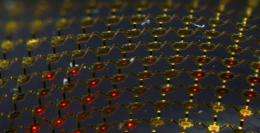
Photo by D. Stevenson and C. Conway, Beckman Institute, University of Illinois

(PhysOrg.com) -- A new process for creating ultrathin, ultrasmall inorganic light-emitting diodes (LEDs) and assembling them into large arrays offers new classes of lighting and display systems with interesting properties, such as see-through construction and mechanical flexibility, that would be impossible to achieve with existing technologies.

Applications for the arrays, which can be printed onto flat or flexible substrates ranging from glass to plastic and rubber, include general illumination, high-resolution home theater displays, wearable health monitors, and biomedical imaging devices.

"Our goal is to marry some of the advantages of inorganic technology with the scalability, ease of processing and resolution of organic LEDs," said John Rogers, the

Flory-Founder Chair Professor of Materials Science and Engineering at the University of Illinois.

Rogers and collaborators at the U. of I., Northwestern University, the Institute of High Performance Computing in Singapore, and Tsinghua University in Beijing describe their work in the Aug. 21 issue of the journal Science.

Compared to organic LEDs, inorganic LEDs are brighter, more robust and longer-lived. Organic LEDs, however, are attractive because they can be formed on flexible substrates, in dense, interconnected arrays. The researchers' new technology combines features of both.

"By printing large arrays of ultrathin, ultrasmall inorganic LEDs and interconnecting them using thin-film processing, we can create general lighting and high-resolution display systems that otherwise could not be built with the conventional ways that inorganic LEDs are made, manipulated and assembled," Rogers said.

To overcome requirements on device size and thickness associated with conventional wafer dicing, packaging and wire bonding methods, the researchers developed epitaxial growth techniques for creating LEDs with sizes up to 100 times smaller than usual. They also developed printing processes for assembling these devices into arrays on stiff, flexible and stretchable substrates.

As part of the growth process, a sacrificial layer of material is embedded beneath the LEDs. When fabrication is complete, a wet chemical etchent removes this layer, leaving the LEDs undercut from the wafer, but still tethered at anchor points.

To create an array, a rubber stamp contacts the wafer surface at selected points, lifts off the LEDs at those points, and transfers them to the desired substrate.

"The stamping process provides a much faster alternative to the standard robotic 'pick and place' process that manipulates inorganic LEDs one at a time," Rogers said. "The new approach can lift large numbers of small, thin LEDs from the wafer in one step, and then print them onto a substrate in another step."

By shifting position and repeating the stamping process, LEDs can be transferred to other locations on the same substrate. In this fashion, large panels and displays can be crafted from small LEDs made in dense arrays on a single, comparatively small wafer. And, because the LEDs can be placed far apart and still provide sufficient light output, the panels and displays can be nearly transparent. The thin device geometries allow the use of thin-film processing methods, rather than wire bonding, for interconnects.

In addition to solid-state lighting, instrument panels and display systems, flexible and even stretchable sheets of printed LEDs can be achieved, with potential use in the health-care industry.

"Wrapping a stretchable sheet of tiny LEDs around the human body offers interesting opportunities in biomedicine and biotechnology," Rogers said, "including applications in health monitoring, diagnostics and imaging."

Source: University of Illinois at Urbana-Champaign (news : web)


print this article email this article download pdf blog this article bookmark this article     Stumble it Digg this share on Facebook retweet share on Reddit add to delicious
Rate this story - 4.8 /5 (11 votes)

Rank Filter

Move the slider to adjust rank threshold, so that you can hide some of the comments.


Display comments: newest first

  • cyclic250 - Aug 20, 2009
    • Rank: not rated yet
    I imagine next they will be interleaving the LEDs with small CMOS sensors to create a display/image capture fabric. this may lead to the emergence of a cloak of invisibility !
  • ThomasS - Aug 21, 2009
    • Rank: 1 / 5 (1)
    we will never-ever have a real invisibility cloak, people need to get over that.
  • Jeffhans1 - Aug 22, 2009
    • Rank: not rated yet
    YOU ThomasS will never have an invisibility cloak perhaps, but making a blanket statement like that just shows you have not been paying attention to progress. How much has the US spent on making "Stealth" aircraft over the years? Having "Cloaked" special forces can negate many of the negative effects of fighting in an urban setting.

August 20, 2009 all stories

Comments: 3

4.8 /5 (11 votes)
  • Stumble this up

  • Digg this

  • share this

  • hide
  • Related Stories

  • World's Largest 21-inch OLED for TVs from Samsung
    created Jan 04, 2005 | popularity not rated yet | comments 0
  • Toward pure white light: Next-generation LEDs show bright promise
    created Sep 24, 2007 | popularity not rated yet | comments 0
  • UI licenses flex electronics technology
    created Dec 19, 2006 | popularity not rated yet | comments 0
  • Rigiflex lithography improves organic LEDs
    created Apr 21, 2006 | popularity not rated yet | comments 0
  • Student Develops First Polarized LED
    created Mar 03, 2008 | popularity not rated yet | comments 0


  • hide
  • Relevant PhysicsForums posts

  • Control System
    created 3 hours ago
  • Base Isolation Systems in Skyscrapers?
    created 17 hours ago
  • Need to interview a Computer Hardware Engineer for school project
    created 19 hours ago
  • transient heat transfer
    created Nov 23, 2009
  • More from Physics Forums - General Engineering

Other News

Selling chip makers on optical computing

Selling chip makers on optical computing

Technology / Semiconductors

created 49 minutes ago | popularity not rated yet | comments 0

(PhysOrg.com) -- Computer chips that transmit data with light instead of electricity consume much less power than conventional chips, but so far, they've remained laboratory curiosities. Professors Vladimir ...


Barnes & Noble reports 2Q loss, cuts guidance

Barnes & Noble reports 2Q loss, cuts guidance

Technology / Business

created 44 minutes ago | popularity not rated yet | comments 0

(AP) -- Barnes & Noble on Tuesday posted a larger second-quarter loss than last year and lowered its profit forecast for this quarter in anticipation of weak holiday sales and high costs of launching its ...


Nokia to ax 220 R&D jobs in Japan

Technology / Business

created 1hour ago | popularity not rated yet | comments 0

(AP) -- Nokia Corp. said Tuesday it is axing 220 jobs at research and development units in Japan as the world's largest mobile phone maker continues to cut costs.


EU drops Qualcomm antitrust probe

Technology / Business

created 1hour ago | popularity not rated yet | comments 0

(AP) -- European Union antitrust regulators on Tuesday dropped a monopoly abuse probe into wireless chip maker Qualcomm Inc. after mobile phone companies withdrew complaints about high royalty fees.


Joost assets bought by online ad company Adconion

Technology / Business

created 1hour ago | popularity not rated yet | comments 0

(AP) -- The struggling online video startup Joost, begun with much fanfare by the creators of Skype and Kazaa, has been sold to an online advertising company.