Washington forests may be solution to state's green-energy quest
August 20, 2009 by Sandra Hines
Washington forests may be solution to state's green-energy quest

Enlarge

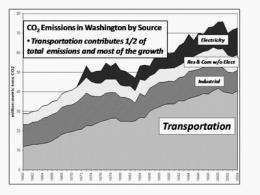
Transportation contributes half of the carbon dioxide emitted in the state in comparison with carbon dioxide produced by industrial processes, residential and commercial activities (excluding emissions from electricity use) and production of electrical power. Image: Community, Trade and Economic Development, Wash.

(PhysOrg.com) -- Wood is a popular fuel for heating homes in the Northwest but few people might see it as an important source of liquid fuels for motor vehicles. However, a new University of Washington report commissioned by the Washington Legislature suggests that woody biomass could represent the state's greatest opportunity to develop biofuels and reduce both green house gas emissions and dependency upon imported oil.

The report by the UW's School of Forest Resources further concludes that the state's biomass would best be used for transportation fuel as opposed to using it to generate electricity.

Woody biomass has three key advantages -- all of which should be weighed no matter which alternative energy source is being evaluated, the report authors say. They are:

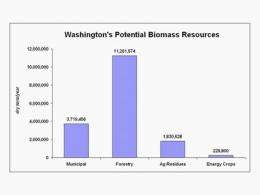
• Sustainability -- For energy production, there has to be enough material on a continuous basis, according to Larry Mason, a researcher in forest resources and lead author of the study. Washington ranks at the top of U.S. states in woody biomass availability, with one-twentieth of the nation's inventoried woody biomass. The term woody biomass refers to the residues left after harvesting trees or manufacturing wood products, the spindly material thinned from forests to reduce risk of wildfires and trees such as cottonwoods grown on plantations. Eleven million dry tons of forest biomass are potentially available annually in the state for energy production, which amounts to two-thirds of the state's available biomass. Woody biomass supplies could also be augmented with agricultural residues and municipal solid waste.

• Energy independence -- Washington has low electricity rates, generates the cleanest electricity in the nation and produces so much electricity that it is exported to other states. At the same time the state is 100 percent reliant on oil imported from other states or abroad. Biomass is by far the most abundant and sustainably available state resource that can be converted into to replace gasoline and diesel. Producing transportation fuels from state biomass resources is the pathway toward greater energy independence, the report says.

• Climate change mitigation -- Another reason to focus on using woody biomass to produce transportation fuel is that half of the carbon dioxide generated in the state comes from transportation. Emissions from transportation dwarf the carbon dioxide released by the production of in Washington. Unlike fossil fuel alternatives, biofuels from wood are considered to be carbon neutral.
Washington forests may be solution to state's green-energy quest
Enlarge

The more than 11 million dry tons of forest biomass that could be available annually for energy production is contrasted with estimates of biomass from municipal solid wastes, agricultural residues and energy crops planted specifically for use as alternative energy sources. Image: Washington State University

In light of these three considerations, state incentives and regulations that encourage generating electrical power from renewable sources such as woody biomass should be examined, says John Calhoun, director of the Olympic Natural Resources Center and a study co-author.

"While wood residue may currently be considered waste," Calhoun says, "Washington must not squander this renewable resource by misdirecting its use if we want to meet our state goals of sustainability, energy independence and climate change mitigation. Woody biomass is the only renewable, clean resource available in Washington that can make a significant contribution toward our energy policy goals."

Another advantage of woody biomass is what's already in place, says Mason. The state's largest biomass process and delivery system is the forest industry. Pulp and paper mills represent the single largest industrial capital investment in renewable energy development. Liquid fuels conversions from woody biomass will require large integrated facilities, such as pulp and paper mills, that, with new investment, could maximize conversion efficiencies and reduce capital and operating costs while producing a steady flow of paper and energy products.

"Co-location with state pulp and paper mills to capture synergies with existing infrastructure represents the greatest single opportunity for bioenergy development. Such mills already have transportation and handling capabilities, a highly-skilled workforce, adequate water supplies and water treatment plants," Mason says.

The report "Wood to in Washington; Imperatives, Opportunities, and Obstacles to Progress" is available at http://tinyurl.com/o6esrw . Other co-authors are Richard Gustafson and Bruce Lippke, both professors of forest resources, and Natalia Raffaeli, graduate student.

More information: Read a summary of "Wood Energy in Washington: Imperatives, Opportunities and Obstacles to Progress."

Provided by University of Washington (news : web)

2.2 /5 (6 votes)  

Filter


Move the slider to adjust rank threshold, so that you can hide some of the comments.


Display comments: newest first

david_42
Aug 21, 2009

Rank: not rated yet
11 million dry tons sounds like a large quantity, but compared to daily oil consumption, it is a very small number. US gasoline consumption is 378 million gallons/day. That's 1.2 million tons per day for gasoline alone. Granted Washington consumes a fraction of the US total, but I suspect the potential here isn't a useful percentage of the requirement.

Also, wood waste is highly variable due to changes in the demand for wood products. Not a good idea for vehicle fuel, which is very inflexible.
jerryd
Aug 22, 2009

Rank: 5 / 5 (1)

The major way to produce gasoline and diesel from the F-T process and one can make electricity along with fuels from biomass.
Washington doesn't have to make fuel for the whole US, just for themselves would be fine.
Rank 2.2 /5 (6 votes)
Relevant PhysicsForums posts
  • Calling function with no input argument
    created15 hours ago
  • Force free body diagram problem on gym equipment
    created16 hours ago
  • Empirical data regarding shower heads and water
    createdFeb 10, 2012
  • feed hold button on CNC lathe
    createdFeb 09, 2012
  • RFAC in Fortran
    createdFeb 09, 2012
  • dynamics 2/32
    createdFeb 08, 2012
  • More from Physics Forums - General Engineering

More news stories

Anonymous knocks CIA website offline (Update)

The website of the Central Intelligence Agency was inaccessible on Friday after the hacker group Anonymous claimed to have knocked it offline.

Technology / Internet

created 10 hours ago | popularity 5 / 5 (9) | comments 16

Google users warned of threat to smartphone wallets

Users of Google smartphone wallets were being warned on Friday that there is a way to crack pass codes intended to thwart thieves from going on illicit shopping sprees.

Technology / Internet

created 8 hours ago | popularity 5 / 5 (2) | comments 0

New error-correcting codes guarantee the fastest possible rate of data transmission

Error-correcting codes are one of the triumphs of the digital age. They’re a way of encoding information so that it can be transmitted across a communication channel — such as an optical fiber o ...

Technology / Computer Sciences

created 18 hours ago | popularity 4.9 / 5 (8) | comments 6 | with audio podcast

New power source discovered

(PhysOrg.com) -- Researchers at the Massachusetts Institute of Technology (MIT) and RMIT University have made a breakthrough in energy storage and power generation.

Technology / Energy & Green Tech

created 17 hours ago | popularity 4.7 / 5 (30) | comments 8 | with audio podcast

Small modular reactor design could be a 'SUPERSTAR'

(PhysOrg.com) -- Though most of today's nuclear reactors are cooled by water, we've long known that there are alternatives; in fact, the world's first nuclear-powered electricity in 1951 came from a reactor ...

Technology / Energy & Green Tech

created 18 hours ago | popularity 4.4 / 5 (13) | comments 23 | with audio podcast


Humans may have helped the decline of African rainforests 3000 years ago

(PhysOrg.com) -- Large areas of rainforests in Central Africa mysteriously disappeared over three thousand years ago, to be replaced by savannas. The prevailing theory has been that the cause was a change ...

The power of estrogen -- male snakes attract other males

A new study has shown that boosting the estrogen levels of male garter snakes causes them to secrete the same pheromones that females use to attract suitors, and turned the males into just about the sexiest ...

Complex wiring of the nervous system may rely on a just a handful of genes and proteins

Researchers at the Salk Institute have discovered a startling feature of early brain development that helps to explain how complex neuron wiring patterns are programmed using just a handful of critical genes. ...

Could Venus be shifting gear?

(PhysOrg.com) -- ESA’s Venus Express spacecraft has discovered that our cloud-covered neighbour spins a little slower than previously measured. Peering through the dense atmosphere in the infrared, the ...

Advanced power-grid model finds low-cost, low-carbon future in West

(PhysOrg.com) -- The least expensive way for the Western U.S. to reduce greenhouse gas emissions enough to help prevent the worst consequences of global warming is to replace coal with renewable and other ...

Fool's gold may prove an unlikely alternative to overexploited catalytic materials

Catalytic materials, which lower the energy barriers for chemical reactions, are used in everything from the commercial production of chemicals to catalytic converters in car engines. However, with current catalytic materials ...