'Jumping genes' create antibiotic resistance in bacteria
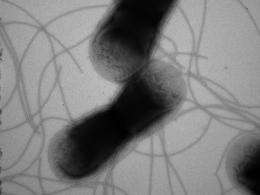
(PhysOrg.com) -- A small piece of foreign DNA recognizes when and where to slip into a bacterium's genetic code, allowing bacteria to genetically adapt to their environment -- and develop resistance to antibiotics, according to a new Cornell study in the Aug. 21 issue of the journal Cell.
The paper focuses on sequences of DNA called Tn7, which fall into a category of genes known as transposons, or "jumping genes," for their ability to move from place to place in DNA. Tn7 contains a cargo area where as many as 50 genes may attach and then insert themselves into a new host's genome.
While researchers have long known that "jumping genes" were involved in antibiotic resistance, the study explains exactly how Tn7 and related "jumping genes" transfer genetic information in bacteria around the world. A previous 2009 study by the same authors described how Tn7 was responsible for the spread of genes between diverse bacteria in such disparate environments as soil, deep-sea hydrothermal vents, food and acid mines.
The new study describes why there is also reason to believe many transposons use a similar mechanism to introduce new genetic information into life forms, including flies, plants and possibly even humans.
"Bacteria evolve through the mass transfer of genes," said Joseph Peters, the paper's senior author and a Cornell associate professor of microbiology. Adam Parks, a former graduate student in Peters' lab and now a postdoctoral fellow at the National Cancer Institute Center for Cancer Research, is the paper's lead author.
"We had no idea Tn7 had such reach that it does. I know of no other genetic element that has the reach of Tn7," said Peters.
The paper describes how antibiotic resistance moves from one bacterium to another. It turns out that Tn7, carrying genes that transfer antibiotic resistance, recognizes a ring of proteins called processivity factors, which are essential proteins found in all living organisms and are part of the DNA replication machinery in cells. Processivity factors circle the DNA like a washer around a string and create a sliding platform that controls replication, where the DNA of one cell copies itself to create a new cell.
By recognizing and attaching itself to processivity factors during replication, Tn7 takes advantage of gaps in the host cells' DNA and inserts itself and its cargo of genetic information, thereby altering the genetic makeup of the new cell. In this way, such traits as antibiotic resistance can transfer efficiently between bacteria. Because processivity factors are essential to all cells, Tn7 can move between very different types of bacteria.
This work may help explain why previous studies of processivity factors in other organisms also identified proteins associated with jumping genes, a finding that remained a mystery until now.
"If you look at transposable elements, you find similar protein enzymes that bind to processivity factors in other species," said Peters. "Knowing how Tn7 works gives us clues to how genetic information can be transferred between living organisms in different corners of the world."
Problems with processivity factors during replication are also associated with cancers, and the researchers suspect the findings of this study may one day lead to better detection and treatment of the disease, said Peters.
Provided by Cornell University (news : web)


