Hydrogen-rich Material Promises Advances in Energy Transmission, Fuel Storage
August 20, 2009 by Nicholas Bock Hydrogen-rich Material Promises Advances in Energy Transmission, Fuel Storage

Enlarge

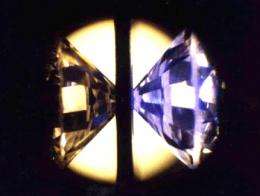
Researchers created material under enormous pressures by squeezing samples between two diamonds. (Photo courtesy Wendy Mao.)

(PhysOrg.com) -- Researchers at the Stanford Institute for Materials and Energy Science, a joint institute of SLAC and Stanford University, have produced a hydrogen-rich alloy that could provide insight into the properties of metallic hydrogen, according to a study published in the August 17 issue of Proceedings of the National Academy of Sciences. The work is a step toward materials with revolutionary implications for energy science, enabling lossless power transmission, next-generation particle accelerators and even magnetic levitation.

Metallic is a state of hydrogen predicted to form under ultra-high pressure. If achieved, some researchers predict it could function as a room-temperature superconductor—a material capable of conducting electricity with zero resistance at temperatures above 0 degrees Celsius. But because the pressure required to make metallic hydrogen is so enormous—much greater the pressure experienced by materials in the center of the earth—researchers have had little luck in producing it.

"People are very interested in hydrogen because it's element one," said SIMES physicist Wendy Mao, who was a co-author on the study. "At high enough pressure, it should be metallic and it should be a room temperature superconductor."

In hopes of getting a better idea of how metallic hydrogen behaves, researchers are becoming increasingly interested in hydrogen-rich compounds that might have properties similar to those seen in pure hydrogen. Called hydrides, the chemicals might undergo similar phase changes as metallic hydrogen, but at more accessible pressures.

One of the most promising candidates of study is called silane, which contains an atom of silicon bound to four atoms of hydrogen. Previous studies have suggested that pure silane metalizes at pressures far lower than those required to produce metallic hydrogen. The goal for Mao's group was to study the properties of composed of hydrogen and silane together.

"People have already identified pure silane as a superconductor," she said. "The next step is to determine what happens if you have something that is mostly hydrogen with a little bit of silane. Maybe you can get something closer to hydrogen."

For the study, Mao and her colleagues studied two different silane-containing samples: one containing equal parts hydrogen and silane, another containing an abundance of hydrogen in a five-to-one ratio.

Using a device called a diamond anvil cell, the samples were squeezed between a pair of diamonds, generating pressures upwards of 6 gigapascals—60,000 times the earth's atmospheric pressure at sea level. Aside from being one of the few materials suited to withstand the high pressures, diamond also provides researchers a window into the process, allowing them to conduct analyses of the pressurized samples.

The alloys solidified at much lower pressures than would be required for hydrogen alone, with the hydrogen-rich alloy forming a solid containing more than 99 percent hydrogen.

The researchers also found that even though the amount of silane in the hydrogen-rich sample was minimal, it had a dramatic effect on hydrogen-hydrogen interactions. According to Shibing Wang, a SIMES graduate student and the lead author on the paper, the finding is significant because it could contribute to a better understanding of the properties of atoms in hydrogen alloys, which are commonly used in hydrogen storage and could have implications for hydrogen fuel storage.

"The interaction between hydrogen and its environment is definitely more complicated than we expected," Wang said. "I'm quite sure this is true for other hydrides that have potential hydrogen storage capabilities."

Provided by SLAC National Accelerator Laboratory (news : web)


print this article email this article download pdf blog this article bookmark this article     Stumble it Digg this share on Facebook retweet share on Reddit add to delicious
Rate this story - 4.3 /5 (19 votes)

Rank Filter

Move the slider to adjust rank threshold, so that you can hide some of the comments.


Display comments: newest first

  • otto1923 - Aug 20, 2009
    • Rank: not rated yet
    I wonder what the ability of nanotubes or balls would be to contain materials under pressure. could you create metallic superconductors on the interior of single- or multi-wall nanotubes to sustain the required pressure? Are the scales appropriate? Could you use buckyballs to contain and stabilize ultra-dense deuterium? Maybe start with graphene rooled around a substance under pressure and then 'zipped up'? Are these even appropriate questions?
  • otto1923 - Aug 20, 2009
    • Rank: not rated yet
    Maybe start with graphene rolled around a substance under pressure and then 'zipped up'?
    -Maybe starting with graphane...
    http://www.physor...755.html
  • Skepticus - Aug 20, 2009
    • Rank: not rated yet
    Too bad they didn't try to explosively compressing hydrogen-saturated palladium...the result would be..er interesting to saythe least..!
  • Alexa - Aug 20, 2009
    • Rank: not rated yet
    ..they didn't try to explosively compressing hydrogen-saturated palladium..
    "They" didn't try too many even way way more trivial things, like Arata's cold fusion..

    http://nextbigfut...sis.html
  • PPihkala - Aug 20, 2009
    • Rank: not rated yet
    Make that deuterium saturated palladium under pressure instead of hydrogen. I bet the boom will be much bigger...
  • otto1923 - Aug 21, 2009
    • Rank: not rated yet
    All they need is some high-grade red mercury
  • Velanarris - Aug 21, 2009
    • Rank: not rated yet
    ..they didn't try to explosively compressing hydrogen-saturated palladium..
    "They" didn't try too many even way way more trivial things, like Arata's cold fusion..


    http://nextbigfut...sis.html

    Because again you're harping on a dead hypothesis.

    You really seem to like these DoA hypotheses.
  • Alexa - Aug 21, 2009
    • Rank: not rated yet
    you're harping on a dead hypothesis
    It's not my intention to waste time with dead hypothesis. Try to compare decomposition of water with radiowaves: it can absorb energy in radiowave frequency energy density range (13 MHz, i.e. 5.10E-8 eV) - while energy required for splitting of water molecule is in 1.23 eV range (300 kJ/kmol), i.e. more then 10E8x higher!

    http://aetherwave...ory.html

    In comparison with it the activation energy of deuterion fusion (5x10E 7 kJ/kmol) isn't very high at all, if we consider its initiation by electrochemical reaction in 1 eV range - it's just 10E 7x higher, i.e. nearly one hundred times more probable, then the splitting of water clusters by radiowaves from thermodynamical perspective.
  • Velanarris - Aug 21, 2009
    • Rank: not rated yet
    Deuterium fusion into HE-4 isn't possible without resultant radioactive presence.

    Since Arata can't prove anything aside from a relatively small thermal flux there is no evidence for fusion of any type.

    What is most likely occuring is muonic capture. And since you're an AWT'er you should know what that is and how it works as well as how it is completely responsible for the results of Arata and explains his inability to reproduce the experiment in a sealed environment.
  • notnewton - Aug 24, 2009
    • Rank: not rated yet
    I would direct you to an article by Dr CW Hunt (geologist) who wrote about Hydrides and the work of the Russian V. Larin at http://eearthk.co...s03.html (short article and links to his books)
    It has been shown that hydrogen nuclei (sans electrons) embed themselves within other metals, densifying them. Hydrogen embrittlement is also well known in deep oil drill shafts (same cause). This leads the open minded to think of totally different science directions including whether the universally accepted "iron core" theory is correct, or is it more likely the core is really made of the universally available elements of hydrogen and helium, and bits of odd other matter.
    KW
  • Alexa - Aug 25, 2009
    • Rank: not rated yet
    ... Arata can't prove anything aside from a relatively small thermal flux...

    ...and hellium formation...;-)
    D D = 4He heat http://tinyurl.com/m4xjzc
    Arata's fusion is the purest energy source, which we can even imagine. You're just ignorant, face it. What will happen, if everybody would behave like you?

    Well, correctly: nothing happens. Progress will stop, people will destroy their life environment and they will die-off.
  • Alexa - Aug 25, 2009
    • Rank: not rated yet
    ..explains his inability to reproduce the experiment in a sealed environment..
    You know nothing about Arata's experiments - they just were done in sealed environment. Why world is full of ignorant idiots, who argue against things, which they apparently don't know at all?

    After all, if some reaction evolves heat and helium spontaneously in presence of deuterium and not in presence of hydrogen - I really don't care very much, if it's cold fusion or not - such result is significant even from pure scientific and practical perspective.

August 20, 2009 all stories

Comments: 12

4.3 /5 (19 votes)
  • Stumble this up

  • Digg this

  • share this

  • hide
  • Related Stories

  • Squashing Silane into Metal
    created Jan 09, 2009 | popularity not rated yet | comments 0
  • On the path to metallic hydrogen
    created Aug 03, 2009 | popularity not rated yet | comments 0
  • Hydrogen Storage for Cars?
    created Dec 21, 2007 | popularity not rated yet | comments 0
  • Scientists discover record-breaking hydrogen storage materials for use in fuel cells
    created Nov 12, 2007 | popularity not rated yet | comments 0
  • High-pressure compound could be key to hydrogen-powered vehicles
    created May 11, 2009 | popularity not rated yet | comments 0


  • hide
  • Relevant PhysicsForums posts

  • Voltage drop in diode
    created 13 hours ago
  • ZENER BREAKDOWN has caused me a breakdown
    created Nov 20, 2009
  • Transistor AMPLifier HelP !!!!
    created Nov 20, 2009
  • A loophole in Kubo formula
    created Nov 20, 2009
  • More from Physics Forums - Atomic, Solid State, Comp. Physics

Other News

Quick restart of Big Bang machine stuns scientists (AP)

Quick restart of Big Bang machine stuns scientists

Physics / General Physics

created 2 hours ago | popularity 4.3 / 5 (9) | comments 2

(AP) -- Scientists moved Saturday to prepare the world's largest atom smasher for exploring the depths of matter after successfully restarting the $10 billion machine following more than a year of repairs.


A view of a superconducting solenoid magnet at the European Organization for Nuclear Research (CERN) near Geneva

CERN atom-smasher restarts after 14-month hiatus: official

Physics / General Physics

created 22 hours ago | popularity 4.6 / 5 (22) | comments 0

The world's biggest atom-smasher, shut down after its inauguration in September 2008 amid technical faults, restarted on Friday, a spokesman for the European Organisation for Nuclear Research said.


Tapering a Free-Electron Laser to Extract More Juice

Tapering a Free-Electron Laser to Extract More Juice

Physics / General Physics

created 22 hours ago | popularity 4 / 5 (1) | comments 0

(PhysOrg.com) -- Researchers from the NSLS and Science Applications International Corporation (SAIC) have demonstrated a technique that could be used to significantly improve the quantity and quality of light ...


Ultra-Powerful Laser Reproduces How Star's Jets Travel through Interstellar Space

Ultra-Powerful Laser Reproduces How Star's Jets Travel through Interstellar Space

Physics / General Physics

created 23 hours ago | popularity 4.4 / 5 (7) | comments 0

(PhysOrg.com) -- A multi-trillion-watt laser at the University of Rochester has simulated a stellar jet -- an outpouring of matter from a fledgling star -- with unprecedented realism.


nuclear power plant

Doubts raised on nuclear industry viability

Physics / General Physics

created Nov 19, 2009 | popularity 3.2 / 5 (17) | comments 18

(PhysOrg.com) -- The investment in nuclear power has been growing around the world over the last few years, being viewed as a means for countries to control their energy security, avoid the price fluctuations ...