Traffic noise could be ruining sex lives of frogs
August 21, 2009 By ROD McGUIRK , Associated Press Writer Traffic noise could be ruining sex lives of frogs (AP)

Enlarge

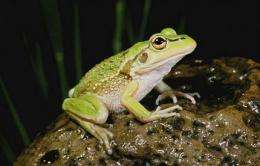
In this undated photo, a Growling Grass Frog sits on a rock in swampy lands near Melbourne, Australia. Traffic noise could be ruining the sex lives of urban frogs by drowning out the seductive croaks of amorous males, an Australian researcher said Friday, Aug. 21, 2009. (AP Photo/Geoff Heard)

(AP) -- Traffic noise could be ruining the sex lives of urban frogs by drowning out the seductive croaks of amorous males, an Australian researcher said Friday.

A well-projected and energetic croak is the male frog's most important asset in the quest to attract mates to his , Melbourne University ecologist Kirsten Parris said.

But competition from traffic noise in Melbourne could be a reason why frog numbers have declined in Australia's second-largest city since her survey of more than 100 ponds began in 2000, she said.

"If there are a number of different males calling, the one that sounds the best often gets the girl," Parris told The Associated Press. "You have to be pretty clear about your assets if you're a male frog."

"Generally, if he's putting a lot of energy into calling - if he's calling loudly or quickly or for a long time or all those things combined - it shows he's fit and strong and generally those things tend to correlate with female choice," she added.

Parris found the distance at which a frog suitor can be heard by a potential mate is slashed by city noise.

"This makes it much harder for frogs to attract mates and this could then mean that their breeding success is reduced," Parris said.

Frog species with low-pitched croaks are most disadvantaged because they are competing against the low-pitched rumble of traffic and machinery such as air conditioners, she said.

The southern brown tree has adapted by raising the pitch of its croak in areas where there is traffic din, she found.

In the noisiest parts of Melbourne, the frog's usual pitch cannot be heard by other frogs beyond 21 yards (19 meters). At the higher pitch, the croaks carry an additional 16 feet (5 meters).

The popplebonk frog's call can be heard by females from 875 yards (800 meters) without background noise. That range shrinks to only 46 feet (14 meters) near busy roads.

Parris presented her research on Thursday to the 10th International Ecology Congress in the eastern city of Brisbane.

Ken Thompson, a University of Sheffield ecologist who edits the British journal, Functional Ecology, described Parris' findings of reduced mating because of traffic noise as "highly plausible."

"There is accumulating evidence that noise in urban habitats is having an effect on the behavior of animals," Thompson said.

He said his own university's research found British birds were singing at night because their habitats had become too noisy during the day.

©2009 The Associated Press. All rights reserved. This material may not be published, broadcast, rewritten or redistributed.


print this article email this article download pdf blog this article bookmark this article     Stumble it Digg this share on Facebook retweet share on Reddit add to delicious
Rate this story - 5 /5 (1 vote)

Rank Filter

Move the slider to adjust rank threshold, so that you can hide some of the comments.


Display comments: newest first

  • Nederluv - Aug 21, 2009
    • Rank: not rated yet
    Don't worry, electric cars are on their way!

August 21, 2009 all stories

Comments: 1

5 /5 (1 vote)
  • Stumble this up

  • Digg this

  • share this

  • hide
  • Related Stories

  • Frogs: Female choice for complex calls led to evolution of unusual male vocal cord
    created May 03, 2006 | popularity not rated yet | comments 0
  • Scientists discover ultrasonic communication among frogs
    created May 11, 2009 | popularity not rated yet | comments 0
  • Frog muscles survive big sleep
    created May 10, 2007 | popularity not rated yet | comments 0
  • Female concave-eared frogs draw mates with ultrasonic calls
    created May 11, 2008 | popularity not rated yet | comments 0
  • Frogs flown from Montserrat to flee deadly fungus
    created May 09, 2009 | popularity not rated yet | comments 0


  • hide
  • Relevant PhysicsForums posts

  • What is transpulmonary pressure?
    created Nov 24, 2009
  • Is there a gay gene?
    created Nov 23, 2009
  • Super quick question about Starling forces?
    created Nov 22, 2009
  • Questions about diffusion
    created Nov 22, 2009
  • More from Physics Forums - Biology

Other News

Variable Temperatures Leave Insects wtih a Frosty Reception

Biology / Plants & Animals

created 1hour ago | popularity not rated yet | comments 0

(PhysOrg.com) -- For the first time, scientists at The University of Western Ontario have shown that insects exposed to repeated periods of cold will trade reproduction for immediate survival.


Experts think toxic algae harming endangered fish

Biology / Ecology

created 1hour ago | popularity not rated yet | comments 0

(AP) -- Scientists say they think toxins from a blue-green algae plaguing lakes and rivers around the West are harming an endangered fish in the Klamath Basin, adding another obstacle to restoring species that have forced ...


When camouflage is a plant's best protection

Rare woodland plant uses 'cryptic coloration' to hide from predators

Biology / Plants & Animals

created 3 hours ago | popularity not rated yet | comments 0

It is well known that some animal species use camouflage to hide from predators. Individuals that are able to blend in to their surroundings and avoid being eaten are able to survive longer, reproduce, and ...


Destruction spreads 'like a disease'

Biology / Ecology

created 2 hours ago | popularity not rated yet | comments 0

(PhysOrg.com) -- People have cleared more than a quarter of the world’s forests and half of its grasslands, according to a paper published today in the Proceedings of the Royal Society by researchers from The University of Que ...


'Safety valve' protects photosynthesis from too much light

Biology / Cell & Microbiology

created 5 hours ago | popularity not rated yet | comments 0

Photosynthetic organisms need to cope with a wide range of light intensities, which can change over timescales of seconds to minutes. Too much light can damage the photosynthetic machinery and cause cell death. Scientists ...