Gene discovery reveals a critical protein's function in hearing
August 21, 2009
Gene discovery reveals a critical protein's function in hearing

Enlarge

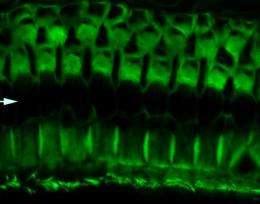
When claudin-9 is mutated, potassium floods the wrong part of the ear's sensory cells, killing a layer of them, as indicated by the arrow in this image. Credit: University of Iowa/PLoS Genetics

Discovery of a deafness-causing gene defect in mice has helped identify a new protein that protects sensory cells in the ear, according to a study led by University of Iowa researchers. The findings, which also involved Kansas State University, appear in the Aug. 21 issue of the open-access journal PLoS Genetics.

In humans, hereditary deafness is one of the most common birth defects, yet most genes involved in hearing are unidentified. Mice are used as research models because mouse and human auditory genetics are very similar.

Using a deaf mouse model generated at The Jackson Laboratory, the team identified the deafness-causing defect in the claudin-9 gene. The mutated gene fails to produce normal claudin-9 protein, which, the University of Iowa team showed, is needed to maintain the proper distribution of potassium in the inner ear.

"Genes in the claudin family number at least 24 and produce proteins that prevent ions, including potassium, from moving between cells," said the paper's senior author Botond Banfi, M.D., Ph.D., assistant professor of anatomy and cell biology in the University of Iowa Carver College of Medicine. "Sensory cells in the hearing organ are bathed in a high potassium solution on one side and in a low potassium solution on the other side. We found that claudin-9 is very important in keeping the amount of potassium on the two sides separate. This separation protects sensory cells from potassium intoxication."

When claudin-9 is mutated, potassium floods the wrong part of the sensory cells, killing most and leaving the remaining ones functionally defective.

In follow-up efforts, Banfi and colleagues, including the study's first author Yoko Nakano, Ph.D., University of Iowa assistant research scientist in anatomy and cell biology, are screening people with hearing impairment to see if some of them have a mutation in claudin-9.

More information: Nakano Y, Kim SH, Kim H-M, Sanneman JD, Zhang Y, et al. (2009) A Claudin-9-Based Ion Permeability Barrier Is Essential for Hearing. PLoS Genet 5(8): e1000610. doi:10.1371/journal.pgen.1000610

Source: University of Iowa


Rank 5 /5 (3 votes)
Relevant PhysicsForums posts

More news stories

Complex wiring of the nervous system may rely on a just a handful of genes and proteins

Researchers at the Salk Institute have discovered a startling feature of early brain development that helps to explain how complex neuron wiring patterns are programmed using just a handful of critical genes. ...

Medicine & Health / Research

created 1 hour ago | popularity 5 / 5 (2) | comments 0 | with audio podcast

Curry spice component may help slow prostate tumor growth

Curcumin, an active component of the Indian curry spice turmeric, may help slow down tumor growth in castration-resistant prostate cancer patients on androgen deprivation therapy (ADT), a study from researchers ...

Medicine & Health / Cancer

created 6 hours ago | popularity 4.5 / 5 (4) | comments 0 | with audio podcast

Both maternal and paternal age linked to autism

Older maternal and paternal age are jointly associated with having a child with autism, according to a recently published study led by researchers at The University of Texas Health Science Center at Houston (UTHealth).

Medicine & Health / Psychology & Psychiatry

created 5 hours ago | popularity not rated yet | comments 0 | with audio podcast

Team isolates nerve cells involved in storing long term memory and gene proteins associated with them

(Medical Xpress) -- A research team in Taiwan has succeeded in isolating two nerve cells in fruit fly brains that are believed to be the major players in allowing for the formation of long term memories. Furthermore, ...

Medicine & Health / Neuroscience

created 7 hours ago | popularity 5 / 5 (4) | comments 1 | with audio podcast report

Seeing colors in music, tasting flavors in shapes may happen in life's early months

Famed violinist Itzhak Perlman sees a deep forest green whenever he plays a B-flat on his Stradivarius' G string. The A on the E string is red.

Medicine & Health / Psychology & Psychiatry

created 8 hours ago | popularity 4.5 / 5 (2) | comments 1 | with audio podcast


NASA sees wide-eyed cyclone Jasmine

Cyclone Jasmine's eye has opened wider on NASA satellite imagery, as it moves through the Southern Pacific Ocean.

NASA sees Giovanna reach cyclone strength, threaten Madagascar

Tropical Storm 12S built up steam and became a cyclone on February 10, 2012 as NASA's Terra satellite passed overhead. Residents of east-central Madagascar should prepare for this cyclone to make landfall ...

CIA website offline, Anonymous takes credit

The website of the Central Intelligence Agency was unresponsive on Friday after the hacker group Anonymous claimed to have knocked it offline.

The power of estrogen -- male snakes attract other males

A new study has shown that boosting the estrogen levels of male garter snakes causes them to secrete the same pheromones that females use to attract suitors, and turned the males into just about the sexiest ...

New error-correcting codes guarantee the fastest possible rate of data transmission

Error-correcting codes are one of the triumphs of the digital age. They’re a way of encoding information so that it can be transmitted across a communication channel — such as an optical fiber o ...

Humans may have helped the decline of African rainforests 3000 years ago

(PhysOrg.com) -- Large areas of rainforests in Central Africa mysteriously disappeared over three thousand years ago, to be replaced by savannas. The prevailing theory has been that the cause was a change ...