Should females trust showy males?
August 21, 2009 Should females trust showy males?

(PhysOrg.com) -- How honest are males when using sexual displays to signal their eligibility to females?

Research by evolutionary biologists at the universities of Glasgow and Exeter suggests females should be wary of initial flashy displays which may not have staying power.

A male animal’s sexual signals, such as his song or bright colouration are an attempt to attract females. Since these displays demand considerable effort to produce, a louder or brighter display is meant to indicate that the male is in good condition. But can females trust these signals to be a reliable indication of the male’s quality?

A team of researchers led by Dr Jan Lindström at the University of Glasgow have found that the honesty of the signal can vary dramatically over time, depending on both the condition of the male and the likelihood of him obtaining future matings. The research suggests it may pay females to wait until ‘dishonest’ have exhausted themselves in producing a flashy signal that they cannot sustain.

, Dr Lindström said: “Honesty in males mostly depends on how many opportunities there are to breed. If males can breed now but the future promises little in terms of further matings, all males should immediately reveal their ‘true colours’ - so that the signals they produce are a reliable indication of their quality. But if males can potentially breed several times over the course of a breeding season, it pays those in best condition to keep some of their strength in reserve.

“In contrast, those males in poorer condition cannot afford to delay seeking a mate, so must signal as hard as they can - with the result that at the start of the breeding season a female cannot reliably judge a male’s quality from his signal. However, as time goes on, the poorer condition males must drop out of the competition, leaving only the better ones and making it easier for a female to pick a high quality mate.”

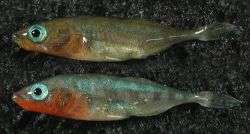
Predictions from a new of these processes were tested using three-spined sticklebacks, a species of fish in which breeding males develop a red throat in order to attract females (see photo below). Sticklebacks can breed several times over the course of the summer, but pay a heavy price since few survive for another year.

Dr Lindström said: “We found that the redness of the males changed over the summer, with all starting out red but only those in good condition being able to sustain their colour. As predicted by our model, females seemed to ignore the redness of a male when choosing a mate in early summer, and only developed a preference for redder males later, once it became a more honest signal of a male’s quality.”

So it seems that the attempts by poor quality males to hide their weaknesses behind a flashy display were only partially successful, which helps explain why the system persists, since are only persuaded by an attractive display at times when it is an honest signal of quality.

More information: The study will be published in the October print issue (available online from 21 August) of the prestigious scientific journal American Naturalist as: Lindstrom, J., Pike, T.W., Blount, J.D. & Metcalfe, N.B. (2009) Optimisation of resource allocation can explain the temporal dynamics and honesty of sexual signals.

Provided by University of Glasgow


print this article email this article download pdf blog this article bookmark this article     Stumble it Digg this share on Facebook retweet share on Reddit add to delicious
Rate this story - 3.6 /5 (5 votes)

Rank Filter

Move the slider to adjust rank threshold, so that you can hide some of the comments.


Display comments: newest first

  • finitesolutions - Aug 21, 2009
    • Rank: not rated yet
    simple_mating_algorithm:
    if (trust==money)
    { stick_around(partner_in_question);}
    else
    {
    improve_yourself();
    search_more_partners();
    goto simple_mating_algorithm;
    }

  • paulthebassguy - Aug 21, 2009
    • Rank: 5 / 5 (1)
    woe, mr finite solutions, I reckon you should burst out that algorithm next time you see a hot chick in a bar. pickUpLine ;
  • gmurphy - Aug 22, 2009
    • Rank: not rated yet
    so, we're talking about the natural equivalent of bling?
  • Au-Pu - Aug 22, 2009
    • Rank: not rated yet
    The researchers have made so many unfounded assumptions that this paper is virtually worthless.
    It is little more than the personal opinion of the researchers and this opinion could be related more to their view of human relations than to those of the fish they were allegedly researching

August 21, 2009 all stories

Comments: 4

3.6 /5 (5 votes)
  • Stumble this up

  • Digg this

  • share this

  • hide
  • Related Stories

  • Masquerading in murky waters
    created Jul 19, 2007 | popularity not rated yet | comments 0
  • Could carrots be the secret to a long-life and sex appeal?
    created May 10, 2007 | popularity not rated yet | comments 0
  • Choosy females make colourful males
    created May 09, 2006 | popularity not rated yet | comments 0
  • Female guppies risk death to avoid sexual harassment
    created Aug 06, 2008 | popularity not rated yet | comments 0
  • Variety is the spice of life: too many males, too little time...
    created Apr 23, 2008 | popularity not rated yet | comments 0


  • hide
  • Relevant PhysicsForums posts

  • What is transpulmonary pressure?
    created Nov 24, 2009
  • Is there a gay gene?
    created Nov 23, 2009
  • Super quick question about Starling forces?
    created Nov 22, 2009
  • Questions about diffusion
    created Nov 22, 2009
  • More from Physics Forums - Biology

Other News

When camouflage is a plant's best protection

Rare woodland plant uses 'cryptic coloration' to hide from predators

Biology / Plants & Animals

created 49 minutes ago | popularity not rated yet | comments 0

It is well known that some animal species use camouflage to hide from predators. Individuals that are able to blend in to their surroundings and avoid being eaten are able to survive longer, reproduce, and ...


'Safety valve' protects photosynthesis from too much light

Biology / Cell & Microbiology

created 2 hours ago | popularity not rated yet | comments 0

Photosynthetic organisms need to cope with a wide range of light intensities, which can change over timescales of seconds to minutes. Too much light can damage the photosynthetic machinery and cause cell death. Scientists ...


Cells defend themselves from viruses, bacteria with armor of protein errors

Biology / Cell & Microbiology

created 2 hours ago | popularity 5 / 5 (3) | comments 0

When cells are confronted with an invading virus or bacteria or exposed to an irritating chemical, they protect themselves by going off their DNA recipe and inserting the wrong amino acid into new proteins to defend them ...


Researchers discover biological basis of 'bacterial immune system'

Biology / Cell & Microbiology

created 2 hours ago | popularity 4 / 5 (1) | comments 0

Bacteria don't have easy lives. In addition to mammalian immune systems that besiege the bugs, they have natural enemies called bacteriophages, viruses that kill half the bacteria on Earth every two days.


Redback spiders were first spotted in Japan in 1995

Venomous Aussie redback spiders invading Japan

Biology / Ecology

created 9 hours ago | popularity 5 / 5 (2) | comments 0

Australia's venomous redback spiders are on the march in Japan, where they are believed to have arrived years ago as stowaways on cargo ships, a wildlife expert warned Wednesday.